Evaluating predictors of kinase activity of STK11 variants identified in primary human non-small cell lung cancers
Yile Chen, Kyoungyeul Lee, Junwoo Woo, Dong-wook Kim, Changwon Keum, Giulia Babbi, Rita Casadio, Pier Luigi Martelli, Castrense Savojardo, Matteo Manfredi, Yang Shen, Yuanfei Sun, Panagiotis Katsonis, Olivier Lichtarge, Vikas Pejaver, David J. Seward, Akash Kamandula

TL;DR
This study evaluates computational tools for predicting the impact of STK11 gene variants in lung cancer, showing their potential for clinical and research use.
Contribution
The study provides a critical evaluation of computational tools using experimentally validated STK11 variants from lung cancer biopsies.
Findings
Computational predictors showed high performance in separating loss-of-function from wildtype-like variants.
3Cnet and three public tools approached the performance of experimental replicates in variant classification.
Combining computational and experimental data led to 16 new clinically actionable variant classifications.
Abstract
Critical evaluation of computational tools for predicting variant effects is important considering their increased use in disease diagnosis and driving molecular discoveries. In the sixth edition of the Critical Assessment of Genome Interpretation (CAGI) challenge, a dataset of 28 STK11 rare variants (27 missense, 1 single amino acid deletion), identified in primary non-small cell lung cancer biopsies, was experimentally assayed to characterize computational methods from four participating teams and five publicly available tools. Predictors demonstrated a high level of performance on key evaluation metrics, measuring correlation with the assay outputs and separating loss-of-function (LoF) variants from wildtype-like (WT-like) variants. The best participant model, 3Cnet, performed competitively with well-known tools. Unique to this challenge was that the functional data was generated…
Genes, proteins, chemicals, diseases, species, mutations and cell lines named across the full text — each resolved to its canonical identifier and authoritative record.
Click any figure to enlarge with its caption.
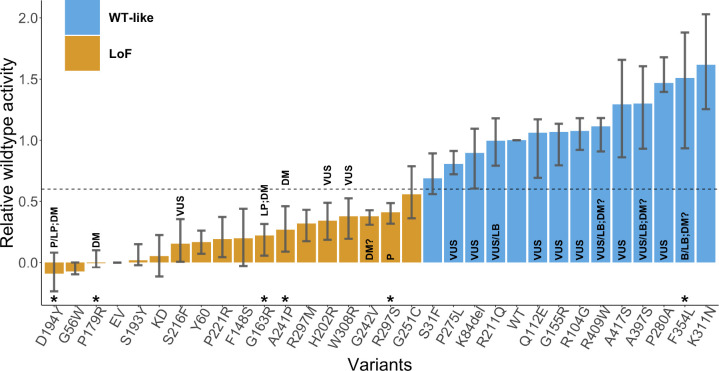 Figure 1
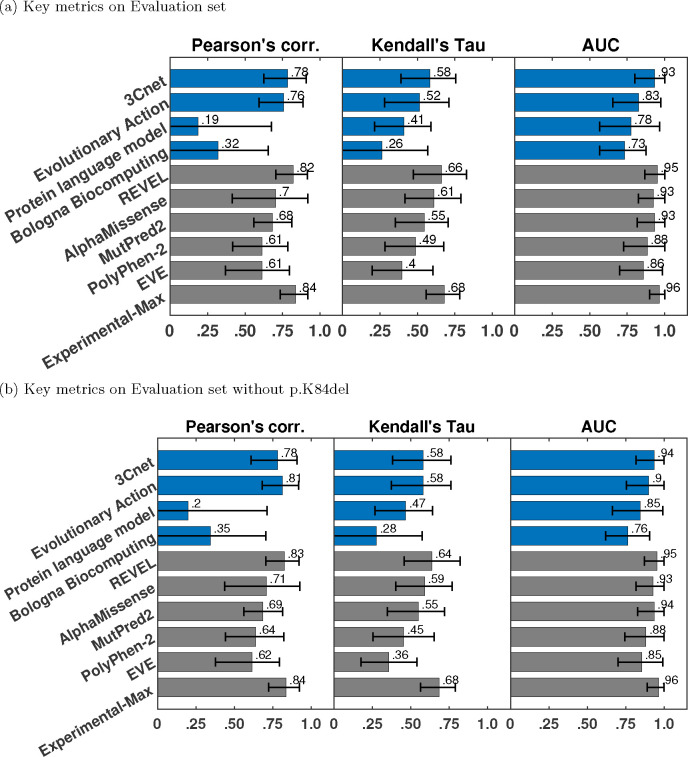 Figure 2
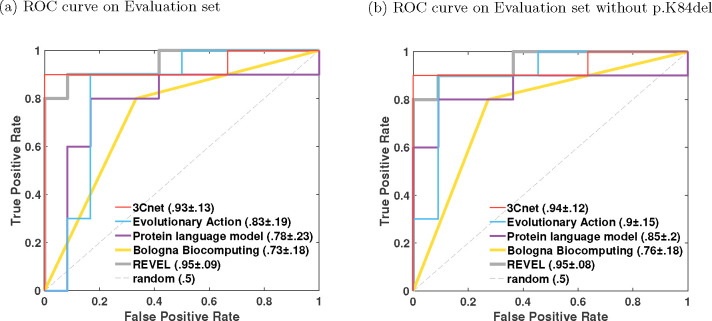 Figure 3
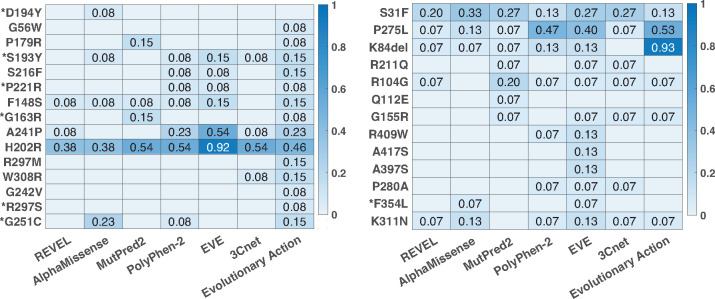 Figure 4
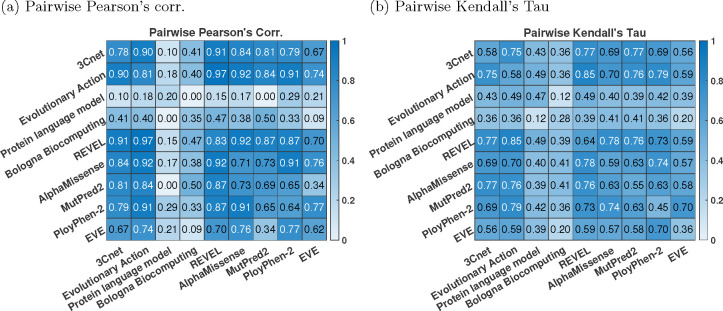 Figure 5
Peer Reviews
No public reviews on file for this paper yet. If you reviewed it on a platform where reviews are public (OpenReview, ICLR, NeurIPS, ICML), you can paste yours below so the community can read it here.
Videos
No videos yet. Explain this paper in a talk, walkthrough, or lecture? Add one.
Taxonomy
TopicsLung Cancer Treatments and Mutations · Genetic factors in colorectal cancer · Colorectal Cancer Treatments and Studies