Post-implantation analysis of genomic variations in the progeny from developing fetus to birth
Yingming Zheng, Chuanping Lin, Wen-Jing Wang, Liya Wang, Yeqing Qian, Luna Mao, Baohua Li, Lijun Lou, Yuchan Mao, Na Li, Jiayong Zheng, Nan Jiang, Chaying He, Qijing Wang, Qing Zhou, Fang Chen, Fan Jin

TL;DR
This study examines de novo mutations in human offspring from the fetal stage to birth, finding significant differences in indels between multifetal reduction and newborn groups.
Contribution
The study provides new insights into the decrease of de novo indels during embryonic development and their impact on genetic selection.
Findings
Newborns had significantly fewer de novo indels compared to the multifetal reduction group.
De novo indels decreased significantly from embryonic tissues to birth, affecting all genomic regions.
Adjusting for parental age and BMI revealed significant differences in de novo mutations between groups.
Abstract
The analysis of genomic variations in offspring after implantation has been infrequently studied. In this study, we aim to investigate the extent of de novo mutations in humans from developing fetus to birth. Using high-depth whole-genome sequencing, 443 parent-offspring trios were studied to compare the results of de novo mutations (DNMs) between different groups. The focus was on fetuses and newborns, with DNA samples obtained from the families’ blood and the aspirated embryonic tissues subjected to deep sequencing. It was observed that the average number of total DNMs in the newborns group was 56.26 (54.17–58.35), which appeared to be lower than that the multifetal reduction group, which was 76.05 (69.70–82.40) (F = 2.42, P = 0.12). However, after adjusting for parental age and maternal pre-pregnancy body mass index (BMI), significant differences were found between the two groups.…
Genes, proteins, chemicals, diseases, species, mutations and cell lines named across the full text — each resolved to its canonical identifier and authoritative record.
Click any figure to enlarge with its caption.
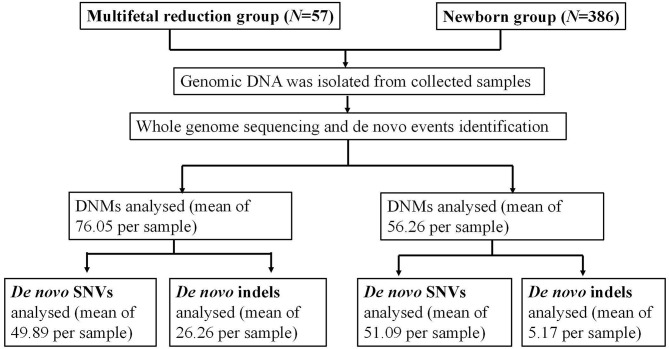 Figure 1
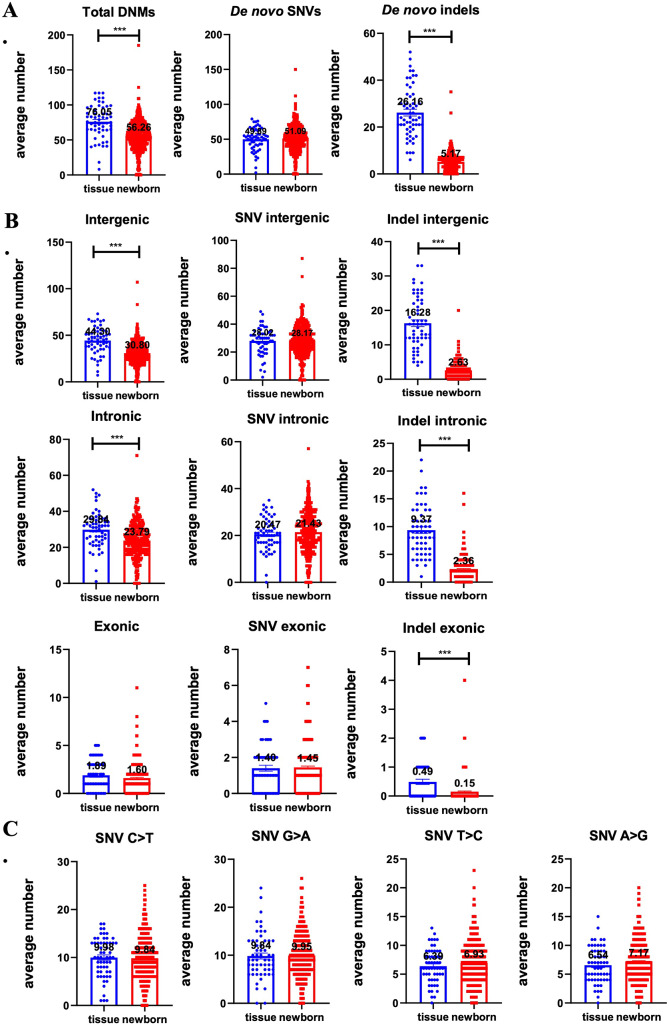 Figure 2
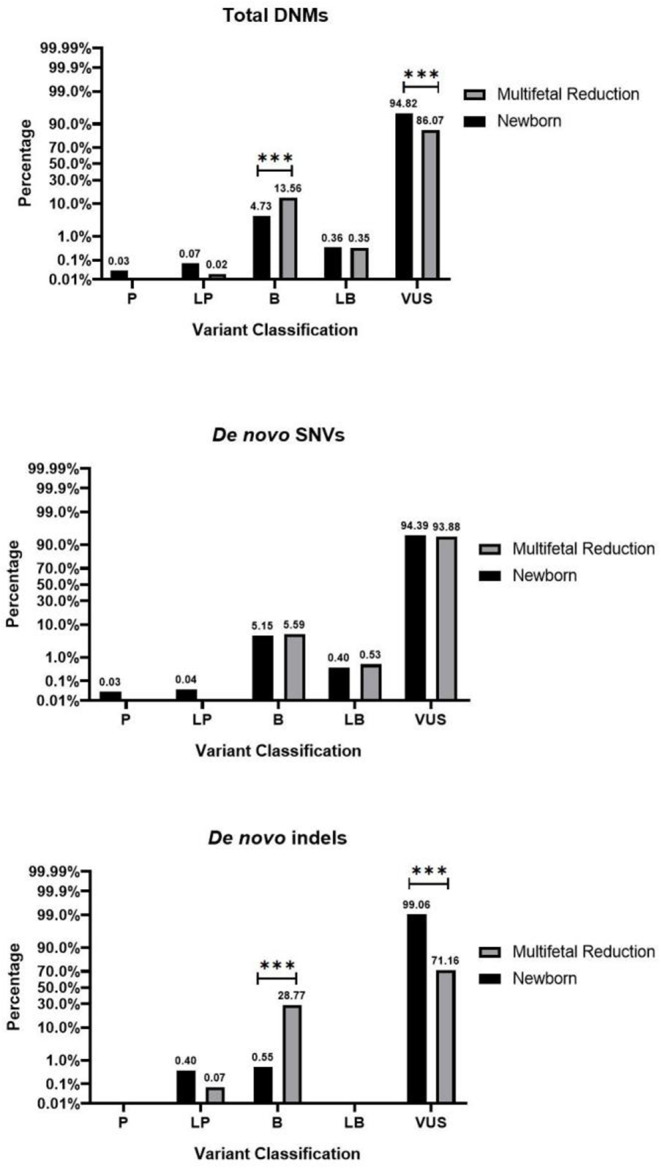 Figure 3
Peer Reviews
No public reviews on file for this paper yet. If you reviewed it on a platform where reviews are public (OpenReview, ICLR, NeurIPS, ICML), you can paste yours below so the community can read it here.
Videos
No videos yet. Explain this paper in a talk, walkthrough, or lecture? Add one.
Taxonomy
TopicsPrenatal Screening and Diagnostics · Genetic Syndromes and Imprinting · Genomic variations and chromosomal abnormalities