It is not the best option to perform transurethral enucleation of the prostate immediately after biopsy in patients with histological inflammation
Tengfei Gu, Jie Li, Ting Chen, Yongtao Pan, Jing Sha

TL;DR
This study finds that performing prostate surgery immediately after a biopsy in patients with prostate inflammation leads to worse short-term outcomes and more complications.
Contribution
The study reveals that histopathological prostatic inflammation worsens short-term surgical outcomes and increases complications after BiLEP, suggesting pre-surgery anti-inflammatory treatment may be beneficial.
Findings
Patients with prostatic inflammation had longer surgery times, higher complication rates, and worse short-term outcomes after BiLEP.
No significant differences in long-term outcomes like QoL, PVR, or Qmax were observed between groups at 1 and 3 months post-surgery.
The BPH + PI group had a higher incidence of postoperative complications and a higher rate of reported prostate cancer after surgery.
Abstract
This study seeks to investigate the impact of histopathological evidence of histological prostatic inflammation (PI) on the surgical outcomes of patients with benign prostatic hyperplasia (BPH) undergoing transurethral bipolar enucleation of the prostate (BiLEP) after biopsy. We conducted a prospective study in which data were collected from 112 patients with BPH who underwent BiLEP immediately after prostate biopsy at the Department of Urology in our hospital between October 2020 and October 2023. This cohort included 52 patients with histopathological prostatic inflammation (BPH + PI group) and 60 patients with simple BPH (BPH group). Baseline characteristics, surgical details, International Prostate Symptom Score (IPSS), quality of life (QoL), post-void residual volume (PVR), maximum flow rate (Qmax), International Index of Erectile Function-5 (IIEF-5), postoperative pathology…
Genes, proteins, chemicals, diseases, species, mutations and cell lines named across the full text — each resolved to its canonical identifier and authoritative record.
Click any figure to enlarge with its caption.
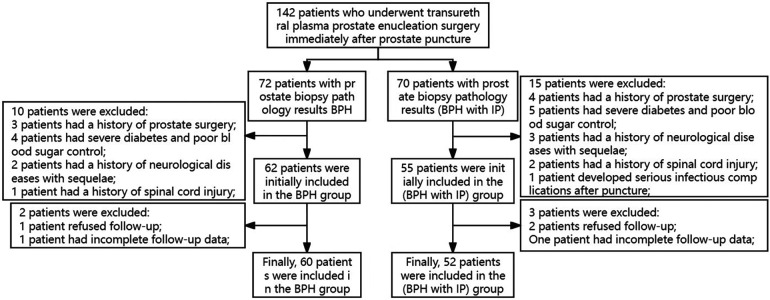 Figure 1
Peer Reviews
No public reviews on file for this paper yet. If you reviewed it on a platform where reviews are public (OpenReview, ICLR, NeurIPS, ICML), you can paste yours below so the community can read it here.
Videos
No videos yet. Explain this paper in a talk, walkthrough, or lecture? Add one.
Taxonomy
TopicsUrinary Bladder and Prostate Research · Prostate Cancer Diagnosis and Treatment · Pelvic floor disorders treatments