Genetic variants of ABCB1 and CES1 genes on dabigatran metabolism in the Kazakh population
Ayan Abdrakhmanov, Elena Zholdybayeva, Aizhana Shaimerdinova, Gulmira Kulmambetova, Svetlana Abildinova, Rustam Albayev, Gulnara Tuyakova, Elena Rib, Zhanasyl Suleimen, Zhanar Abdrakhmanova, Makhabbat Bekbossynova

TL;DR
This study explores how genetic variations in two genes affect dabigatran metabolism in the Kazakh population, influencing drug concentration and bleeding risk.
Contribution
The study identifies specific CES1 and ABCB1 gene polymorphisms linked to dabigatran pharmacokinetics in a Kazakh population.
Findings
Patients with rs2244613 GG genotype had lower dabigatran concentrations compared to TT genotype carriers.
The rs8192935 AA genotype was associated with significantly lower dabigatran concentrations than the GG genotype.
ABCB1 SNPs rs4148738 and rs1045642 showed significant differences in APTT values among genotypes.
Abstract
Allelic variants of genes encoding enzymes of the esterase system (CES1) and P-glycoprotein (ABCB1) can change the metabolism and pharmacokinetics of dabigatran. Therefore, they act as determining factors in the development of side effects, especially bleeding. We analyzed the genotype–phenotype relationship of ABCB1 (rs1045642, rs4148738, rs2032582, and rs1128503) and CES1 (rs8192935, rs71647871, and rs2244613) polymorphisms in patients with atrial fibrillation who had been treated with dabigatran. A total of 150 patients were recruited for this study. TaqMan technology was used for SNP genotyping. Patients with the rs2244613 GG genotype had a lower concentration (55.27 ± 34.22 ng/ml) compared to those with the TT genotype (63.33 ± 52.25 ng/ml) (additive model, P = 0.000). Individuals with the rs8192935 AA genotype had a lower concentration (52.72 ± 30.45 ng/ml) compared to those…
Genes, proteins, chemicals, diseases, species, mutations and cell lines named across the full text — each resolved to its canonical identifier and authoritative record.
Click any figure to enlarge with its caption.
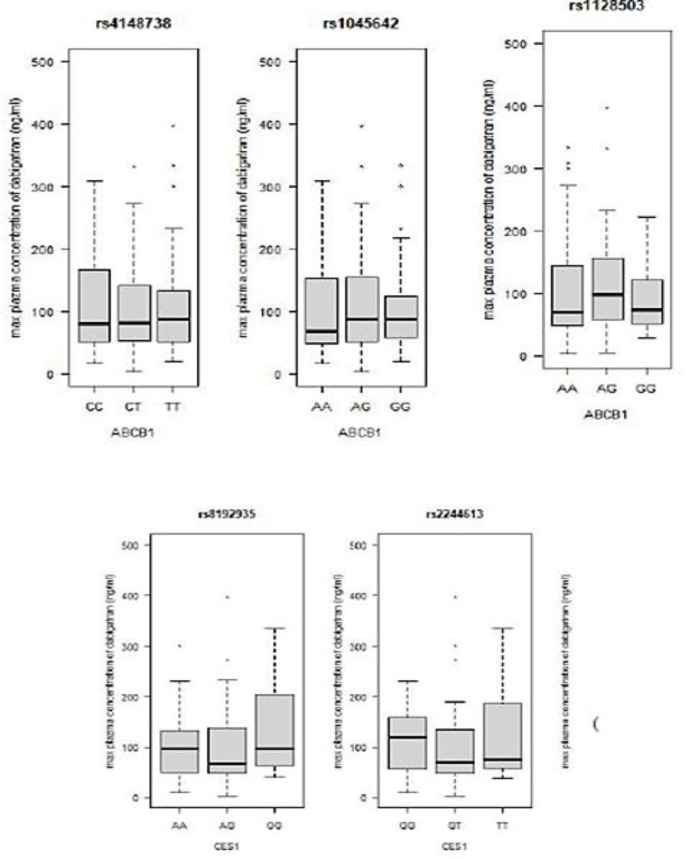 Figure 1
Peer Reviews
No public reviews on file for this paper yet. If you reviewed it on a platform where reviews are public (OpenReview, ICLR, NeurIPS, ICML), you can paste yours below so the community can read it here.
Videos
No videos yet. Explain this paper in a talk, walkthrough, or lecture? Add one.
Taxonomy
TopicsGenomics and Rare Diseases