The Accuracy of Pulse Oxygen Saturation, Heart Rate, Blood Pressure, and Respiratory Rate Raised by a Contactless Telehealth Portal: Validation Study
Julian Gerald Dcruz, Paichang Yeh

TL;DR
This study validates the accuracy of a contactless telehealth portal for measuring vital signs like heart rate, blood pressure, oxygen saturation, and respiratory rate.
Contribution
The study demonstrates that a contactless telehealth system can accurately measure vital signs compared to traditional medical devices.
Findings
The Docsun Telehealth Portal met accuracy standards for heart rate, respiratory rate, and oxygen saturation.
Systolic and diastolic blood pressure measurements were accurate in 94.81% and 95.71% of cases, respectively.
Abstract
The traditional measurement of heart rate (HR), oxygen saturation (SpO2), blood pressure (BP), and respiratory rate (RR) via physical examination can be challenging, and the recent pandemic has accelerated trends toward telehealth and remote monitoring. Instead of going to the physician to check these vital signs, measuring them at home would be more convenient. Vital sign monitors, also known as physiological parameter monitors, are electronic devices that measure and display biological information about patients under constant monitoring. The purpose of this study was to validate the accuracy of the pulse SpO2, HR, BP, and RR raised by Docsun Telehealth Portal by comparing it with approved medical devices. This is a noninvasive, self-check, system-based study conducted to validate the detection of vital signs (SpO2, HR, BP, and RR) raised by Docsun Telehealth Portal. The input for…
Genes, proteins, chemicals, diseases, species, mutations and cell lines named across the full text — each resolved to its canonical identifier and authoritative record.
Click any figure to enlarge with its caption.
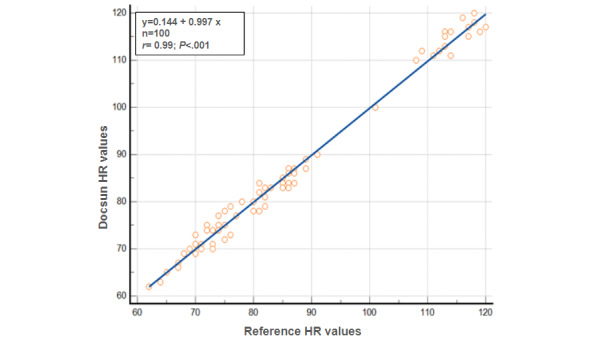 Figure 1
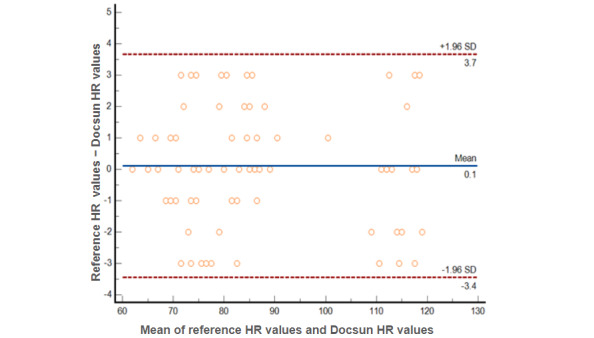 Figure 2
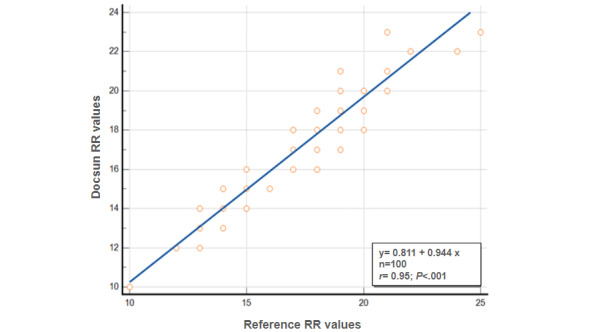 Figure 3
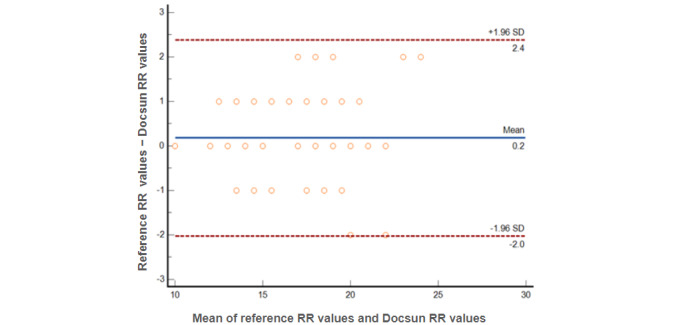 Figure 4
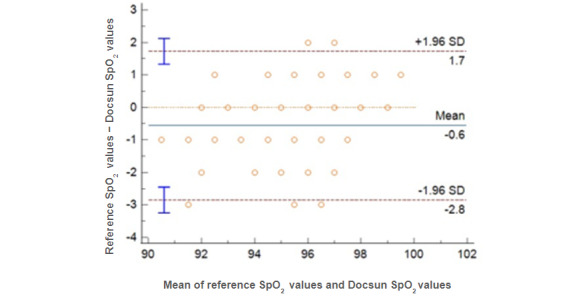 Figure 5
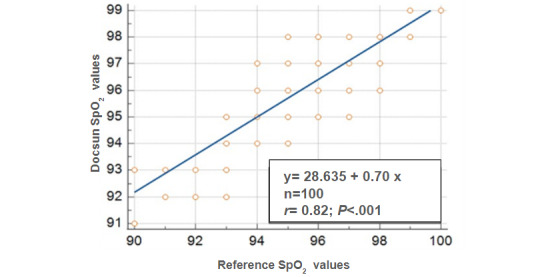 Figure 6
| Characteristics | Values, n (%) | |
|
| ||
|
| Female | 42 (42) |
|
| Male | 58 (58) |
|
| Total | 100 (100) |
|
| ||
|
| 18-20 | 11 (11) |
|
| 20-40 | 45 (45) |
|
| 41-65 | 44 (44) |
| Model | Accuracy (%; 95 % CI) | Error bias (mm Hg; 95 % CI) | Error SD (mm Hg; 95 % CI) | Information gain vs reference SD (%; 95 % CI) | Intraclass correlation (95 % CI) | Pearson correlation (95 % CI) |
| Systolic BP | 94.81 (94.79-94.83) | 7.30 (7.28-7.32) | 7.30 (7.28-7.32) | 25.5 (25.3-25.7) | 0.60 (0.60-0.60) | 0.67 (0.67-0.67) |
| Diastolic BP | 95.71 (95.69-95.73) | 6.00 (5.98-6.02) | 6.00 (5.98-6.02) | 12.0 (11.7-12.3) | 0.37 (0.32-0.42) | 0.47 (0.46-0.48) |
Peer Reviews
No public reviews on file for this paper yet. If you reviewed it on a platform where reviews are public (OpenReview, ICLR, NeurIPS, ICML), you can paste yours below so the community can read it here.
Videos
No videos yet. Explain this paper in a talk, walkthrough, or lecture? Add one.
Taxonomy
TopicsNon-Invasive Vital Sign Monitoring · Hemodynamic Monitoring and Therapy · Heart Rate Variability and Autonomic Control
Introduction
Background
Heart rate (HR), blood pressure (BP), oxygen saturation (SpO_2_), and respiratory rate (RR) are the 4 cardinal vital signs. The measurement of these vital signs is the starting point of physical assessment for both health and wellness. The traditional measurement of these vital signs through physical examination can be challenging, and the recent pandemic has accelerated trends toward telehealth and remote monitoring. Instead of going to the physician to check HR, SpO_2_, BP, body temperature, and RR, it would be convenient to measure them at home [1]. Vital sign monitors, also known as physiological parameter monitors, are electronic devices that measure and display biological information about patients under constant monitoring [2]. The purpose of this study was to validate the HR, BP, SpO_2_, and RR accuracy of the Docsun Telehealth Portal [3], compared to existing approved medical devices.
HR, RR, and SpO_2_ are 3 of the 5 vital signs indicating the criticality of a patient’s condition (aside from BP and body temperature). If any of these vital signs deteriorate, it indicates that the patient requires immediate medical intervention [4]. With the introduction of photoplethysmography-based pulse oximeters, HR and SpO_2_ can easily be monitored using a single device, and respiration is often monitored visually or through separate devices as required. A single device that can monitor all 3 signs is a desirable diagnostic tool for emergency medicine and for the monitoring as well as diagnosis of other diseases [5].
Objectives
The aim of this study was to validate the accuracy of the SpO_2_, HR, BP, and RR raised by Docsun Telehealth compared against clinically approved medical devices.
Methods
Ethical Considerations
Human Subject Research Ethics Review and Approvals
This study underwent ethical review and approval by the appropriate authorities at the clinic (Oloolua Dispensary, Kenya; DCM-HM-02) and followed the principles outlined in the Declaration of Helsinki and Good Clinical Practice guidelines. The study protocol, including all amendments, and the patient information sheets were reviewed and approved by authorized clinical investigators. No exemptions were granted for this study, and all procedures adhered to ethical standards for human subject research.
The study was conducted in accordance with the Code of Federal Regulations (CFR) for nonsignificant risk medical device studies, following the Food and Drug Administration’s Good Clinical Practice regulations at 21 CFR parts 50, 56, and 812. It also adhered to the relevant International Organization for Standardization (ISO) 14155, and the International Conference on Harmonization (ICH) of Technical Requirements for Registration of Pharmaceuticals for Human Use “Good Clinical Practice: Consolidated Guidance” (ICH E6) [6].
Informed Consent
All participants were enrolled between March 7 and March 12, 2022. Prior to participation, all participants provided written informed consent after a detailed explanation of the study procedures and associated risks. The informed consent process ensured that participants understood their voluntary participation, the purpose of the study, potential risks and benefits, and the confidentiality of their data. For studies identified as human subject research, informed consent was obtained from all participants based on ethical guidelines. Any waivers of informed consent did not apply to this study, as all participants provided explicit consent for their involvement.
Privacy and Confidentiality Protection
Measures were implemented to safeguard the privacy and confidentiality of participants’ data throughout the study. Study data were anonymized or deidentified to ensure that individual participants could not be identified from the collected data. Additionally, access to identifiable information was restricted to authorized personnel only, and all electronic data were securely stored on password-protected servers. Any physical records containing participant information were stored in locked filing cabinets accessible only to designated study personnel. Participants’ confidentiality was upheld by using unique identifiers instead of personal identifiers in study documentation. Moreover, any publication or presentation of study results ensured that no identifiable information about participants was disclosed, maintaining their anonymity and confidentiality.
Compensation
No compensation was provided to participants for their involvement in this study. Participation was voluntary, and participants did not receive any financial incentives or compensation of any kind for their participation. This decision was made to minimize any potential influence on participants’ motivations for involvement and to uphold the integrity of the study’s findings.
Device Description
The Docsun Telehealth Portal uses a custom algorithm and optical coherence tomography technology to capture micrometer-resolution, 2D, and 3D images from within biological tissue. The noninvasive and highly repeatable optical coherence tomography procedure provides a fully automated screening process, which helps monitor health signs. The software panel allows the user to upload a prerecorded video or use the webcam on the device to run the detection. The software algorithm runs the video recording and produces the detection results within 60 seconds showing the user’s pulse and RR.
The artificial intelligence (AI) system checks if the features are visible and under ambient lighting conditions, and if not, a message will appear to ask the user to position their face at a more visible angle. The detection runs for 60 seconds, after which the outcome will be visible with readings of pulse rate and RR. The user can use the health report for self-analysis or share it for further medical consultation. The users have access to their previous readings on our software, which they can use as a reference for self-analysis.
Indications for Use
The Docsun Telehealth Portal is a web application intended to be used for monitoring, displaying, reviewing, and storing multiple physiological patient parameters, such as SpO_2_, HR, BP, and RR. The Docsun Telehealth Portal is intended for use in a professional setting or at home and is a noninvasive vital sign monitoring system. The data and results provided by this device are for precheck screening purposes only and cannot be directly used for diagnosis or treatment.
The device is indicated for use on humans 18 years of age or older who do not require critical care or continuous vital sign monitoring.
The device is not intended to be the sole method of checking the physical health of a person.
Reference Equipment
A pulse oximeter and digital BP monitor were used as a reference standard device for obtaining the functional values (for HR, BP, SpO_2_, and RR) during the study.
Validation Equipment
This noninvasive, self-check, system-based study was conducted to validate the detection of vital signs (ie, HR, BP, SpO_2_, and RR) using an AI tool. Data for this study were collected at a single collaborating site approved by Docsun. The data of patients visiting the site were collected based on the study criteria after obtaining their informed consent.
This study aims to collect basic vital signs information on the current health status to generate a diagnostic report using an AI tool. The input for the software processing involves a facial screening without any accessories on the face, directly scanned through the software application portal. The participant’s facial features are detected and screened to extract necessary readings.
The study setup was designed so that the participant was always at a distance of 2 meters from the study staff. The brochures and participant signature logs were placed near the study screening space. Basic vital signs, such as HR and RR, were measured using a pulse oximeter and digital blood pressure monitor as reference devices. The readings were noted in a case report form. A webcam was installed at a convenient distance from the participant for facial screening. Then the participant was asked to look into the webcam for software screening. The participant was asked not to make any sudden movements but to breathe normally for 60 seconds.
The software provided a health report, and the report’s upload time was noted for study data collection purposes. The study area was then sanitized using a spray and fumigation machine before the entry of the next participant.
Inclusion Criteria
Participants aged 18 years and older, with cardiovascular and respiratory diseases, and able to provide informed consent were included in the study.
Exclusion Criteria
Participants wearing contact lenses and those who did not require critical medical care were excluded from the study.
Subject Demographics
Participant demographics are shown in Table 1.
Data Analysis
Microsoft Excel was used as the data analysis tool. Measurements were paired observations, as follows: the algorithm-estimated HR, BP, SpO_2_, and RR as well as the reference HR, BP, SpO_2_, and RR from the reference devices. The absolute error of each paired measurement was calculated as the absolute value of the difference between the algorithm-estimated and the reference HR, SpO_2_, BP, and RR values.
The mean absolute error was the mean value of all absolute errors. Similarly, the absolute error from each paired measurement was divided by the reference value for that measurement and multiplied by 100 to produce the absolute percentage error. The mean absolute percentage error was the mean value for all absolute percentage error values. The values from each participant were treated as statistically independent, as the clustering effects were observed to be minimal.
For the HR, BP, SpO_2_, and RR measurement validation, the main outcome was the mean of the absolute difference between the respective investigational devices and the reference values as well as the absolute percentage difference between the respective investigational devices and the reference values.
HR measurements were considered accurate if the mean absolute difference was within either ±10 % or ±5 beats per minute (bpm), depending on which of the two was greater.
RR measurements were considered accurate if the mean absolute difference was within either ±10 % or ±3 bpm.
SpO_2_ measurements were considered accurate if the mean absolute difference was ≤3.0%
For BP measurements, a tolerable error of ≤10 mm Hg and an estimated probability of that error of at least 85% was acceptable as a compromise, considering the performance of currently available BP monitors. This was compatible with the current American National Standards Institute, Association for the Advancement of Medical Instrumentation, the ISO requirements, and the requirements of the revised European Society of Hypertension International Protocol, allowing for a 10 mm Hg error with a frequency of 12% to 18%.
The main outcome data were visualized using Bland-Altman plots. The Bland-Altman analysis is a simple and efficient method to assess the agreement between two measurements in clinical studies [7]. In addition, correlation analyses and scatter plots were used to assess the relation between the respective investigational devices and the reference values.
Results
Principal Results
A total of 100 participants who met the inclusion criteria were enrolled, and data from all participants were considered, as they fell within the predetermined target readings of HR and RR values when compared with the respective investigational devices.
Heart Rate
If the HR was within ±10% of the reference standard or 5 bpm, it was considered to be acceptable for clinical purposes. The average absolute difference between the Docsun Telehealth Portal and the reference values was 1.41 (SD 1.14) bpm. The mean absolute percentage difference was 1.69% (SD 1.37). The Docsun Telehealth Portal, therefore, met the predefined accuracy cutoff for HR measurements. Correlation analysis revealed a statistically significant, strong correlation (r=0.99; P<.001) between the Docsun Telehealth Portal and the reference device values (Figure 1).
Figure 2 shows the Bland-Altman plots comparing the HR measurements raised by the Docsun Telehealth Portal and the reference HR values raised by a pulse oximeter. All observations were within ±5 bpm. Compared to the reference HR, the mean absolute percentage error of the overall study population was 1.69%, which was significantly lower than the prespecified study target of 10%.
Correlation of the Docsun Telehealth Portal’s heart rate values against the reference heart rate values from a pulse oximeter.
Bland-Altman plots for heart rate (HR); the reference HR was obtained from a pulse oximeter. Dots represent individual participants; blue lines indicate the mean difference; red lines indicate the 95% limits of agreement (mean 0.1, 1.96 SD).
Respiratory Rate
The mean difference and limits of agreement derived from the reference device and the investigational device were all within the predefined acceptance range.
If the RR was within ±10% of the reference standard or 3 bpm, it was considered acceptable for clinical purposes. The average absolute difference between the Docsun Telehealth Portal and the reference values was 0.86 bpm. The absolute percentage difference was 4.72%. The Docsun Telehealth Portal, therefore, met the predefined accuracy cutoff for RR measurements. Correlation analysis revealed a statistically significant strong correlation (r=0.95; P<.001) between the Docsun Telehealth Portal and the reference device values (Figure 3).
Figure 4 shows the Bland-Altman plots for comparing the RR measurements raised by the Docsun Telehealth Portal and the reference RR values raised by a digital blood pressure monitor. All observations were within ±3 breaths per minute. Compared to the reference RR, the mean absolute percentage error of the overall study population was 4.72%, which was significantly lower than the prespecified study target of 10%.
Correlation of the Docsun Telehealth Portal’s respiratory rate (RR) values against the reference respiratory rate values from a digital blood pressure monitor.
The Bland-Altman plots for comparing the respiratory rate (RR) measurements raised by the Docsun Telehealth Portal and the reference RR values raised by a digital blood pressure monitor.
Pulse Oxygen Saturation
If the mean absolute difference between the Docsun Telehealth Portal and the reference pulse oximeter was within ±3%, it was considered accurate. The mean absolute difference in this study for SpO_2_ levels was calculated at 0.59%, which was significantly lower than the predefined study target of ±3%.
Figure 5 shows the Bland-Altman plots for comparing the reference SpO_2_ measurements with the actual SpO_2_ values. Correlation analysis revealed a statistically significant strong correlation between the Docsun Telehealth Portal and the reference values (Figure 6).
Bland-Altman plots for SpO2 measurements; the reference SpO2 values were obtained from a pulse oximeter.
Correlation of the Docsun Telehealth Portal’s pulse oxygen saturation values against the reference pulse oxygen saturation values obtained from a pulse oximeter.
Blood Pressure
The Docsun Telehealth Portal measured the systolic BP with an accuracy of 94.81% and the diastolic BP with an accuracy of 95.71%. The average prediction bias was 0.39 (SD 7.30) mm Hg for systolic BP and −0.20 (SD 6.00) mm Hg for diastolic BP. These SDs represent information gains of 25.5% and 12%, respectively. Our findings corresponded to average intraclass correlations of 0.60 and 0.37 for systolic BP and average Pearson correlations of 0.67 and 0.47 for diastolic BP (Table 2).
Discussion
Principal Findings
The study aimed to evaluate the accuracy of the Docsun Telehealth Portal in measuring vital signs, including HR, RR, SpO_2_, and BP, compared to reference devices. Overall, the study found that the Docsun Telehealth Portal demonstrated high accuracy in measuring these vital signs, meeting predefined accuracy cutoffs for HR, RR, SpO_2_, and BP measurements. These findings support the efficacy of the portal as a reliable tool for noninvasive vital sign monitoring, aligning with the objectives outlined in the introduction.
The detailed analysis of the study findings reveals several important insights. The accuracy of vital sign measurements provided by the Docsun Telehealth Portal has significant implications for clinical practice, particularly in remote patient monitoring and early detection of health conditions. The strong correlations observed between the portal and reference device values indicate a high level of agreement, further validating the reliability of the measurements obtained. These results are consistent with existing literature, which underscores the importance of accurate vital sign monitoring in health care delivery.
However, it is essential to acknowledge the limitations of the study. The sample size was relatively small, and data were collected from a single collaborating site, which may limit the generalizability of findings to broader populations. Additionally, while efforts were made to minimize biases and confounding factors, there may be other unaccounted variables that could have influenced study outcomes. Future research should address these limitations by conducting larger-scale studies with more diverse populations and settings.
The findings of this study have significant implications for health care delivery and patient outcomes. The accuracy and reliability of the Docsun Telehealth Portal in measuring vital signs offer a promising solution for remote patient monitoring, particularly in underserved or remote areas. By providing accessible, accurate, and timely vital sign monitoring, the portal has the potential to enhance patient care, improve health outcomes, and reduce health care disparities. Continued research and development in this area are warranted to fully realize the transformative potential of AI-based health monitoring systems in improving health care delivery worldwide.
Conclusions
This study aimed to assess the accuracy of 4 vital sign measurements—HR, BP, SpO_2_, and RR—using the Docsun Telehealth Portal in comparison to clinically approved medical devices. The results of the study show that the accuracy guidelines for HR, BP, SpO_2_, and RR measurements were met by the investigational device when compared with the reference devices. In conclusion, the Docsun Telehealth Portal proved to efficiently and effectively provide accurate results when compared with the HR, BP, SpO_2_, and RR values measured by existing approved medical devices (ie, pulse oximeters and digital blood pressure monitors).
The reference list from the paper itself. Each links out to its DOI / PubMed record.
- 1Sinhal R Singh K Shankar A Estimating vital signs through non-contact video-based approaches: a survey 20172017 International Conference on Recent Innovations in Signal processing and Embedded Systems (RISE)October 27-29Bhopal, India 13914110.1109/RISE.2017.8378141 · doi ↗
- 2Rodríguez-Salazar LA Gamboa-Delgado EM Plata Rangel S Mantilla-Prada OA Sarmiento-Caraballo E Rincón-Riveros JD Clinical validation study of the Sign Care vital signs monitor of fundación cardiovascular de Colombia Rev Fac Med 2016070164345910.15446/revfacmed.v 64n 3.49339 · doi ↗
- 3Docsun Telehealth Portal 2024-06-12 https://docsun.health/telehealth/
- 4Kramer M Lobbestael A Barten E Eian J Rausch G Wearable pulse oximetry measurements on the torso, arms, and legs: a proof of concept Military Medicine 201703182 S 1929810.7205/milmed-d-16-0012928291458 · doi ↗ · pubmed ↗
- 5Callahan JM Pulse oximetry in emergency medicine Emerg Med Clin North Am 20081126486979, vii 10.1016/j.emc.2008.08.00619059087 S 0733-8627(08)00089-819059087 · doi ↗ · pubmed ↗
- 6ICH guidance documents US Food and Drug Administration 2024-06-12 https://www.fda.gov/science-research/clinical-trials-and-human-subject-protection/ich-guidance-documents
- 7Giavarina D Understanding Bland Altman analysis Biochem Med 201525214115110.11613/bm.2015.015PMC 447009526110027 · doi ↗ · pubmed ↗