Enhancing neural operator learning with invariants to simultaneously learn various physical mechanisms
Siran Li, Chong Liu, Hao Ni

TL;DR
This paper introduces PIANO, a new framework that improves learning of physical mechanisms by incorporating physical knowledge into neural operators.
Contribution
The novel Physics Invariant Attention Neural Operator (PIANO) framework is introduced for integrating physical knowledge from multi-physical scenarios.
Findings
PIANO is designed to decipher and integrate physical knowledge from PDEs.
The framework is suitable for multi-physical scenarios and sampled PDE data.
Abstract
We discuss the recent advancement in PDE learning, focusing on Physics Invariant Attention Neural Operator (PIANO). PIANO is a novel neural operator learning framework for deciphering and integrating physical knowledge from PDEs sampled from multi- physical scenarios.
Genes, proteins, chemicals, diseases, species, mutations and cell lines named across the full text — each resolved to its canonical identifier and authoritative record.
Click any figure to enlarge with its caption.
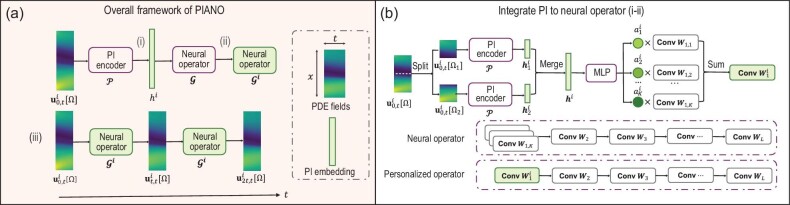 Figure 1
Peer Reviews
No public reviews on file for this paper yet. If you reviewed it on a platform where reviews are public (OpenReview, ICLR, NeurIPS, ICML), you can paste yours below so the community can read it here.
Videos
No videos yet. Explain this paper in a talk, walkthrough, or lecture? Add one.
Taxonomy
TopicsModel Reduction and Neural Networks · Neural Networks and Applications · Computational Physics and Python Applications
Partial differential equations (PDEs) play a fundamental role in the modelling and analysis of a wide range of physical and geometric problems. Numerous numerical techniques, classical and new, have been proposed to approximate PDE solutions, aiming at attaining high accuracy and efficiency. Most recently, by utilising deep neural networks to represent PDE solutions, machine learning (ML) methods have emerged as a revolutionary tool that demonstrates enormous potential to overcome the curse of dimensionality and to deal with complex geometries.
The neural operator approach, which uses neural networks to learn the differential operator, stands out as arguably the most promising ML approach to simulate physical systems [1,4]. It nonetheless faces two major challenges: (i) it is only applicable to PDEs generated by a single physical mechanism and (ii) it requires access to high-level physical information governing the PDEs, which is infeasible or expensive to collect in real-world applications.
To this end, Zhang et al. [3] proposed a novel neural operator learning framework—the physics invariant attention neural operator (PIANO)—for deciphering and integrating physical knowledge from PDEs sampled from multi-physical scenarios. Such PDEs, most notably, contain various physical invariants (PIs), e.g. PDE coefficients and boundary/initial data.
In contrast to abundant literature focusing on one single fixed PDE (e.g. [4,5]), Zhang et al. [3] tackled the dataset generated by a family of PDEs with varying parameters arising from multi-physical processes. PIANO (Fig. 1) is proposed to enhance the neural operator method by incorporating the inherent invariance of PDEs.
To illustrate the idea, consider the following schematic initial-boundary value problem of PDEs:
Here \documentclass[12pt]{minimal} \usepackage{amsmath} \usepackage{wasysym} \usepackage{amsfonts} \usepackage{amssymb} \usepackage{amsbsy} \usepackage{upgreek} \usepackage{mathrsfs} \setlength{\oddsidemargin}{-69pt} \begin{document} \mathcal {R}\end{document} and \documentclass[12pt]{minimal} \usepackage{amsmath} \usepackage{wasysym} \usepackage{amsfonts} \usepackage{amssymb} \usepackage{amsbsy} \usepackage{upgreek} \usepackage{mathrsfs} \setlength{\oddsidemargin}{-69pt} \begin{document} \mathcal {B}\end{document} are the differential and boundary operators, respectively, governed by global parameters \documentclass[12pt]{minimal} \usepackage{amsmath} \usepackage{wasysym} \usepackage{amsfonts} \usepackage{amssymb} \usepackage{amsbsy} \usepackage{upgreek} \usepackage{mathrsfs} \setlength{\oddsidemargin}{-69pt} \begin{document} \theta =(\theta _{\mathcal {R}}, \theta _{\mathcal {B}})\end{document} . Zhang et al. [3] focus on the case in which \documentclass[12pt]{minimal} \usepackage{amsmath} \usepackage{wasysym} \usepackage{amsfonts} \usepackage{amssymb} \usepackage{amsbsy} \usepackage{upgreek} \usepackage{mathrsfs} \setlength{\oddsidemargin}{-69pt} \begin{document} \theta\end{document} is independent of t.
The learning task of PIANO is to predict the next t-frame solution given the past t-frame solution, using a dataset consisting of solutions governed by diverse parameters. Compared with [2], an essential feature of the work of Zhang et al. [3] is that it assumes no prior knowledge about the PDE parameters.
PIANO consists of two branches: (i) a PI encoder to extract invariant representation and (ii) a personalised operator to predict the complementary field representation of each PDE. Contrastive learning is employed to learn the embedding of each PDE in a data-driven fashion. In addition, three physics-aware cropping strategies are proposed to enhance consistency with the inherent invariance of the PDE system. Extensive numerical results on Burgers’ equation and the Navier–Stokes equations show that the proposed PIANO consistently outperforms the existing methods by reducing the relative errors by 13.6%–82.2%. Moreover, the supervised learning tasks of predicting the PDE coefficients demonstrate the usefulness of the learned PI representation in downstream tasks.
In conclusion, PIANO proposed by Zhang et al. [3] provides a novel, general framework for learning PDEs arising from multi-physical processes. It significantly improves empirical performance, is applicable to general backbone models and further inspires the design of neural operators for foundation models of PDE learning. Future research could explore the theoretical underpinnings of PIANO and extend its numerical validation to higher-dimensional problems. It is also of great interest to extend PIANO to the out-of-distribution generalisation tasks and transfer learning, noting that Zhang et al. [3] only studied such possibilities of the PI encoder. Moreover, the idea of utilising personalised encoders derived from larger models—which enables PIANO to accelerate the inference time while preserving the expressive power—opens up new avenues for the design of foundational models for PDE learning and the study of complex multi-physical problems in science and engineering.
The reference list from the paper itself. Each links out to its DOI / PubMed record.
- 1Kovachki N, Li Z, Liu B et al. J Mach Learn Res 2023; 24: 89
- 2Wang R, Walters R, Yu R. Meta-learning dynamics forecasting using task inference. In: Koyejo S, Mohamed S, Agarwal A et al. (eds.) Advances in Neural Information Processing Systems. Red Hook, NY: Curran Associates, 2022, 21640–53.10.48550/ar Xiv.2102.10271 · doi ↗
- 3Zhang R, Meng Q, Ma Z. Natl Sci Rev 2024; 11: nwad 336.38487494 10.1093/nsr/nwad 336PMC 10939376 · doi ↗ · pubmed ↗
- 4Li Z, Kovachki N, Azizzadenesheli K et al. Fourier neural operator for parametric partial differential equations. International Conference on Learning Representations, Virtual, 26 April -1 May 2020.10.48550/ar Xiv.2010.08895 · doi ↗
- 5Li Z, Peng W, Yuan Z et al. Theor Appl Mech Lett 2022; 12: 100389.