Administration of the American Board of Anesthesiology’s virtual APPLIED Examination: successes, challenges, and lessons learned
Mark T. Keegan, Ann E. Harman, Thomas M. McLoughlin, Alex Macario, Stacie G. Deiner, Robert R. Gaiser, David O. Warner, Santhanam Suresh, Huaping Sun

TL;DR
The American Board of Anesthesiology successfully administered a large-scale virtual exam during the pandemic, facing technical and security challenges but proving the feasibility of remote certification assessments.
Contribution
Demonstrates the practicality of virtual high-stakes exams in anesthesiology certification during the pandemic, highlighting both successes and limitations.
Findings
Over 80% of candidates completed the virtual exam without major issues, with only 2.5% of SOE and 1.5% of OSCE candidates needing rescheduling due to technical problems.
Approximately 40% of examiners found virtual evaluation more difficult than in-person, and 56% of SOE examiners considered the virtual format less secure.
The virtual exam format was eventually replaced by in-person exams in 2022 due to concerns about standardization and security.
Abstract
In response to the COVID-19 pandemic, the American Board of Anesthesiology transitioned from in-person to virtual administration of its APPLIED Examination, assessing more than 3000 candidates for certification purposes remotely in 2021. Four hundred examiners were involved in delivering and scoring Standardized Oral Examinations (SOEs) and Objective Structured Clinical Examinations (OSCEs). More than 80% of candidates started their exams on time and stayed connected throughout the exam without any problems. Only 74 (2.5%) SOE and 45 (1.5%) OSCE candidates required rescheduling due to technical difficulties. Of those who experienced “significant issues”, concerns with OSCE technical stations (interpretation of monitors and interpretation of echocardiograms) were reported most frequently (6% of candidates). In contrast, 23% of examiners “sometimes” lost connectivity during their multiple…
Genes, proteins, chemicals, diseases, species, mutations and cell lines named across the full text — each resolved to its canonical identifier and authoritative record.
Click any figure to enlarge with its caption.
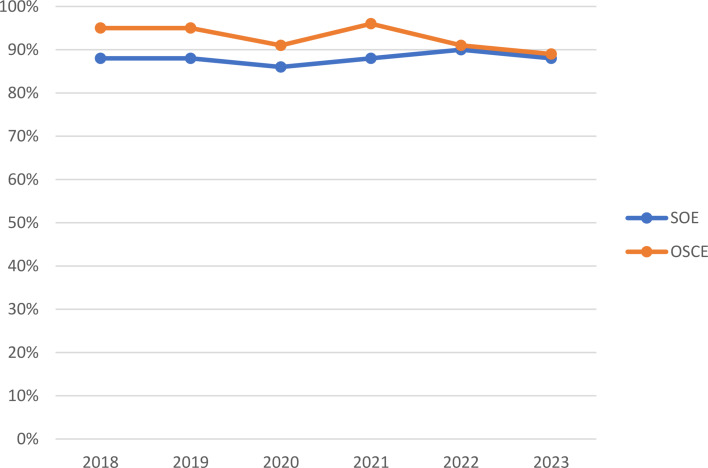 Figure 1
Peer Reviews
No public reviews on file for this paper yet. If you reviewed it on a platform where reviews are public (OpenReview, ICLR, NeurIPS, ICML), you can paste yours below so the community can read it here.
Videos
No videos yet. Explain this paper in a talk, walkthrough, or lecture? Add one.
Taxonomy
TopicsInnovations in Medical Education · Cardiac, Anesthesia and Surgical Outcomes · Ultrasound in Clinical Applications