The Expression of Toll-like Receptors (TLR7 and TLR9) in Class III and Class IV of Recently Diagnosed Lupus Nephritis with 12-Month Follow-Up
José Ignacio Cerrillos-Gutiérrez, Miguel Medina-Pérez, Jorge Andrade-Sierra, Andrés García-Sánchez, Ernesto Germán Cardona-Muñoz, Wendy Campos-Pérez, Erika Martínez-López, Daniela Itzel Sánchez-Lozano, Tannia Isabel Campos-Bayardo, Daniel Román-Rojas

TL;DR
This study compares TLR7 and TLR9 protein levels in patients with lupus nephritis and healthy controls, finding distinct patterns that may help in early diagnosis.
Contribution
The study identifies differential expression of TLR7 and TLR9 in newly diagnosed Class III and IV lupus nephritis patients, suggesting potential diagnostic utility.
Findings
TLR7 protein expression was significantly higher in Class III LN patients compared to healthy controls at baseline and after 12 months.
TLR9 expression decreased in Class III and IV LN patients compared to controls, with no significant increase over time.
Renal function markers showed mixed results, with some improvement in SLEDAI and complement levels but persistent proteinuria in Class III.
Abstract
Renal involvement is an important cause of morbidity and mortality in systemic lupus erythematosus (SLE). The present study included patients with recently diagnosed Class III and Class IV lupus nephritis (LN) treated by Rheumatology who, upon the detection of alterations in their kidney function, were referred to Nephrology for the joint management of both medical specialties. The purpose of this study was to compare the plasma expression of Toll-Like Receptor 7 (TLR7) and TLR9 in healthy control (HC) subjects and newly diagnosed Class III and Class IV LN patients with 12-month follow-ups. The plasma expression of TLR7 and TLR9 proteins was determined by the ELISA method. A significant increase in the expression of TLR7 protein was found in Class III LN in the basal determination compared to the expression in the HC (p = 0.002) and at 12 months of follow-up (p = 0.03) vs. HC. The…
Genes, proteins, chemicals, diseases, species, mutations and cell lines named across the full text — each resolved to its canonical identifier and authoritative record.
Click any figure to enlarge with its caption.
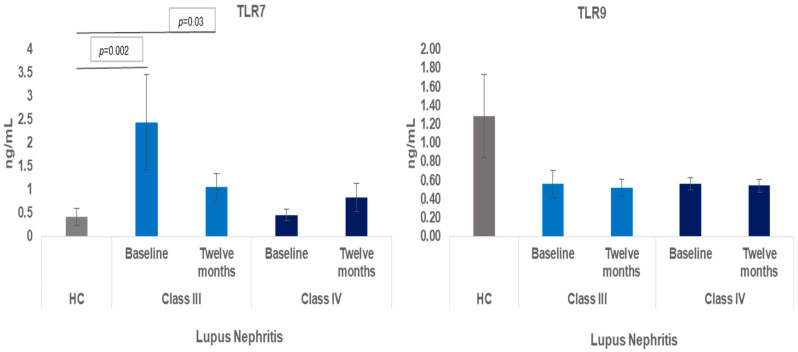 Figure 1
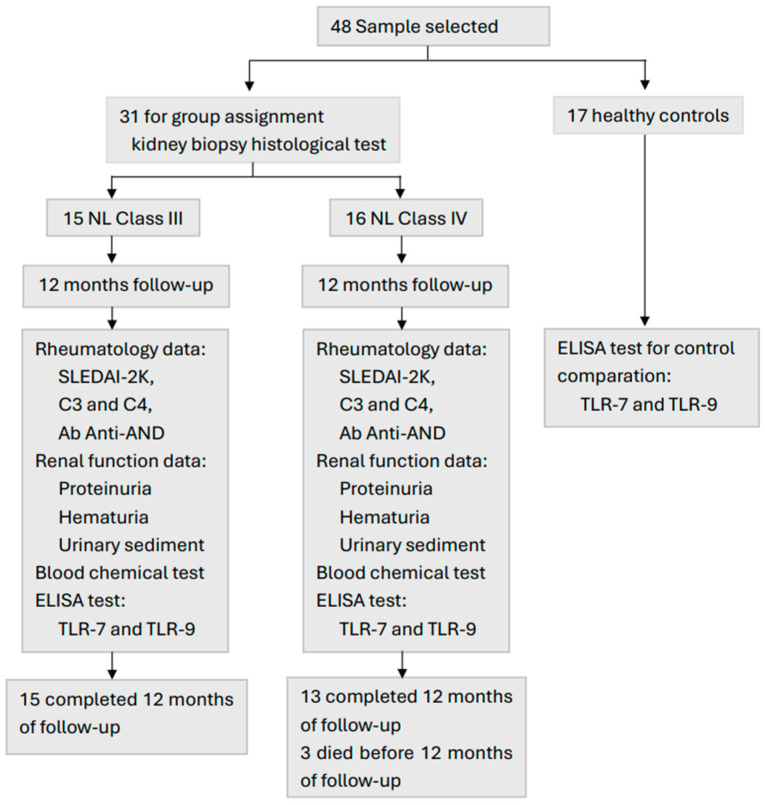 Figure 2
Peer Reviews
No public reviews on file for this paper yet. If you reviewed it on a platform where reviews are public (OpenReview, ICLR, NeurIPS, ICML), you can paste yours below so the community can read it here.
Videos
No videos yet. Explain this paper in a talk, walkthrough, or lecture? Add one.
Taxonomy
TopicsSystemic Lupus Erythematosus Research · Immune Response and Inflammation · Liver Diseases and Immunity