Effect of the degree of follicular diameter ≥18mm differentiation on the day of hCG administration to the outcome of controlled ovarian hyperstimulation (COH)
Hongyi Xu, Qi Chen, Jiarong Tian, Xin Chen, Xin Zhang, Xin Li, Ying Wu, Changjun Zhang, Ying Zhang

TL;DR
This study shows that more uniform follicle sizes on the day of hCG administration lead to better pregnancy outcomes in assisted reproduction.
Contribution
The study introduces a new method to assess follicular homogeneity using standard deviation of follicle size for predicting COH outcomes.
Findings
Lower BMI and higher FSH and AMH levels were observed in the group with the least follicular size variation.
Groups with higher follicular size variation had significantly lower implantation and pregnancy rates.
Live birth rates decreased as follicular size variation increased.
Abstract
To explore the impact of the level of differentiation in a minimum of two follicles with a diameter of ≥18 mm on the outcome of controlled ovarian hyperstimulation on the day of human chorionic gonadotropin (hCG) administration. Single-center data from January 2018 to December 2021 was retrospectively analyzed for 1,199 patients with fresh embryo transfer for assisted reproduction. The absolute value of the standard deviation of the follicle size of at least 2 follicles ≥18 mm in diameter in both ovaries on the day of hCG was taken as the degree of differentiation of the dominant follicle after ovulation induction, based on the standard deviation response to the degree of dispersion of the data. The degree of follicular differentiation was divided into 3 groups according to the size of the value, and the general clinical conditions, laboratory indexes, and clinical outcomes of the…
Genes, proteins, chemicals, diseases, species, mutations and cell lines named across the full text — each resolved to its canonical identifier and authoritative record.
Click any figure to enlarge with its caption.
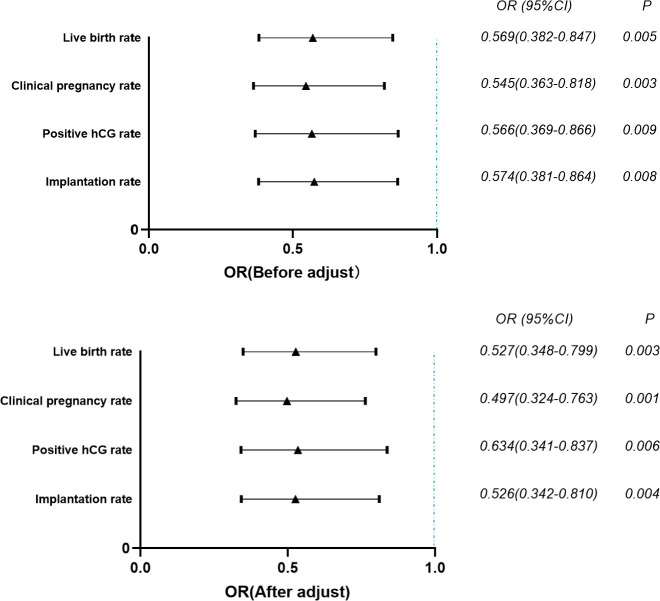 Figure 1
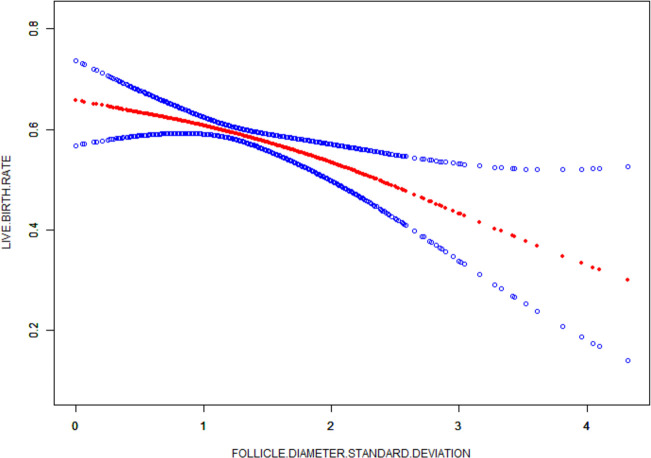 Figure 2
Peer Reviews
No public reviews on file for this paper yet. If you reviewed it on a platform where reviews are public (OpenReview, ICLR, NeurIPS, ICML), you can paste yours below so the community can read it here.
Videos
No videos yet. Explain this paper in a talk, walkthrough, or lecture? Add one.
Taxonomy
TopicsReproductive Biology and Fertility · Assisted Reproductive Technology and Twin Pregnancy · Ovarian function and disorders