Genetic–environment associations explain genetic differentiation and variation between western and eastern North Pacific rhinoceros auklet (Cerorhinca monocerata) breeding colonies
Brendan A. Graham, J. Mark Hipfner, Kyle W. Wellband, Motohiro Ito, Theresa M. Burg

TL;DR
This study explores how environmental factors influence genetic differences in rhinoceros auklet populations across the North Pacific.
Contribution
The study is the first to quantify genetic-environment associations in rhinoceros auklets, revealing local adaptation between western and eastern Pacific populations.
Findings
262 candidate adaptive loci were identified, explaining 3.0% of genetic variation between western and eastern Pacific populations.
Genetic variation was more strongly associated with pH and current velocity than sea surface temperature.
Isolation-by-distance patterns were observed within western and eastern Pacific populations.
Abstract
Animals are strongly connected to the environments they live in and may become adapted to local environments. Examining genetic–environment associations of key indicator species, like seabirds, provides greater insights into the forces that drive evolution in marine systems. Here we examined a RADseq dataset of 19,213 SNPs for 99 rhinoceros auklets (Cerorhinca monocerata) from five western Pacific and 10 eastern Pacific breeding colonies. We used partial redundancy analyses to identify candidate adaptive loci and to quantify the effects of environmental variation on population genetic structure. We identified 262 candidate adaptive loci, which accounted for 3.0% of the observed genetic variation among western Pacific and eastern Pacific breeding colonies. Genetic variation was more strongly associated with pH and maximum current velocity, than maximum sea surface temperature.…
Genes, proteins, chemicals, diseases, species, mutations and cell lines named across the full text — each resolved to its canonical identifier and authoritative record.
Click any figure to enlarge with its caption.
 Figure 1
 Figure 2
 Figure 3
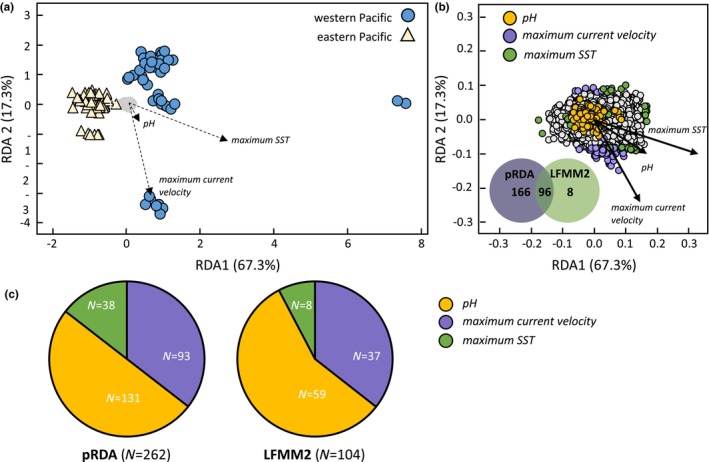 Figure 4
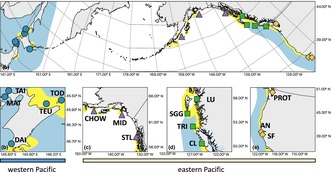 Figure 5
Peer Reviews
No public reviews on file for this paper yet. If you reviewed it on a platform where reviews are public (OpenReview, ICLR, NeurIPS, ICML), you can paste yours below so the community can read it here.
Videos
No videos yet. Explain this paper in a talk, walkthrough, or lecture? Add one.
Taxonomy
TopicsGenetic diversity and population structure · Avian ecology and behavior · Marine and coastal plant biology