Seven new species of the subgenus Homoneura Malloch (Diptera, Lauxaniidae, Homoneura) from Jiangjin District, southwestern Chongqing, China

Abstract
Genes, proteins, chemicals, diseases, species, mutations and cell lines named across the full text — each resolved to its canonical identifier and authoritative record.
Click any figure to enlarge with its caption.
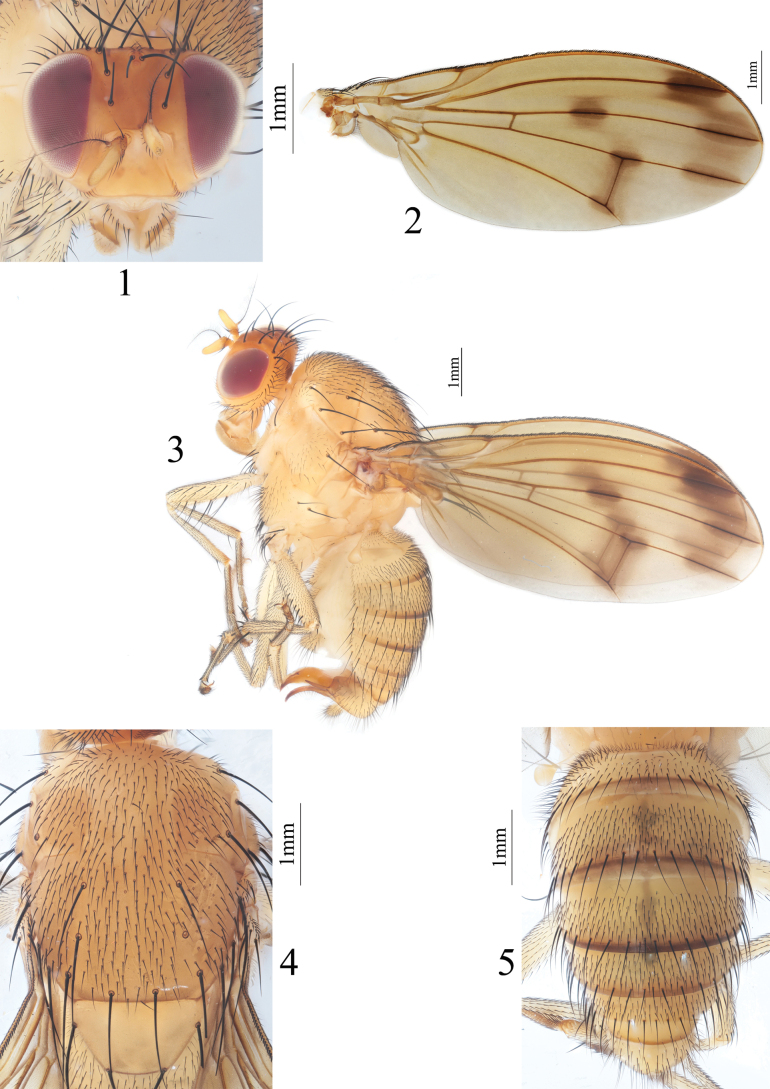 Figures 1–5
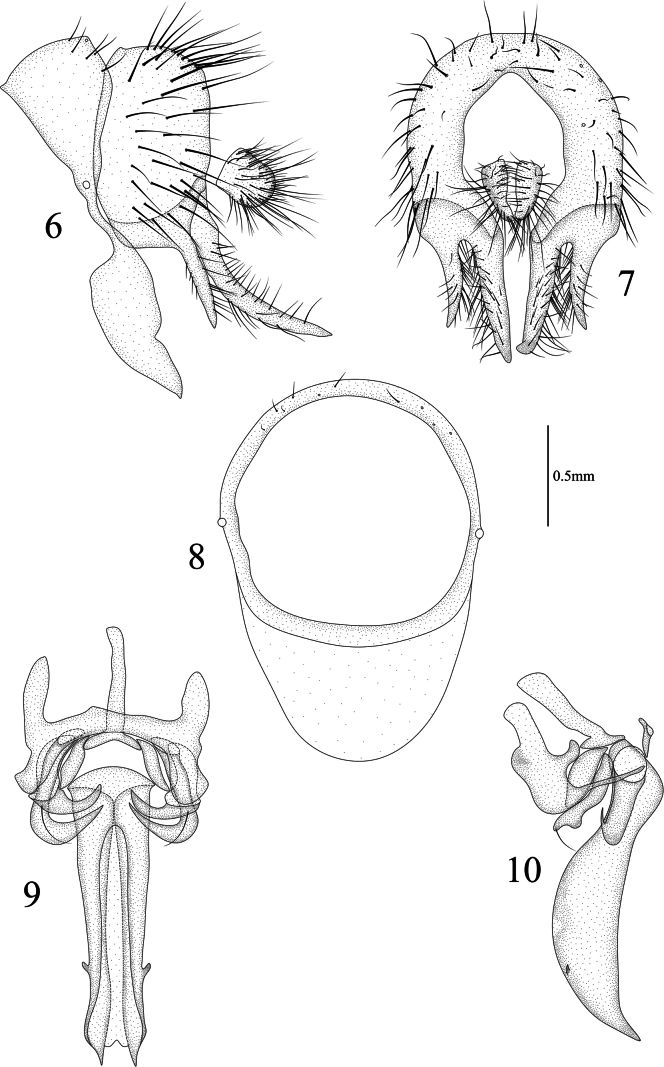 Figures 6–10
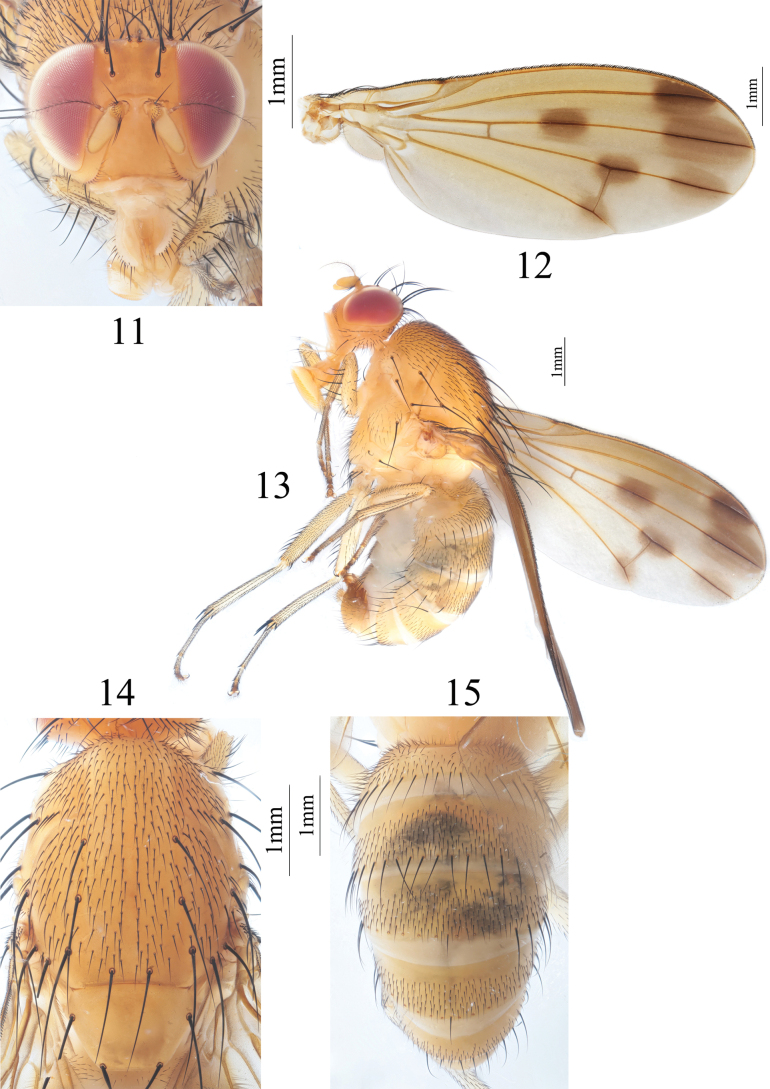 Figures 11–15
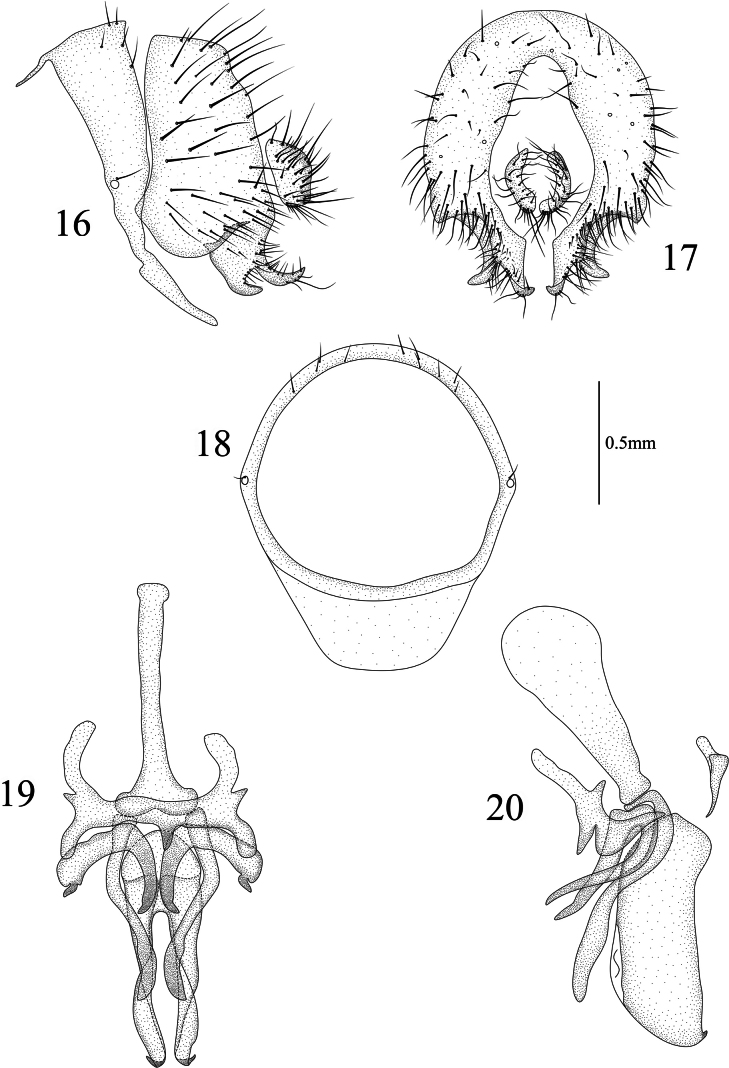 Figures 16–20
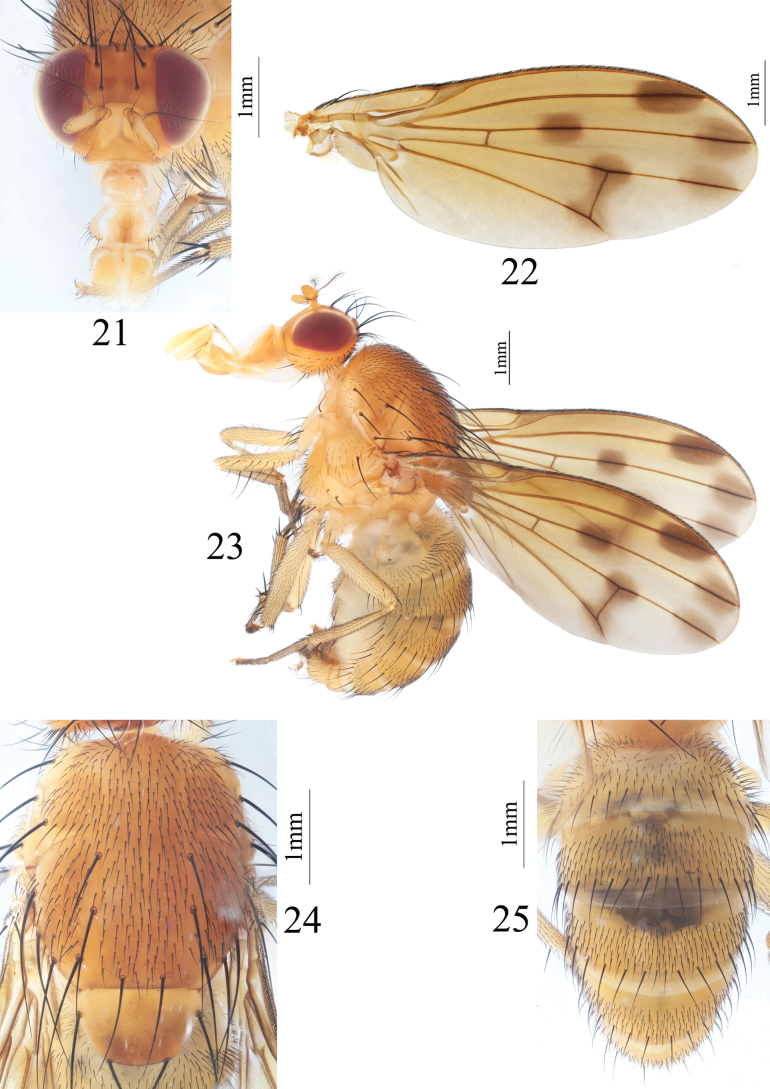 Figures 21–25
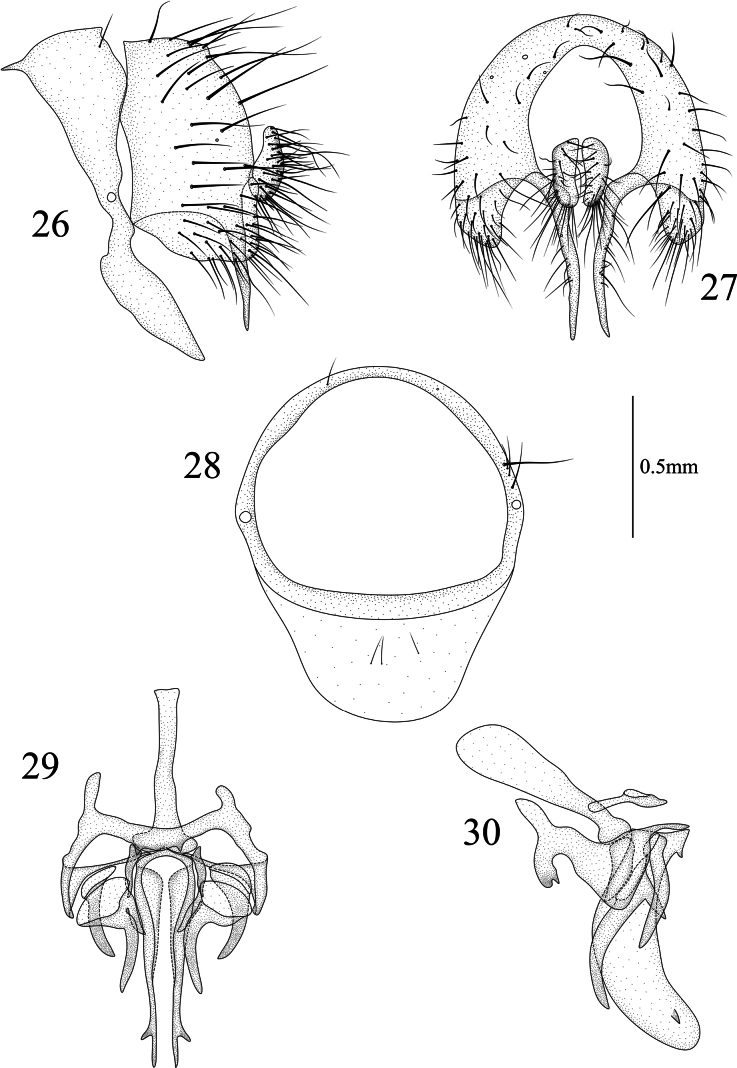 Figures 26–30
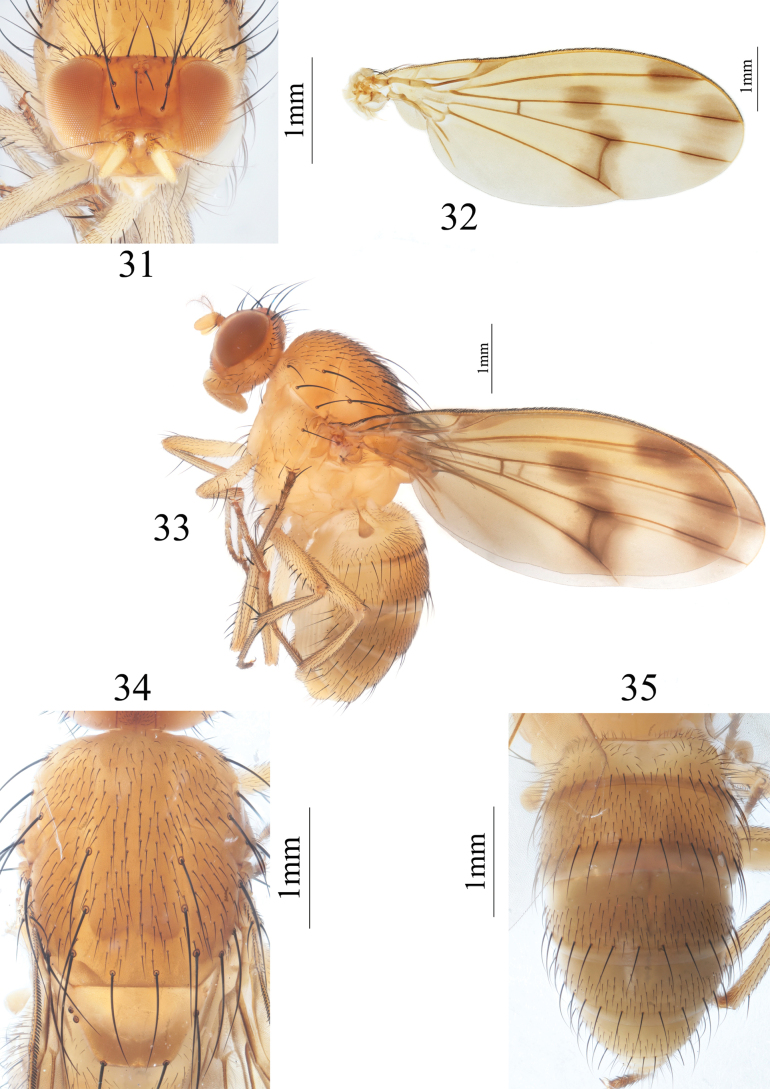 Figures 31–35
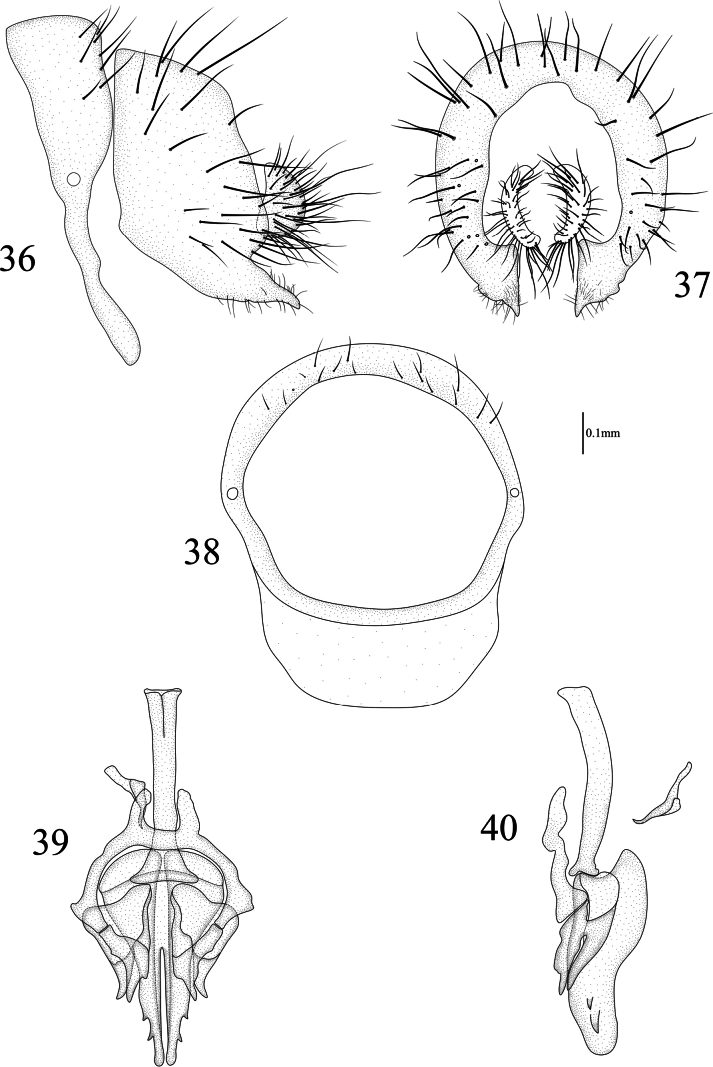 Figures 36–40
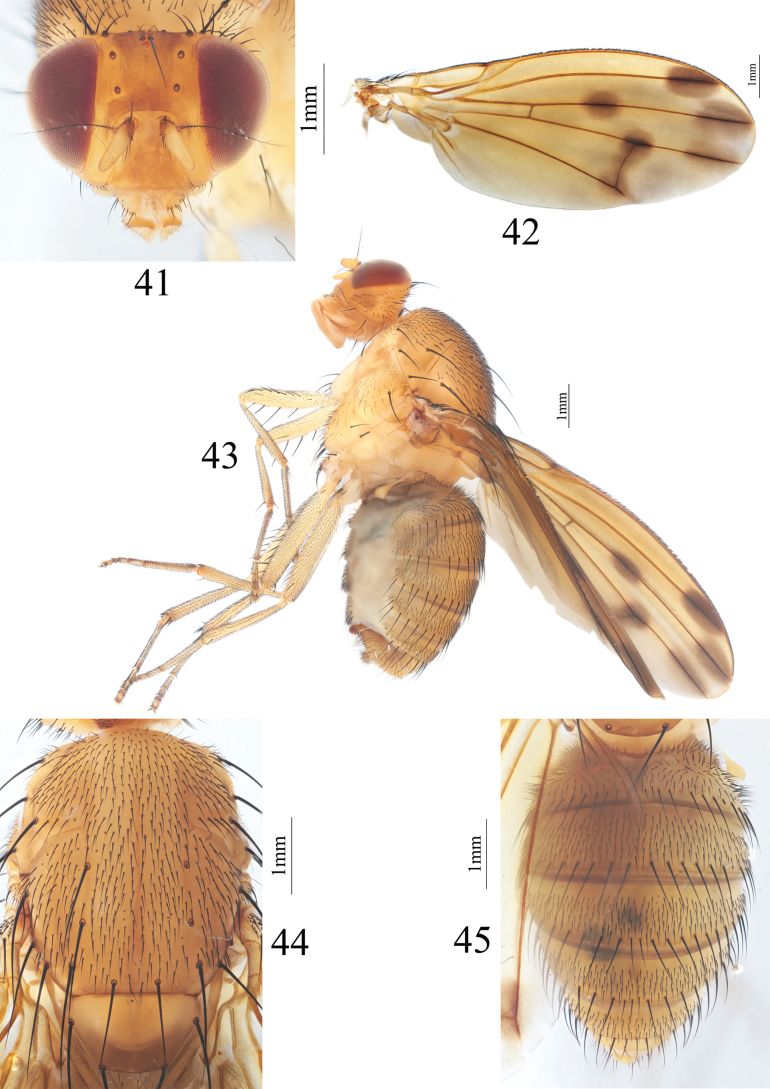 Figures 41–45
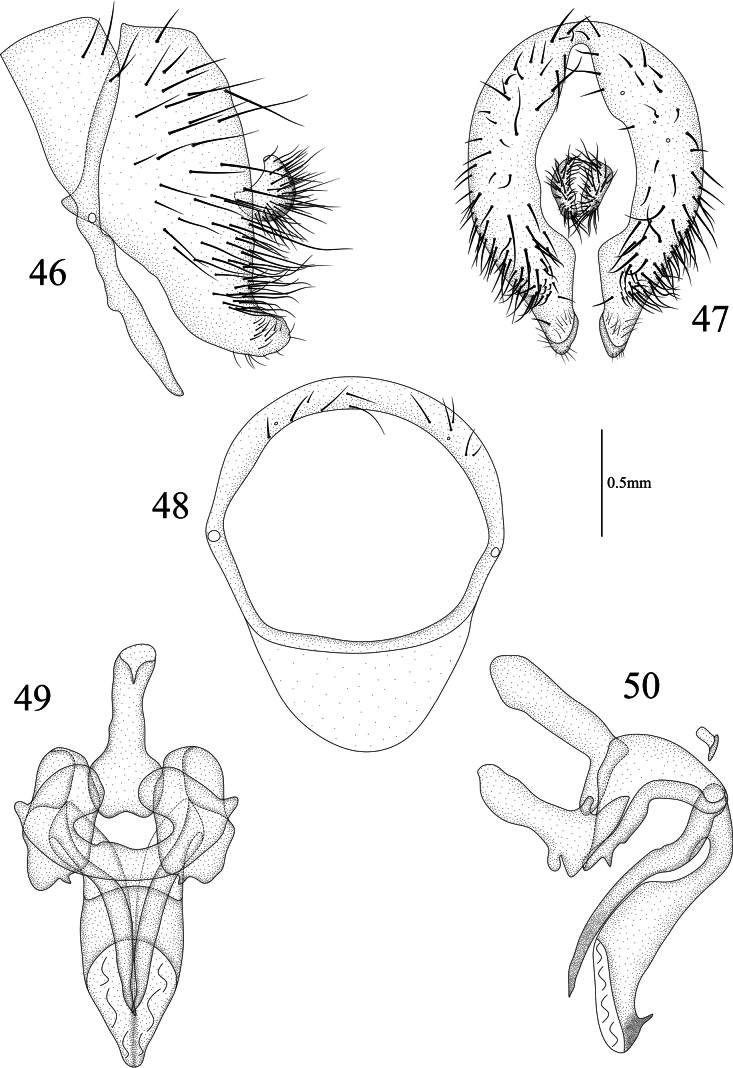 Figures 46–50
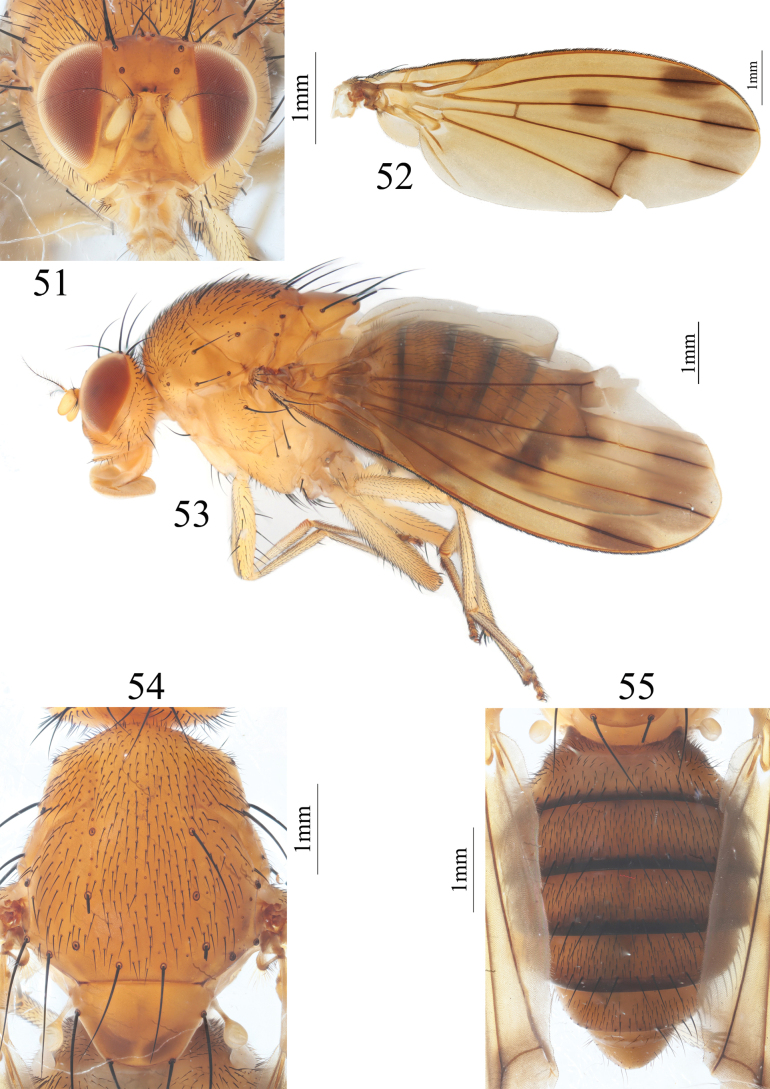 Figures 51–55
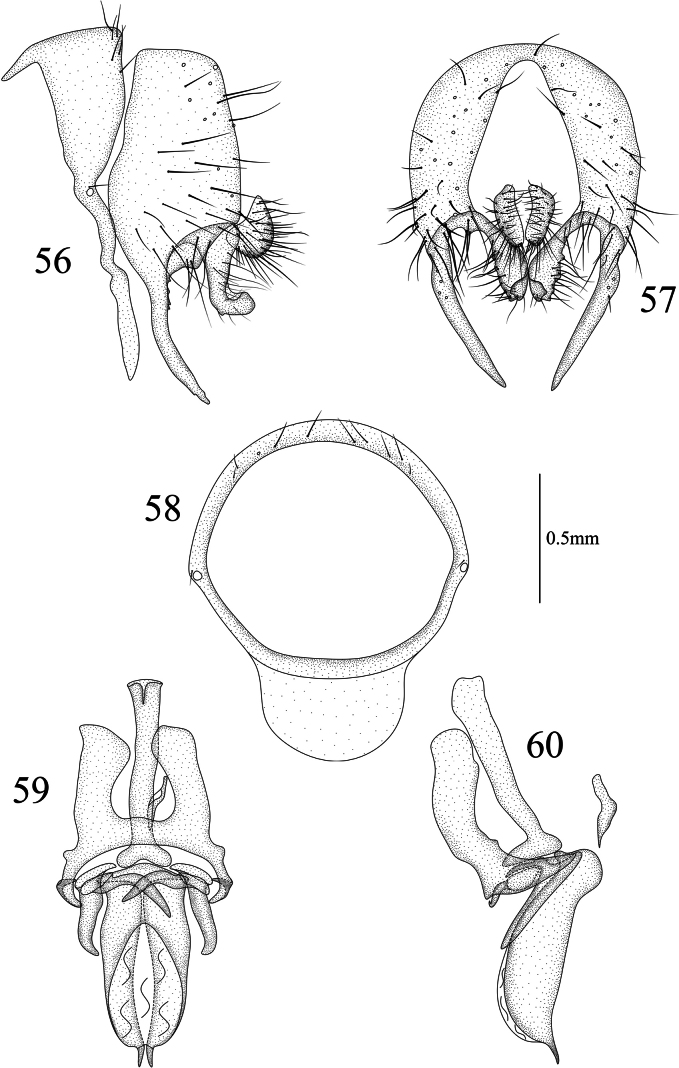 Figures 56–60
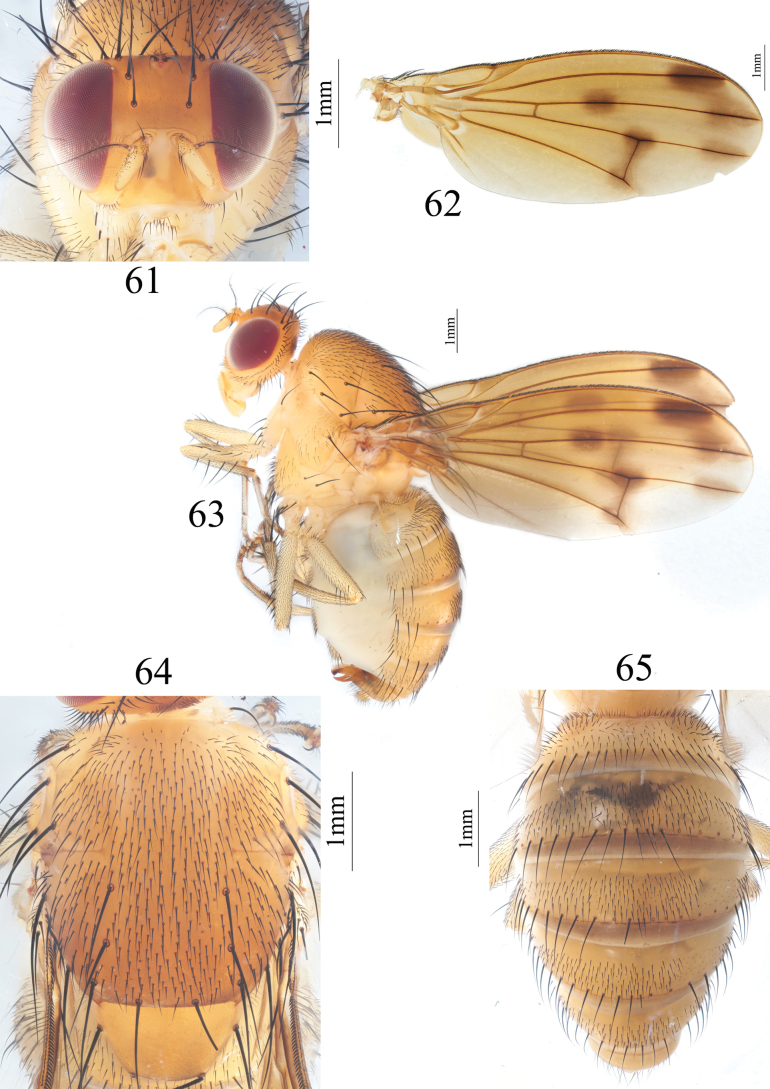 Figures 61–65
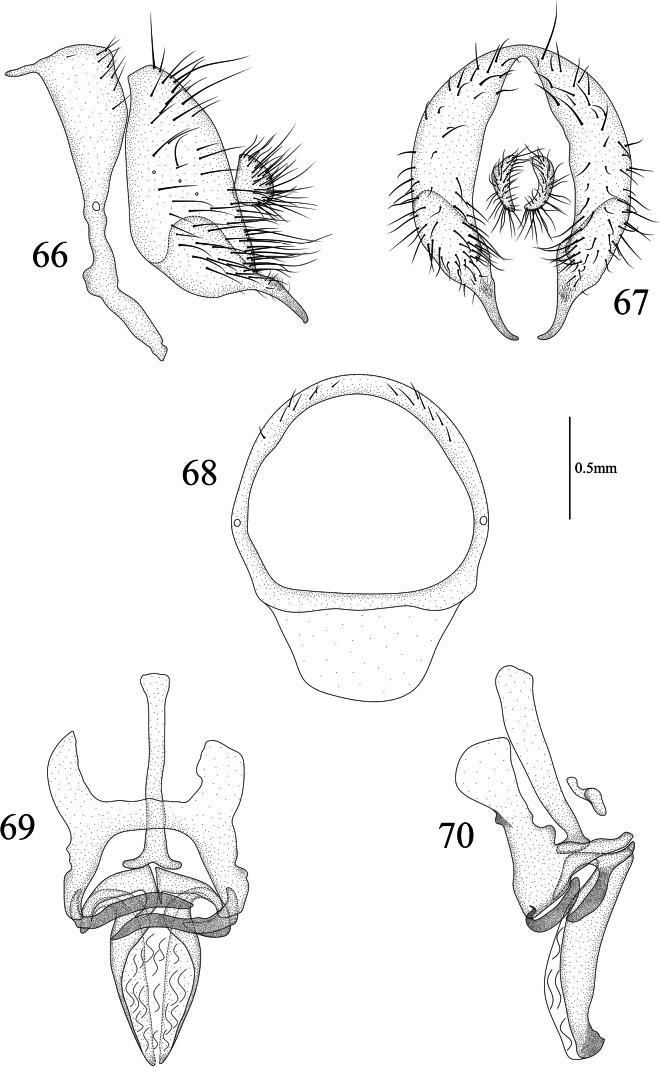 Figures 66–70
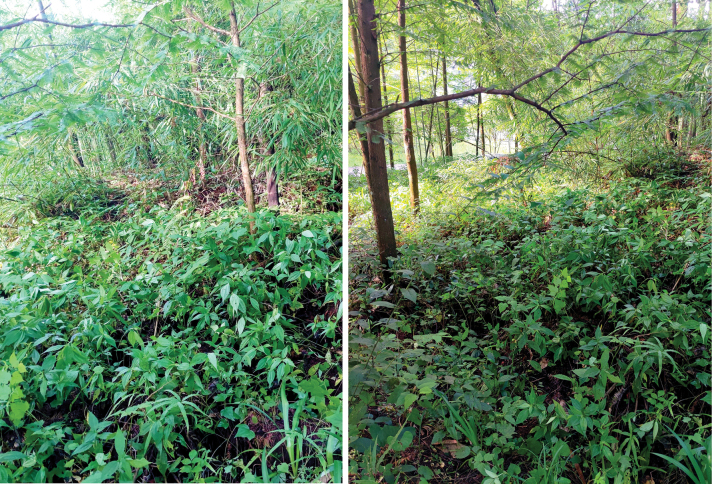 Figure 71
| 1 | Wing with brown spot at tip of Sc and R1 elongating along costal margin |
|
| – | Wing without brown spot at tip of Sc and R1 |
|
| 2 | Basal edge of brown apical spot on R2+3 behind vertical level as crossvein dm-cu; wing with brown spot at tip of Sc and R1 slightly elongating along costal margin; surstylus claviform with 3 long setulae, postgonite long coniform with 5 short setulae |
|
| – | Basal edge of brown apical spot on R2+3 at same vertical level as crossvein dm-cu; wing with brown spot at tip of Sc and R1, extending closely to brown apical spot on R2+3 along costal margin; surstylus without long setula, short claviform with a subapical concavity in posterior view; postgonite hook-like and sharp at apex |
|
| 3 | Basal edge of brown apical spot on R2+3 at same vertical level as crossvein dm-cu |
|
| – | Basal edge of brown apical spot on R2+3 behind vertical level as crossvein dm-cu |
|
| 4 | Palpus yellow except for black at tip; surstylus broad, sheet-like with short apical setulae in lateral view and curved apically in posterior view |
|
| – | Palpus entirely yellow; surstylus not as above |
|
| 5 | Mesonotum with acrostichal setulae in 6 irregular rows |
|
| – | Mesonotum with acrostichal setulae in 8–10 irregular rows |
|
| 6 | Arista with longest ray slightly < 1/2 height of first flagellomere; surstylus with a small triangular process with several setulae in lateral view |
|
| – | Arista with longest ray as long as height of first flagellomere; surstylus with a long digitiform process in lateral view and without subapical concavity |
|
| 7 | Mesonotum with acrostichal setulae in 8 irregular rows |
|
| – | Mesonotum with acrostichal setulae in 10 irregular rows |
|
| 8 | Wing with brown apical spots on R2+3, R4+5, and M1 entirely separated (Fig. |
|
| – | Wing with brown apical spots on R2+3, R4+5, and M1 confluent, or brown apical spots on R4+5 and M1 confluent, separated from apical spot on R2+3 |
|
| 9 | Subcostal cell hyaline (Fig. |
|
| – | Subcostal cell pale brown |
|
| 10 | Ultimate and penultimate sections of M1 in proportion of 1.2: 1 |
|
| – | Ultimate and penultimate sections of M1 in proportion of 1: 1 |
|
| 11 | Brown apical spots on R4+5 and M1 confluent, separated from apical spot on R2+3 |
|
| – | Brown apical spots on R2+3, R4+5, and M1 slightly confluent and forming pale brown connecting area between 3 apical spots |
|
| 12 | Abdominal tergites 2–5 without brown posterior margin; syntergosternite with 2 or 3 setulae around spiracle; surstylus consisting of wide knife-like process and triangular process in lateral view; postgonites symmetrical in ventral view |
|
| – | Abdominal tergites 2–5 each with brown posterior margin; syntergosternite without setula around spiracle; surstylus long and furcated in lateral view; postgonites asymmetrical in ventral view |
|
| 13 | Male tergites 2–5 each with blackish brown posterior margin (Fig. |
|
| – | Male tergites 2–5 each with brown posterior margin; ctenidium with 18–20 short setae on fore femur; surstylus not as above |
|
| 14 | Fore femur with 8 posterior dorsal setae, 6 posterior ventral setae; mid femur with 6 or 7 anterior setae; brown apical spots on R2+3 longer, at least 2/3 length of ultimate section of M1; brown median spot on R4+5 at middle point of distance between r-m and dm-cu |
|
| – | Fore femur with 9 posterior dorsal setae, 4 posterior ventral setae; mid femur with 5 anterior setae; brown apical spots on R2+3 shorter, as long as 1/2 length of ultimate section of M1 (Fig. |
|
| 15 | Basal edge of brown apical spot on R2+3 at same vertical level as apical spot on R4+5; apical spot on R4+5 close to brown spot on crossvein dm-cu or at least 2/3 length of ultimate section of M1 |
|
| – | Basal edge of brown apical spot on R4+5 behind vertical level as apical spot on R2+3; apical spot on R4+5 far from brown spot on crossvein dm-cu and < 2/3 length of ultimate section of M1 |
|
| 16 | Apical spot on R4+5 close to brown spot on crossvein dm-cu; ctenidium with 16 short setae on fore femur; surstylus apically acute in lateral view; pregonite absent; postgonite consisting of a furcated process and a subuliform process in ventral view |
|
| – | Apical spot on R4+5 ~ 2/3 length of ultimate section of M1, not close to brown spot on crossvein dm-cu; ctenidium with 12–14 short setae on fore femur; surstylus apically blunt in lateral view, pregonite with inverse U-shaped process and postgonite consisting a pair of subuliform processes in ventral view |
|
| 17 | Hypandrium with a short ventral process; pregonite with a pair of inverse U-shaped processes in ventral view; postgonite short and acute, but pregonite longer than postgonite in ventral view |
|
| – | Hypandrium with a long ventral process; shape of pregonite and postgonite not as above, but pregonite shorter than postgonite in ventral view |
|
| 18 | Phallus with a pair of lateral teeth subapically in ventral view; 2 arms of inverse U-shaped pregonite asymmetrical distinctly |
|
| – | Phallus without a pair of lateral teeth subapically in ventral view; 2 arms of inverse U-shaped pregonite almost symmetrical in length |
|
| 19 | Wing with brown string-like spot on R2+3 and apical spots on R4+5 and M1; epandrium slender and surstylus apically acute with a long seta in lateral view |
|
| – | Wing with round, elliptical or quadrate spot on R2+3, R4+5, and M1; epandrium and surstylus not as above |
|
| 20 | Wing with brown apical spots on R2+3, R4+5, and M1 entirely confluent, or slightly confluent and forming pale brown connecting area between apical spots on R2+3, R4+5, and M1 |
|
| – | Wing with brown apical spots on R4+5 and M1 confluent, separated from apical spot on R2+3, or apical spots on R2+3, R4+5, and M1 entirely separated |
|
| 21 | Brown medial spot on R4+5 separated from brown cloud on crossvein dm-cu |
|
| – | Brown medial spot on R4+5 confluent with brown cloud on crossvein dm-cu |
|
| 22 | Abdominal tergites 2–5 without blackish brown posterior margin; syntergosternite with long hairs around spiracle |
|
| – | Abdominal tergites 2–5 with blackish brown posterior margin; syntergosternite without long hair around spiracle |
|
| 23 | Mesonotum with acrostichal setulae in 8 irregular rows; fore femur with 3 posterior ventral setae; syntergosternite without ventral process; surstylus blunt apically; phallapodeme normal apically |
|
| – | Mesonotum with acrostichal setulae in 10 rows (Fig. |
|
| 24 | Mesonotum with acrostichal setulae in 8 irregular rows; fore femur with 10 posterior dorsal setae and ctenidium with 12 short setae; subcostal cell pale brown apically; surstylus with concavity apically in lateral view |
|
| – | Mesonotum with acrostichal setulae in 10 irregular rows (Fig. |
|
| 25 | Fore femur with 4 posteroventral setae; syntergosternite circular |
|
| – | Fore femur with 6 posteroventral setae; syntergosternite semicircular |
|
| 26 | Abdominal tergites 2–5 without blackish brown posterior margin; surstylus indistinct, blunt apically; hypandrium Y-shaped; phallus without triangular median process in ventral view |
|
| – | Abdominal tergites 2–5 with blackish brown posterior margin; surstylus distinctly digitiform in lateral view; hypandrium H-shaped; phallus with a pair of triangular median process in ventral view |
|
| 27 | Wing with brown apical spot on R4+5 and M1 slightly confluent and forming pale brown connecting area between 2 apical spots; apical spot on R2+3 distinctly separated from apical spot on R4+5 |
|
| – | Wing with brown apical spots on R2+3, R4+5, and M1 entirely separated |
|
| 28 | Mesonotum with acrostichal setulae in 10 rows |
|
| – | Mesonotum with acrostichal setulae in 6–8 rows |
|
| 29 | Subcostal cell hyaline |
|
| – | Subcostal cell pale brown or brown apically |
|
| 30 | Surstylus bulged claviform, with long setulae in lateral view; abdominal tergites 2–5 with pale brown posterior margin; arista with longest ray as long as height of first flagellomere; ctenidium with 16 or 17 short setae on fore femur; hypandrium Y-shaped |
|
| – | Surstylus T-shaped and rounded apically in lateral view; abdominal tergites 2–5 without pale brown posterior margin; arista with longest ray shorter than height of first flagellomere; ctenidium with 10 short setae on fore femur; hypandrium H-shaped |
|
| 31 | Mesoscutum with 1 square or oval brown spot before scutoscutellar suture, scutellum with 1 square brown spot at middle; fore femur with 7 or 8 posterior dorsal setae, ctenidium with 22 short setae; surstylus long and spine-like in lateral view, without inner process |
|
| – | Mesoscutum without spot before scutoscutellar suture, scutellum without brown spot; fore femur with 5 posterior dorsal setae, ctenidium with 12 short setae; surstylus with 1 short, claviform inner process in lateral view |
|
| 32 | Abdomen yellow or pale brown, at least tergites 2–5 with black or brown posterior margin |
|
| – | Abdomen yellow, tergites 1–6 without brown posterior margin |
|
| 33 | Abdomen pale brown; surstylus straight and claviform in lateral view |
|
| – | Abdomen yellow; surstylus subuliform in lateral view |
|
| 34 | Arista with longest ray as long as 1/2 height of first flagellomere; ultimate section of CuA1 ~ 1/9 of penultimate; hypandrium inverse U-shaped; postgonite short, with 2 teeth-like processes in lateral view; phallus curved backwards apically and acute at apex in lateral view |
|
| – | Arista with longest ray as long as height of first flagellomere (Fig. |
|
| 35 | Mid femur with 5 or 6 anterior setae |
|
| – | Mid femur with 4 anterior setae |
|
| 36 | Mesonotum with acrostichal setulae in 6 rows |
|
| – | Mesonotum with acrostichal setulae in 8 rows |
|
| 37 | Arista with longest ray as long as 4/5 height of first flagellomere; surstylus long and curved at apex in lateral view |
|
| – | Arista with longest ray slightly shorter than height of first flagellomere; surstylus short and narrow in lateral view |
|
| 38 | Fore femur with 6 posterior dorsal setae, 2 posterior ventral setae and ctenidium with 12 short setae; surstylus consisting of a small acute apical process, directed downward and a slender knife-like process with dense setulae on dorsal margin in lateral view |
|
| – | Fore femur with 8 posterior dorsal setae, 4 posterior ventral setae and ctenidium with 15–17 short setae; surstylus claviform in lateral view |
|
| 39 | Wing with a brown spot between r-m and apical spot on R4+5 distinctly or slightly confluent with brown spot on crossvein dm-cu; surstylus claviform or digitiform |
|
| – | Wing with a brown quadrate spot between r-m and apical spot on R4+5 separated from brown spot on crossvein dm-cu; surstylus not as above |
|
| 40 | Ctenidium with 15 short setae on fore femur; surstylus absent; pregonite short, broad, and acute apically in ventral view; postgonite consisting of a furcated process and a subuliform process in ventral view |
|
| – | Ctenidium with 13 short setae on fore femur; surstylus digitiform with long setulae in lateral view; pregonite and postgonite furcated apically, pregonite shorter than postgonite in ventral view |
|
| 41 | Fore femur with 3 posteroventral setae; epandrium blunt triangular apically; surstylus separated from epandrium and originated from anterior ventral corner of epandrium, with dense tiny setulae on apical 2/3 |
|
| – | Fore femur with 4 posteroventral setae; epandrium and surstylus fused, blunt round apically |
|
| 42 | Ctenidium with 17–19 short setae on fore femur |
|
| – | Ctenidium with 10–16 short setae on fore femur |
|
| 43 | The first flagellomere ~ 1.8 × longer than high; surstylus narrow and columnar in lateral view and broad with tiny setulae in posterior view; postgonites triangular with sharp apex in lateral view |
|
| – | The first flagellomere ~ 2.3 × longer than high; surstylus light color and narrow at base while dark yellow and broad at apex, nearly trapeziform with 2 long setulae in lateral view; postgonite hook-like in lateral view |
|
| 44 | Pregonite and postgonite subuliform in ventral view or short and triangular in lateral view |
|
| – | Pregonite and postgonite not as above |
|
| 45 | Surstylus without acute or triangular process, blunt and rounded apically and slightly rolled up with several setulae in lateral view |
|
| – | Surstylus with acute or triangular process, not as above in lateral view |
|
| 46 | Surstylus very broad ball-like with a triangular process apically in lateral view; hypandrium H-shaped; phallus acute subapically in lateral view |
|
| – | Surstylus narrow, acute apically in lateral view; hypandrium Y-shaped; phallus blunt and subapically rounded in lateral view |
|
| 47 | Subcostal cell hyaline or pale yellow apically |
|
| – | Subcostal cell dark apically |
|
| 48 | Mesonotum with acrostichal setulae in 6 regular rows; surstylus curved and knife-like in lateral view; postgonite absent |
|
| – | Mesonotum with acrostichal setulae in 10 irregular rows; surstylus not as above |
|
| 49 | Basal edge of brown apical spot on R4+5 at same vertical level as apical spot on M1; surstylus consisting of a slender knife-shaped process and a furcated process with several setulae on subapical and apical margin and a small tooth on lateral margin in lateral view |
|
| – | Basal edge of brown apical spot on R4+5 behind vertical level as apical spot on M1; surstylus short and broad, with a row of long apical setulae |
|
| 50 | Syntergosternite elliptic without sternal part flat; surstylus broad and slightly curved apically in lateral view |
|
| – | Syntergosternite circular, but with sternal part flat; surstylus not as above |
|
| 51 | Mesonotum with acrostichal setulae in 8 rows |
|
| – | Mesonotum with acrostichal setulae in 10 irregular rows |
|
| 52 | A brown elliptical spot present between r-m and apical spot on R4+5; mid femur with 6–8 anterior setae; surstylus curved knife-like, acute apically in lateral view; postgonite longer than phallus, elongate subuliform, curved forwards apically in lateral view |
|
| – | A brown square spot present between r-m and apical spot on R4+5; mid femur with 4 anterior setae; surstylus short, triangular, and acute apically, with several long setae on dorsal margin and a row of short setulae on ventral margin in lateral view; both pregonite and postgonite shorter subuliform, ~ ½ length of phallus in ventral view |
|
Peer Reviews
No public reviews on file for this paper yet. If you reviewed it on a platform where reviews are public (OpenReview, ICLR, NeurIPS, ICML), you can paste yours below so the community can read it here.
Videos
No videos yet. Explain this paper in a talk, walkthrough, or lecture? Add one.
Taxonomy
TopicsDiptera species taxonomy and behavior · Insect behavior and control techniques · Forensic Entomology and Diptera Studies
Introduction
The Lauxaniid fauna in southwestern China is relatively well-known, but new species are continuously discovered in the humid parts and especially in southern Yunnan and southwestern Guizhou, where significantly higher species richness and endemism are found (Gao and Yang 2002, 2005; Shi et al. 2009, 2017a, 2020; Li and Yang 2012, 2013, 2015; Shi and Yang 2015; Li et al. 2019, 2020a, 2020b, 2020c, 2020d, 2020e, 2020f, 2021a, 2021b, 2023; Zhao et al. 2022). Compared to these areas, research on the diversity of lauxaniid flies in Chongqing is relatively weak, and currently only nine species in five genera are known; four Homoneura species were described more recently by You et al. (2023) from Yintiaoling Nature Reserve, Chongqing, China.
Jiangjin District is located in southwestern Chongqing, adjacent to Guizhou Province to the southeast and Sichuan Province to the west and southwest. The geographical coordinates are between 105°49'–106°38' east longitude and 28°28'–29°28' north latitude. It has a subtropical humid monsoon climate, with a mild climate and abundant precipitation, high vegetation abundance and rich humus and fungi, providing a good environment for the habitat and reproduction of many organisms.
Homoneura (Homoneura) Malloch, 1927 is the largest subgenus of genus Homoneura Wulp, 1891 with more than 700 species distributed worldwide. The Chinese fauna of H. (Homoneura) is richly represented with more than 220 species, which are sorted into 21 species groups based on external characters and male genitalia morphology (Shi and Yang 2014). Seven new species described in this paper are assigned to the henanensis group of the subgenus Homoneura Malloch by the the wing having five brown spots, which are respectively located between the r-m and apical spot on R_4+5_, crossvein dm-cu and the tips of R_2+3_, R_4+5_, and M_1_.
At present, there are 46 known species of henanensis group in China (Kertész 1915; Matsumura 1916; Malloch 1926; Yang et al. 1999, 2001, 2003; Gao and Yang 2002, 2003, 2004, 2005; Wang et al. 2012; Papp and Gaimari 2013; Shi and Yang 2014; Shi et al. 2017b; Gao and Shi 2019; Chen and Li 2022; You et al. 2023). Seven new species were found among recently collected specimens from Jiangjin District, Chongqing in southwestern China. In present paper, the descriptions and illustrations of male genitalia of these new species are provided, increasing the number of species of the Homoneurahenanensis group to 53 species in China, with 11 in Chongqing.
Materials and methods
General terminology follows Cumming and Wood (2017) and Gaimari and Miller (2021). Genitalia preparations were made by removing and macerating the apical portion of the abdomen in pancreatin for six hours (Álvarez-Padilla and Hormiga 2007), then rinsing them with distilled water for dissection and study. After examination in glycerin, they were transferred to fresh glycerin and stored in a microvial pinned below the specimen. Specimens examined were deposited in the Henan University of Science and Technology, Luoyang, Henan, China (HAUST).
Taxonomy
Key to species of Homoneura (Homoneura) henanensis group in China (modified from Gao and Shi 2019; You et al. 2023)
**: **
Species descriptions
Homoneura (Homoneura) biconica
Taxon classificationAnimaliaDipteraLauxaniidae
Chen & Li sp. nov.
34DDBAE2-60AA-5998-B41B-DAA5F5E28D1E
https://zoobank.org/FA24E555-3C34-4BC7-8DBA-8C8BCA604CC2
Figs 1–5 , 6–10 Chinese name: 双锥同脉缟蝇
Type material.
Holotype: ♂, China, Chongqing City, Jiangjin District, Simianshan Natural Reserve, Zhengqiangou, 28°36'59.54"N, 106°26'25.88"E, 1273 m, 14.VI.2022, leg. Xulong Chen. Paratypes: 6♂♂, same data as holotype; 1♂, China, Chongqing City, Jiangjin District, Simianshan Natural Reserve, Dahonghai, 28°35'34.27"N, 106°26'34.93"E, 1144 m, 15.VII.2022, leg. Xulong Chen.
Etymology.
The specific name comes from the combination of the prefix bi- (meaning two) and the Latin word, conica (meaning cone-shaped), referring to the surstylus consisting of two subuliform processes in lateral view.
Diagnosis.
Mesonotum with acrostichal setulae in ten irregular rows. Basal margin of brown apical spot on R_2+3_ behind vertical level as crossvein dm-cu; brown apical spots on R_2+3_, R_4+5_, and M_1_ slightly confluent; subcostal cell hyaline. Male tergites 2–5 with blackish brown posterior margin. Surstylus consisting of two subuliform processes in lateral view. Pregonite and postgonite inwardly curved, pregonite with one long setula. Phallus long and knife-like with an acute subapical tooth in lateral view.
Description.
Male. Body length 8.4–8.6 mm, wing length 8.3–8.4 mm.
Head (Fig. 1) yellow. Frons as long as wide and parallel-sided; ocellar triangle yellow, ocellar seta developed, longer than anterior fronto-orbital seta, anterior fronto-orbital seta shorter than posterior fronto-orbital seta. Gena ~ 1/7 height of eye. Antenna yellow, first flagellomere ~ 2.0 × longer than high; arista black except pale brown at base, long plumose, with longest ray as long as height of first flagellomere. Proboscis and palpus yellow.
Homoneura (Homoneura) biconica sp. nov. male 1 head, anterior view 2 wing 3 habitus, lateral view 4 thorax, dorsal view 5 abdomen, dorsal view.
Thorax (Fig. 4) yellow, with gray pruinosity. 0+3 dorsocentral setae, anteriormost postsutural dorsocentral seta far from scutal suture, acrostichal setulae in ten irregular rows. Legs yellow. Fore femur with eight posterior dorsal setae, five posterior ventral setae and ctenidium with 16 short setae; fore tibia with one dorsal preapical seta and one short apical ventral seta. Mid femur with five or six anterior setae and one apical posterior seta; mid tibia with one dorsal preapical seta and three strong apical ventral setae. Hind femur with several weak anterior ventral setae and one preapical anterior dorsal seta; hind tibia with one weak dorsal preapical seta and one short apical ventral seta. Wing (Fig. 2) slightly yellow, basal margin of brown apical spot on R_2+3_ behind vertical level as crossvein dm-cu; brown apical spots on R_2+3_, R_4+5_, and M_1_ slightly confluent and forming pale brown connecting area between apical spots on R_2+3_, R_4+5_, and M_1_; brown median spot on R_4+5_ separated from brown cloud-like spot on crossvein dm-cu; subcostal cell hyaline; eight short hairs present at base of R_4+5_; costa with 2^nd^ (between R_1_ and R_2+3_), 3^rd^ (between R_2+3_ and R_4+5_), and 4^th^ (between R_4+5_ and M_1_) sections in proportion of 4: 1: 0.8; r-m before middle of discal cell; ultimate and penultimate sections of M_1_ in proportion of 3.5: 3.3; ultimate section of CuA_1_ ~ 1/8 of penultimate. Haltere yellow.
Abdomen (Fig. 5) yellow, tergites 2–5 with blackish brown posterior margin. Male genitalia (Figs 6–10): syntergosternite circular, with a triangular ventral process and with several dorsal setulae. Epandrium broad in lateral view; surstylus consisting of a longer subuliform process and a shorter subuliform process in lateral view. Hypandrium H-shaped. Pregonite and postgonite curved inwards, pregonite with one long setula. Phallus long, knife-like, and with an acute subapical tooth in lateral view. Phallapodeme shorter than phallus.
Homoneura (Homoneura) biconica sp. nov. male 6 syntergosternite and epandrium, lateral view 7 epandrial complex, posterior view 8 syntergosternite, anterior view 9 phallic complex, ventral view 10 phallic complex, lateral view. Scale bar: 0.5 mm.
Female. Unknown.
Distribution.
China (Chongqing).
Remarks.
The new species resembles Homoneura (Homoneura) apiconcava in the habitus and abdominal tergites 2–5 with blackish brown posterior margin [see You et al. 2023: figs 3, 5], but it can be distinguished from the latter by the following: mesonotum with acrostichal setulae in ten irregular rows; fore femur with eight posterior dorsal setae and ctenidium with 16 short setae; subcostal cell hyaline; surstylus consisting of a longer subuliform process and a shorter subuliform process in lateral view. In H. (H.) apiconcava, mesonotum with acrostichal setulae in eight irregular rows; fore femur with ten posterior dorsal setae and ctenidium with 12 short setae; subcostal cell pale brown apically; surstylus with concavity apically in lateral view [see You et al. 2023: figs 2–6].
Homoneura (Homoneura) dilatata
Taxon classificationAnimaliaDipteraLauxaniidae
Chen & Li sp. nov.
1C2CEA6C-B3C9-5EAC-8318-081463A94673
https://zoobank.org/8E80C793-E526-48DD-B79B-88B1DF3D89BF
Figs 11–15 , 16–20 Chinese name: 膨突同脉缟蝇
Type material.
Holotype: ♂, China, Chongqing City, Jiangjin District, Simianshan Natural Reserve, Zhengqiangou, 28°36'59.54"N, 106°26'25.88"E, 1273 m, 14.VI.2022, leg. Xulong Chen. Paratypes: 1♂, China, Chongqing City, Jiangjin District, Simianshan Natural Reserve, Dawopu, 28°34'11.28"N, 106°20'26.96"E, 1007 m, 6.IX.2022, leg. Xulong Chen.
Etymology.
The specific name refers to the phallapodeme expanded apically in lateral view.
Diagnosis.
Mesonotum with acrostichal setulae in ten irregular rows. Basal margin of brown apical spot on R_2+3_ behind vertical level as crossvein dm-cu; brown apical spots on R_2+3_, R_4+5_, and M_1_ slightly confluent. Syntergosternite with a setula around spiracle. Surstylus furcated into two short, curved processes in lateral view. Hypandrium with one short subuliform ventral process. Phallapodeme expanded apically in lateral view.
Description.
Male. Body length 7.7–8.1 mm, wing length 7.9–8.0 mm.
Head (Fig. 11) yellow. Frons as long as wide and parallel-sided; ocellar triangle yellow, ocellar seta developed, as long as anterior fronto-orbital seta, anterior fronto-orbital seta shorter than posterior fronto-orbital seta. Gena ~ 1/8 height of eye. Antenna yellow, first flagellomere ~ 2.0 × longer than high; arista black except pale brown at base, long plumose, with longest ray as long as height of first flagellomere. Proboscis and palpus yellow.
Homoneura (Homoneura) dilatata sp. nov. male 11 head, anterior view 12 wing 13 habitus, lateral view 14 thorax, dorsal view 15 abdomen, dorsal view.
Thorax (Fig. 14) yellow, with gray pruinosity. 0+3 dorsocentral setae, anteriormost postsutural dorsocentral seta far from scutal suture, acrostichal setulae in ten irregular rows. Legs pale yellow. Fore femur with nine posterior dorsal setae, five posterior ventral setae and ctenidium with 16 short setae; fore tibia with one dorsal preapical seta and one short apical ventral seta. Mid femur with five anterior setae and one apical posterior seta; mid tibia with one dorsal preapical seta and three strong apical ventral setae. Hind femur with several weak anterior ventral setae and one preapical anterior dorsal seta; hind tibia with one weak dorsal preapical seta and one short apical ventral seta. Wing (Fig. 12) slightly yellow, basal margin of brown apical spot on R_2+3_ behind vertical level as crossvein dm-cu; brown apical spots on R_2+3_, R_4+5_, and M_1_ slightly confluent and forming pale brown connecting area between apical spots on R_2+3_, R_4+5_, and M_1_; brown median spot on R_4+5_ separated from brown cloud-like spot on crossvein dm-cu; subcostal cell pale brown apically; three short hairs present at base of R_4+5_; costa with 2^nd^ (between R_1_ and R_2+3_), 3^rd^ (between R_2+3_ and R_4+5_), and 4^th^ (between R_4+5_ and M_1_) sections in proportion of 10.5: 2.7: 2.2; r-m before middle of discal cell; ultimate and penultimate sections of M_1_ in proportion of 1: 1; ultimate section of CuA_1_ ~ 1/6 of penultimate. Haltere yellow.
Abdomen (Fig. 15) yellow. Male genitalia (Figs 16–20): syntergosternite circular with a trapeziform ventral process, with several dorsal setulae and a setula around spiracle. Epandrium broad in lateral view; surstylus hairy, furcated into two short, curved processes in lateral view. Hypandrium H-shaped, with one short subuliform ventral process. Pregonite V-shaped in ventral view, acute apically, postgonite curved, claviform. Phallus with one small, curved hook in lateral view. Phallapodeme expanded apically in lateral view, slightly shorter than phallus.
Homoneura (Homoneura) dilatata sp. nov. male 16 syntergosternite and epandrium, lateral view 17 epandrial complex, posterior view 18 syntergosternite, anterior view 19 phallic complex, ventral view 20 phallic complex, lateral view. Scale bar: 0.5 mm.
Female. Unknown.
Distribution.
China (Chongqing).
Remarks.
The new species resembles Homoneura (Homoneura) martini in brown apical spots on R_2+3_, R_4+5_, and M_1_ slightly confluent, abdominal tergites 2–5 without blackish brown posterior margin and syntergosternite with long hairs around spiracle [see Shi et al. 2017b: figs 10, 13, 14, 16], but it can be distinguished from the latter by the following: mesonotum with acrostichal setulae in ten rows; fore femur with five posterior ventral setae; syntergosternite with a trapeziform ventral process; surstylus furcated into two short, curved processes in lateral view; phallapodeme expanded apically. In H. (H.) martini, mesonotum with acrostichal setulae in eight irregular rows; fore femur with three posterior ventral setae; syntergosternite without ventral process; surstylus blunt apically; phallapodeme normal apically [see Shi et al. 2017b: figs 12, 16, 17, 19].
Homoneura (Homoneura) jiangjinensis
Taxon classificationAnimaliaDipteraLauxaniidae
Chen & Li sp. nov.
042E9CAA-6B98-5C5D-A99D-93A124A7474D
https://zoobank.org/5EEEC111-1B29-44FD-89EC-8F7616B7D0D1
Figs 21–25 , 26–30 Chinese name: 江津同脉缟蝇
Type material.
Holotype: ♂, China, Chongqing City, Jiangjin District, Simianshan Natural Reserve, Zhengqiangou, 28°36'59.54"N, 106°26'25.88"E, 1273 m, 14.VI.2022, leg. Xulong Chen. Paratypes: 1♂, same data as holotype.
Etymology.
The specific name refers to the type locality Jiangjin District.
Diagnosis.
Basal margin of brown apical spot on R_2+3_ at same vertical level as crossvein dm-cu; brown apical spots on R_2+3_, R_4+5_, and M_1_ entirely separated. Syntergosternite with several setulae above right spiracle, ventral process with several hairs at middle. Surstylus consisting of a long spinous process and a hairy blunt process in lateral view. Hypandrium with a pair of tooth-like ventral processes at middle. Pregonite consisting of a short spinous process and a long curved spinous process, postgonite curved and spine-like in lateral view. Phallus with a subapical tooth in lateral view.
Description.
Male. Body length 7.0–7.1 mm, wing length 6.9 mm.
Head (Fig. 21) yellow. Frons as long as wide and parallel-sided; ocellar triangle yellow, ocellar seta developed, longer than anterior fronto-orbital seta, anterior fronto-orbital seta shorter than posterior fronto-orbital seta. Gena ~ 1/8 height of eye. Antenna yellow, first flagellomere ~ 2.0 × longer than high; arista black except yellow at base, long plumose, with longest ray as long as height of first flagellomere. Proboscis and palpus yellow.
Homoneura (Homoneura) jiangjinensis sp. nov. male 21 head, anterior view 22 wing 23 habitus, lateral view 24 thorax, dorsal view 25 abdomen, dorsal view.
Thorax (Fig. 24) yellow, with gray pruinosity. 0+3 dorsocentral setae, anteriormost postsutural dorsocentral seta far from scutal suture, acrostichal setulae in ten irregular rows. Legs yellow. Fore femur with ten posterior dorsal setae, five or six posterior ventral setae and ctenidium with 16 short setae; fore tibia with one dorsal preapical seta and one short apical ventral seta. Mid femur with five anterior setae and one apical posterior seta; mid tibia with one dorsal preapical seta and three strong apical ventral setae. Hind femur with several weak anterior ventral setae and one preapical anterior dorsal seta; hind tibia with one weak dorsal preapical seta and one short apical ventral seta. Wing (Fig. 22) slightly yellow, basal margin of brown apical spot on R_2+3_ at same vertical level as crossvein dm-cu; brown apical spots on R_2+3_, R_4+5_, and M_1_ entirely separated; brown median spot on R_4+5_ separated from brown cloud-like spot on crossvein dm-cu; subcostal cell pale brown apically; costa with 2^nd^ (between R_1_ and R_2+3_), 3^rd^ (between R_2+3_ and R_4+5_), and 4^th^ (between R_4+5_ and M_1_) sections in proportion of 4: 1.2: 0.8; r-m before middle of discal cell; ultimate and penultimate sections of M_1_ in proportion of 1.1: 1; ultimate section of CuA_1_ ~ 1/7 of penultimate. Haltere yellow.
Abdomen (Fig. 25) yellow. Male genitalia (Figs 26–30): syntergosternite circular with a trapeziform ventral process, with several dorsal setulae and several setulae above right spiracle, ventral process with several hairs at middle. Epandrium broad in lateral view; surstylus consisting of a long spinous process and a blunt and hairy process in lateral view. Hypandrium H-shaped, with a pair of tooth-like ventral processes at middle. Pregonite consisting of a short spinous process and a long curved spinous process, postgonite curved and spine-like in lateral view. Phallus curved backwards, with a subapical tooth in lateral view. Phallapodeme shorter than phallus.
Homoneura (Homoneura) jiangjinensis sp. nov. male 26 syntergosternite and epandrium, lateral view 27 epandrial complex, posterior view 28 syntergosternite, anterior view 29 phallic complex, ventral view 30 phallic complex, lateral view. Scale bar: 0.5 mm.
Female. Unknown.
Distribution.
China (Chongqing).
Remarks.
The new species resembles Homoneura (Homoneura) caoi in the habitus, mesonotum with acrostichal setulae in ten irregular rows and brown apical spots on R_2+3_, R_4+5_, and M_1_ entirely separated [see Wang et al. 2012: figs 12, 14, 15], but it can be distinguished from the latter by the following: fore femur with ten posterior dorsal setae and ctenidium with 16 short setae; subcostal cell pale brown apically; abdominal tergites 2–5 without brown posterior margin; syntergosternite with several setulae above right spiracle; surstylus consisting of a long spinous process and a blunt hairy process in lateral view; hypandrium with a pair of tooth-like ventral processes at middle; pregonite consisting of a short spinous process and a long curved spinous process, postgonite curved and spine-like in lateral view. In H. (H.) caoi, fore femur with seven or eight posterior dorsal setae and ctenidium with 12 or 13 short setae; subcostal cell hyaline; abdominal tergites 2–5 with brown posterior margin; syntergosternite without setula around spiracle; surstylus trifurcated; gonopod with three inwardly curved arc-shaped processes [see Wang et al. 2012: figs 12, 15, 16, 19, 20, 21].
Homoneura (Homoneura) microtricha
Taxon classificationAnimaliaDipteraLauxaniidae
Chen & Li sp. nov.
4C5ED6FF-7976-5993-92EF-9B637FE70D26
https://zoobank.org/3070733C-4EF9-48F9-BBC2-45424FC52630
Figs 31–35 , 36–40 Chinese name: 微毛同脉缟蝇
Type material.
Holotype: ♂, China, Chongqing City, Jiangjin District, Simianshan Natural Reserve, Zhengqiangou, 28°36'59.54"N, 106°26'25.88"E, 1273 m, 15.VI.2022, leg. Xulong Chen. Paratypes: 43♂♂6♀♀, China, Chongqing City, Jiangjin District, Simianshan Natural Reserve, Zhengqiangou, 28°36'59.54"N, 106°26'25.88"E, 1273 m, 14.VI.2022, leg. Xulong Chen; 1♂, China, Chongqing City, Jiangjin District, Simianshan Natural Reserve, Zhengqiangou, 28°36'59.54"N, 106°26'25.88"E, 1273 m, 26.VI.2022, leg. Pengyan You; 3♂♂8♀♀, China, Chongqing City, Jiangjin District, Simianshan Natural Reserve, Dahonghai, 28°35'34.27"N, 106°26'34.93"E, 1144 m, 15.VII.2022, leg. Xulong Chen; 5♂♂, China, Chongqing City, Jiangjin District, Simianshan Natural Reserve, Mohuayan, 28°35'15.67"N, 106°22'7.36"E, 1017 m, 14.VII.2022, leg. Xulong Chen; 2♂♂1♀, China, Chongqing City, Jiangjin District, Simianshan Natural Reserve, Zhenzhutan, 28°35'50.74"N, 106°25'25.70"E, 1226 m, 15.VII.2022, leg. Xulong Chen; 2♂♂2♀♀, China, Chongqing City, Jiangjin District, Simianshan Natural Reserve, Tudiyan, 28°37'24.45"N, 106°24'6.69"E, 1126 m, 15.VII.2022, leg. Xulong Chen; 1♂2♀♀, China, Chongqing City, Jiangjin District, Simianshan Natural Reserve, Chaoyuanguan, 28°38'53.38"N, 106°20'23.84"E, 920 m, 14. VII.2022, leg. Xulong Chen; 1♂, China, Chongqing City, Jiangjin District, Taihe Management and Protection Station, Heishenmiao, 28°48'9.21"N, 106°15'46.04"E, 836 m, 14.VII.2022, leg. Xulong Chen; 1♂, China, Chongqing City, Jiangjin District, Dayuandong National Forest Park, Kongzimiao, 28°53'9.68"N, 106°15'24.28"E, 709m, 12.VII.2022, leg. Xulong Chen; 1♂1♀, China, Chongqing City, Jiangjin District, Dayuandong National Forest Park, Shuijingwan, 28°53'10.96"N, 106°14'19.32"E, 717 m, 13.VII.2022, leg. Xulong Chen; 2♂♂1♀, China, Chongqing City, Jiangjin District, Dayuandong National Forest Park, Tian’ehu, 28°52'54.45"N, 106°15'14.53"E, 728 m, 13.VII.2022, leg. Xulong Chen; 4♂♂12♀♀, China, Chongqing City, Jiangjin District, Dayuandong National Forest Park, Diaojiaolou, 28°53'5.89"N, 106°15'42.18"E, 731 m, 13.VII.2022, leg. Xulong Chen.
Etymology.
The specific name comes from the combination of the prefix micro- (meaning small) and the Latin word, tricha (meaning hair), referring to the surstylus covered by small hairs.
Diagnosis.
Mesonotum with acrostichal setulae in eight irregular rows. Brown apical spots on R_4+5_ and M_1_ slightly confluent, separated from apical spot on R_2+3_; brown median spot on R_4+5_ slightly fused with brown cloud-like spot on crossvein dm-cu. Surstylus subuliform in lateral view. Pregonite knife-like in ventral view, connected with postgonite; postgonite long and spine-like in lateral view. Phallus with two pairs of subapical teeth in lateral view.
Description.
Male. Body length 5.8–6.3 mm, wing length 5.6–6.1 mm.
Head (Fig. 31) yellow. Frons as long as wide and parallel-sided; ocellar triangle yellow, ocellar seta developed, longer than anterior fronto-orbital seta, anterior fronto-orbital seta shorter than posterior fronto-orbital seta. Gena ~ 1/8 height of eye. Antenna yellow, first flagellomere ~ 2.0 × longer than high; arista black except yellow at base, long plumose, with longest ray slightly shorter than height of first flagellomere. Proboscis pale yellow, palpus yellow.
Homoneura (Homoneura) microtricha sp. nov. male 31 head, anterior view 32 wing 33 habitus, lateral view 34 thorax, dorsal view 35 abdomen, dorsal view.
Thorax (Fig. 34) yellow, with gray pruinosity. 0+3 dorsocentral setae, anteriormost postsutural dorsocentral seta far from scutal suture, acrostichal setulae in eight irregular rows. Legs yellow. Fore femur with seven posterior dorsal setae, four posterior ventral setae, and ctenidium with 14 or 15 short setae; fore tibia with one dorsal preapical seta and one short apical ventral seta. Mid femur with four or five anterior setae and one apical posterior seta; mid tibia with one dorsal preapical seta and three strong apical ventral setae. Hind femur with one preapical anterior dorsal seta; hind tibia with one weak dorsal preapical seta and one short apical ventral seta. Wing (Fig. 32) slightly yellow, basal margin of brown apical spot on R_2+3_ behind vertical level as crossvein dm-cu; brown apical spots on R_4+5_ and M_1_ slightly confluent, separated from apical spot on R_2+3_; brown median spot on R_4+5_ slightly fused with brown cloud-like spot on crossvein dm-cu; subcostal cell pale brown apically; costa with 2^nd^ (between R_1_ and R_2+3_), 3^rd^ (between R_2+3_ and R_4+5_), and 4^th^ (between R_4+5_ and M_1_) sections in proportion of 9.7: 2.7: 2; r-m before middle of discal cell; ultimate and penultimate sections of M_1_ in proportion of 3: 2.3; ultimate section of CuA_1_ ~ 1/5 of penultimate. Haltere pale brown.
Abdomen (Fig. 35) yellow, tergites 2–5 with pale brown posterior margin. Male genitalia (Figs 36–40): syntergosternite circular, with a trapeziform ventral process and with several dorsal setulae. Epandrium broad in lateral view; surstylus hairy, subuliform in lateral view. Hypandrium H-shaped. Pregonite knife-like in ventral view, connected with postgonite; postgonite long and spine-like in lateral view. Phallus with two pairs of subapical teeth in lateral view. Phallapodeme as long as phallus.
Homoneura (Homoneura) microtricha sp. nov. male 36 syntergosternite and epandrium, lateral view 37 epandrial complex, posterior view 38 syntergosternite, anterior view 39 phallic complex, ventral view 40 phallic complex, lateral view. Scale bar: 0.1 mm.
Female. Body length 5.9–6.3 mm, wing length 6.0–6.2 mm.
Distribution.
China (Chongqing).
Remarks.
The new species resembles Homoneura (Homoneura) longiacutata in the habitus and surstylus that is subuliform in lateral view [see Gao and Shi 2019: figs 35, 41–42], but it can be distinguished from the latter by the following: arista with longest ray as long as height of first flagellomere; ultimate section of CuA_1_ ~ 1/5 of penultimate; hypandrium H-shaped; postgonite long and spine-like in lateral view; phallus not curved backwards apically, without acute tip in lateral view. In H. (H.) longiacutata, arista with longest ray as long as 1/2 height of first flagellomere; ultimate section of CuA_1_ ~ 1/9 of penultimate; hypandrium inverse U-shaped; postgonite short, with two teeth-like processes in lateral view; phallus curved backwards apically and acute at apex in lateral view [see Gao and Shi 2019: figs 36, 40, 44, 45].
Homoneura (Homoneura) multiseta
Taxon classificationAnimaliaDipteraLauxaniidae
Chen & Li sp. nov.
0D544508-1404-5E1A-9B27-053413A84C85
https://zoobank.org/8749E02C-8EC1-4C65-93E8-6478A74D82D4
Figs 41–45 , 46–50 Chinese name: 多鬃同脉缟蝇
Type material.
Holotype: ♂, China, Chongqing City, Jiangjin District, Simianshan Natural Reserve, Dahonghai, 28°35'34.27"N, 106°26'34.93"E, 1144 m, 15.VII.2022, leg. Xulong Chen. Paratypes: 1♂, China, Chongqing City, Jiangjin District, Simianshan Natural Reserve, Zhengqiangou, 28°36'59.54"N, 106°26'25.88"E, 1273 m, 14.VI.2022, leg. Xulong Chen.
Etymology.
The specific name comes from the combination of the prefix multi and the Latin seta, referring to the epandrium covered by many setae.
Diagnosis.
Basal margin of brown apical spot on R_2+3_ at same vertical level as crossvein dm-cu; brown apical spots on R_2+3_, R_4+5_, and M_1_ slightly confluent. Male tergites 2–5 with brown posterior margin. Surstylus blunt and rolled up in ventral view. Hypandrium U-shaped. Pregonite broad and postgonite long, spine-like. Phallus with small sharp process in lateral view.
Description.
Male. Body length 8.7–8.8 mm, wing length 8.5 mm.
Head (Fig. 41) yellow. Frons as long as wide and parallel-sided; ocellar triangle yellow, ocellar seta developed. Gena ~ 1/8 height of eye. Antenna yellow, first flagellomere ~ 2.0 × longer than high; arista black except yellow at base, long plumose, with longest ray shorter than height of first flagellomere. Proboscis and palpus yellow.
Homoneura (Homoneura) multiseta sp. nov. male 41 head, anterior view 42 wing 43 habitus, lateral view 44 thorax, dorsal view 45 abdomen, dorsal view.
Thorax (Fig. 44) yellow, with gray pruinosity. 0+3 dorsocentral setae, anteriormost postsutural dorsocentral seta far from scutal suture, acrostichal setulae in ten rows. Legs yellow. Fore femur with nine posterior dorsal setae, four posterior ventral setae and ctenidium with 18 short setae; fore tibia with one dorsal preapical seta and one short apical ventral seta. Mid femur with five or six anterior setae and one apical posterior seta; mid tibia with one dorsal preapical seta and three strong apical ventral setae. Hind femur with several weak anterior ventral setae and one preapical anterior dorsal seta; hind tibia with one weak dorsal preapical seta and one short apical ventral seta. Wing (Fig. 42) slightly yellow, basal margin of brown apical spot on R_2+3_ at same vertical level as crossvein dm-cu; brown apical spots on R_2+3_, R_4+5_, and M_1_ slightly confluent and forming pale brown connecting area between apical spots on R_2+3_, R_4+5_, and M_1_; brown median spot on R_4+5_ separated from brown cloud-like spot on crossvein dm-cu; subcostal cell hyaline; seven short hairs present at base of R_4+5_; costa with 2^nd^ (between R_1_ and R_2+3_), 3^rd^ (between R_2+3_ and R_4+5_), and 4^th^ (between R_4+5_ and M_1_) sections in proportion of 4: 1: 0.8; r-m before middle of discal cell; ultimate and penultimate sections of M_1_ in proportion of 1: 1; ultimate section of CuA_1_ ~ 1/7 of penultimate. Haltere yellow.
Abdomen (Fig. 45) yellow, tergites 2–5 with brown posterior margin. Male genitalia (Figs 46–50): syntergosternite circular with a trapeziform ventral process, with several dorsal setulae. Epandrium broad in lateral view; surstylus blunt in lateral view, hairy and rolled up in ventral view. Hypandrium U-shaped. Pregonite broad, with a small tooth apically, postgonite long spine-like. Phallus curved backwards, with a small sharp process in lateral view. Phallapodeme shorter than phallus.
Homoneura (Homoneura) multiseta sp. nov. male 46 syntergosternite and epandrium, lateral view 47 epandrial complex, posterior view 48 syntergosternite, anterior view 49 phallic complex, ventral view 50 phallic complex, lateral view. Scale bar: 0.5 mm.
Female. Unknown.
Distribution.
China (Chongqing).
Remarks.
The new species resembles Homoneura (Homoneura) shunhuangshana in the habitus, basal margin of brown apical spot on R_2+3_ at same vertical level as crossvein dm-cu and mesonotum with acrostichal setulae in ten rows [see Chen and Li 2022: figs 7B–D], but it can be distinguished from the latter by the following: subcostal cell hyaline; brown apical spots on R_2+3_ shorter, as long as 1/2 length of ultimate section of M_1_; brown median spot on R_4+5_ behind middle point of distance between r-m and dm-cu; surstylus blunt, rolled up in ventral view; hypandrium U-shaped. In H. (H.) shunhuangshana, subcostal cell pale brown apically; brown apical spots on R_2+3_ longer, at least 2/3 length of ultimate section of M_1_; brown median spot on R_4+5_ at middle point of distance between r-m and dm-cu; surstylus horn-shaped in lateral view; hypandrium H-shaped [see Chen and Li 2022: figs 7B, 8A, D].
Homoneura (Homoneura) serrulata
Taxon classificationAnimaliaDipteraLauxaniidae
Chen & Li sp. nov.
16C278CD-FA3B-5091-AADF-B7D046B5F13B
https://zoobank.org/0D01DD62-421D-43DC-8745-9EE3F678F714
Figs 51–55 , 56–60 Chinese name: 锯缘同脉缟蝇
Type material.
Holotype: ♂, China, Chongqing City, Jiangjin District, Dayuandong National Forest Park, Shuijingwan, 28°53'10.96"N, 106°14'19.32"E, 717 m, 13.VII.2022, leg. Xulong Chen. Paratypes: 1♂, China, Chongqing City, Jiangjin District, Dayuandong National Forest Park, Tian’ehu, 28°52'54.45"N, 106°15'14.53"E, 728 m, 13.VII.2022, leg. Xulong Chen.
Etymology.
The specific name refers to the inner process of surstylus with serrulate margin in posterior view.
Diagnosis.
Basal margin of brown apical spot on R_2+3_ at same vertical level as crossvein dm-cu. Male tergites 2–5 with blackish brown posterior margin. Syntergosternite with a setula around spiracle. Inner process of surstylus evaginable apically with serrulate margin in posterior view, outer process long spine-like. Pregonite crossed at front of phallus in ventral view, postgonite digitiform and curved apically. Phallus tapering apically in lateral view.
Description.
Male. Body length 7.7 mm, wing length 7.8–7.9 mm.
Head (Fig. 51) yellow. Frons as long as wide and parallel-sided; ocellar triangle yellow, ocellar seta developed. Gena ~ 1/10 height of eye. Antenna yellow, first flagellomere ~ 2.0 × longer than high; arista black except yellow at base, long plumose, with longest ray as long as height of first flagellomere. Proboscis pale yellow, palpus yellow.
Homoneura (Homoneura) serrulata sp. nov. male 51 head, anterior view 52 wing 53 habitus, lateral view 54 thorax, dorsal view 55 abdomen, dorsal view.
Thorax (Fig. 54) yellow, with gray pruinosity. 0+3 dorsocentral setae, anteriormost postsutural dorsocentral seta far from scutal suture, acrostichal setulae in ten rows. Legs yellow. Fore femur with eight posterior dorsal setae, four or five posterior ventral setae and ctenidium with 14 short setae; fore tibia with one dorsal preapical seta and one short apical ventral seta. Mid femur with five or six anterior setae and one apical posterior seta; mid tibia with one dorsal preapical seta and three strong apical ventral setae. Hind femur with several weak anterior ventral setae and one preapical anterior dorsal seta; hind tibia with one weak dorsal preapical seta and one short apical ventral seta. Wing (Fig. 52) slightly yellow, basal margin of brown apical spot on R_2+3_ at same vertical level as crossvein dm-cu; brown apical spots on R_2+3_, R_4+5_, and M_1_ slightly confluent and forming pale brown connecting area between apical spots on R_2+3_, R_4+5_, and M_1_; brown median spot on R_4+5_ separated from brown cloud-like spot on crossvein dm-cu; subcostal cell pale brown apically; seven short hairs present at base of R_4+5_; costa with 2^nd^ (between R_1_ and R_2+3_), 3^rd^ (between R_2+3_ and R_4+5_), and 4^th^ (between R_4+5_ and M_1_) sections in proportion of 7.5: 2: 1.5; r-m before middle of discal cell; ultimate and penultimate sections of M_1_ in proportion of 1.1: 1.2. Haltere yellow.
Abdomen (Fig. 55) yellow, tergites 2–5 with blackish brown posterior margin. Male genitalia (Figs 56–60): syntergosternite circular with a trapeziform ventral process, with several dorsal setulae and setula around spiracle. Epandrium broad in lateral view; surstylus consisting of inner process and outer process, inner process evaginable apically with serrulate margin in posterior view, outer process long spine-like. Hypandrium H-shaped. Pregonite acute apically, crossed at front of phallus in ventral view, postgonite digitiform and curved apically. Phallus tapering apically in lateral view. Phallapodeme shorter than phallus.
Homoneura (Homoneura) serrulata sp. nov. male 56 syntergosternite and epandrium, lateral view 57 epandrial complex, posterior view 58 syntergosternite, anterior view 59 phallic complex, ventral view 60 phallic complex, lateral view. Scale bar: 0.5 mm.
Female. Unknown.
Distribution.
China (Chongqing).
Remarks.
The new species resembles Homoneura (Homoneura) anadaequata in the habitus, basal margin of brown apical spot on R_2+3_ at same vertical level as crossvein dm-cu and mesonotum with acrostichal setulae in ten rows [see Gao and Shi 2019: figs 1, 4, 7], but it can be distinguished from the latter by the following: brown apical spots on R_2+3_, R_4+5_, and M_1_ slightly confluent; syntergosternite with a setula around spiracle; inner process of surstylus evaginable apically with serrulate margin in posterior view; postgonites symmetrical in ventral view. In H. (H.) anadaequata, brown apical spots on R_4+5_ and M_1_ confluent, separated from apical spot on R_2+3_; syntergosternite without setula around spiracle; surstylus long and furcated in posterior view; postgonites asymmetrical in ventral view [see Gao and Shi 2019: figs 7, 9, 10, 11].
Homoneura (Homoneura) simianshana
Taxon classificationAnimaliaDipteraLauxaniidae
Chen & Li sp. nov.
F086B010-96B6-515C-B2EE-4785712DDD12
https://zoobank.org/10AC3A27-80B5-41BD-8E58-221DAE4F0838
Figs 61–65 , 66–70 Chinese name: 四面山同脉缟蝇
Type material.
Holotype: ♂, China, Chongqing City, Jiangjin District, Simianshan Natural Reserve, Dawopu, 28°34'11.28"N, 106°20'26.96"E, 1007 m, 6.IX.2022, leg. Xulong Chen. Paratypes: 3♂♂, same data as holotype; 4♂♂1♀, China, Chongqing City, Jiangjin District, Simianshan Natural Reserve, Zhengqiangou, 28°36'59.54"N, 106°26'25.88"E, 1273 m, 14.VI.2022, leg. Xulong Chen; 4♂♂3♀♀, China, Chongqing City, Jiangjin District, Simianshan Natural Reserve, Tudiyan, 28°37'23.62"N, 106°24'4.02"E, 1128 m, 7.IX.2022, leg. Xulong Chen; 1♂, China, Chongqing City, Jiangjin District, Simianshan Natural Reserve, Qinjiagou, 28°37'6.32"N, 106°23'53.40"E, 1131 m, 15.VII.2022, leg. Xulong Chen; 1♂, China, Chongqing City, Jiangjin District, Simianshan Natural Reserve, Zhenzhutan, 28°35'50.74"N, 106°25'25.70"E, 1226 m, 15.VII.2022, leg. Xulong Chen; 1♂, China, Chongqing City, Jiangjin District, Simianshan Natural Reserve, Dahonghai, 28°35'34.27"N, 106°26'34.93"E, 1144 m, 15.VII.2022, leg. Xulong Chen; 1♂1♀, China, Chongqing City, Jiangjin District, Dayuandong National Forest Park, Diaojiaolou, 28°52'16.19"N, 106°15'18.47"E, 759 m, 8.IX.2022, leg. Xulong Chen; 1♂, China, Chongqing City, Jiangjin District, Dayuandong National Forest Park, Diaojiaolou, 28°53'5.89"N, 106°15'42.18"E, 731 m, 13.VII.2022, leg. Xulong Chen.
Etymology.
The specific name refers to the type locality Simianshan Natural Reserve.
Diagnosis.
Basal margin of brown apical spot on R_2+3_ at same vertical level as crossvein dm-cu; brown apical spots on R_2+3_, R_4+5_, and M_1_ slightly confluent. Male tergites 2–5 with brown posterior margin. Surstylus inwardly curved apically in posterior view. Postgonite consisting of a pair of asymmetric sclerites, furcated in lateral view.
Description.
Male. Body length 8.6–8.8 mm, wing length 8.5–8.6 mm.
Head (Fig. 61) yellow. Frons as long as wide and parallel-sided; ocellar triangle yellow, ocellar seta developed, slightly longer than anterior fronto-orbital seta, anterior fronto-orbital seta shorter than posterior fronto-orbital seta. Gena ~ 1/6 height of eye. Antenna yellow, first flagellomere ~ 2.0 × longer than high; arista black except brown at base, long plumose, with longest ray slightly shorter height of first flagellomere. Proboscis pale yellow; palpus yellow.
Homoneura (Homoneura) simianshana sp. nov. male 61 head, anterior view 62 wing 63 habitus, lateral view 64 thorax, dorsal view 65 abdomen, dorsal view.
Thorax (Fig. 64) yellow, with gray pruinosity. 0+3 dorsocentral setae, anteriormost postsutural dorsocentral seta far from scutal suture, acrostichal setulae in ten irregular rows. Legs yellow. Fore femur with nine posterior dorsal setae, four posterior ventral setae. and ctenidium with 18–20 short setae; fore tibia with one dorsal preapical seta and one short apical ventral seta. Mid femur with five anterior setae and one apical posterior seta; mid tibia with one dorsal preapical seta and three strong apical ventral setae. Hind femur with several weak anterior ventral setae and one preapical anterior dorsal seta; hind tibia with one dorsal preapical seta and one short apical ventral seta. Wing (Fig. 62) slightly yellow, basal margin of brown apical spot on R_2+3_ at same vertical level as crossvein dm-cu; brown apical spots on R_2+3_, R_4+5_, and M_1_ slightly confluent and forming pale brown area between apical spots on R_2+3_, R_4+5_, and M_1_; brown median spot on R_4+5_ separated from brown cloud-like spot on crossvein dm-cu; subcostal cell pale brown apically; four short hairs present at base of R_4+5_, costa with 2^nd^ (between R_1_ and R_2+3_), 3^rd^ (between R_2+3_ and R_4+5_), and 4^th^ (between R_4+5_ and M_1_) sections in proportion of 5.5: 1.5: 1; r-m before middle of discal cell; ultimate and penultimate sections of M_1_ in proportion of 1: 1; ultimate section of CuA_1_ ~ 1/8 of penultimate. Haltere yellow.
Abdomen (Fig. 65) yellow, tergites 2–5 with brown posterior margin. Male genitalia (Figs 66–70): syntergosternite circular, with a trapeziform ventral process and with several dorsal setulae. Epandrium broad in lateral view; surstylus long digitiform in lateral view, inwardly curved apically in posterior view. Hypandrium H-shaped. Pregonite long digitiform and curved apically in ventral view, postgonite consisting of a pair of asymmetric sclerites, furcated in lateral view. Phallus curved backwards in lateral view. Phallapodeme as long as phallus.
Homoneura (Homoneura) simianshana sp. nov. male 66 syntergosternite and epandrium, lateral view 67 epandrial complex, posterior view 68 syntergosternite, anterior view 69 phallic complex, ventral view 70 phallic complex, lateral view. Scale bar: 0.5 mm.
Female. Body length 8.8 mm, wing length 8.5–8.6 mm.
Distribution.
China (Chongqing).
Remarks.
The new species resembles Homoneura (Homoneura) shunhuangshana in the habitus, mesonotum with acrostichal setulae in ten rows, basal margin of brown apical spot on R_2+3_ at same vertical level as crossvein dm-cu and tergites 2–5 each with brown posterior margin [see Chen and Li 2022: figs 7B–E], but it can be distinguished from the latter by the following: fore femur with nine posterior dorsal setae, four posterior ventral setae; mid femur with five anterior setae; brown apical spots on R_2+3_ shorter, as long as 1/2 length of ultimate section of M_1_; brown median spot on R_4+5_ behind middle point of distance between r-m and dm-cu. In H. (H.) anadaequata, fore femur with eight posterior dorsal setae, six posterior ventral setae; mid femur with six or seven anterior setae; brown apical spots on R_2+3_ longer, at least 2/3 length of ultimate section of M_1_; brown median spot on R_4+5_ at middle point of distance between r-m and dm-cu [see Chen and Li 2022: fig. 7B, C].
Discussion
Homoneura (Homoneura) henanensis species group is species rich in Oriental and Palearctic species, with 53 described species, and is now the largest group of the subgenus Homoneura. The species of the henanensis group are almost unified in external morphological characters (i.e., large body size, antennal first flagellomere ~ 2.0 × longer than high, wing with five large brown spots), but are not sufficient for species identification. Interestingly, the male genitalia of henanensis group are extremely complex and variable, and different species exhibit distinctive shapes and forms; therefore, the male genitalia structures can provide the most reliable diagnostic characters for species delimitation, while the value of the female genitalia is relatively limited for species identification. Seven new species of the henanensis group are described in this paper, of which six species have extremely characteristic male genitalia, except for H. (H.) microtricha sp. nov. that resembles H. (H.) longiacutata in the shape of surstylus, but the new species can be separated from the latter by the following male genitalia characters: 1) the H-shaped hypandrium; 2) the long spine-like postgonite in lateral view; 3) the not curved phallus, blunt and round apically. In H. (H.) longiacutata, the hypandrium is U-shaped, the postgonite is short and the middle part depressed, and the phallus is curved backwards apically and acute at the apex.
The henanensis group is diverse in Chinese moist and shaded herb habitats (Fig. 71; including Shaanxi, Chongqing, Henan, Guangdong, Guangxi, Zhejiang), and suitable habitats can attract a large number of species that survive and reproduce here, which may be the reason they are abundant in collections, as well as contribute to the discovery of new species. However, it is surprising that only one species of this group has been found in Yunnan province, which has the highest species richness of lauxaniid flies in China; such distributional gaps may be the result of insufficient sampling for this group. There is no doubt that additional species await discovery in unsampled primary forests throughout southwestern China.
Habitat and plants in Simianshan Natural Reserve, Zhengqiangou.
Supplementary Material
XML Treatment for Homoneura (Homoneura) biconica
XML Treatment for Homoneura (Homoneura) dilatata
XML Treatment for Homoneura (Homoneura) jiangjinensis
XML Treatment for Homoneura (Homoneura) microtricha
XML Treatment for Homoneura (Homoneura) multiseta
XML Treatment for Homoneura (Homoneura) serrulata
XML Treatment for Homoneura (Homoneura) simianshana
The reference list from the paper itself. Each links out to its DOI / PubMed record.
- 1Álvarez-Padilla F Hormiga G (2007) A protocol for digesting internal soft tissues and mounting spiders for scanning electron microscopy.The Journal of Arachnology 35(3): 538–542. 10.1636/Sh 06-55.1 · doi ↗
- 2Chen XL Li WL (2022) Four new species of the subgenus Homoneura from Hunan Province, China (Diptera: Lauxaniidae: Homoneura).Oriental Insects 56(4): 437–462. 10.1080/00305316.2021.2022546 · doi ↗
- 3Cumming JM Wood DM (2017) 3. Adult morphology and terminology. In: Kirk-Spriggs AH Sinclair BJ (Eds) Manual of Afrotropical Diptera: Vol.1. Suricata 4. South African National Biodiversity Institute, Pretoria, 89–133.
- 4Gaimari SD Miller RM (2021) 74. Lauxaniidae (Lauxaniid flies). In: Kirk-Spriggs AH Sinclair BJ (Eds) Manual of Afrotropical Diptera.Vol. 3. Brachycera—Cyclorrhapha, excluding Calyptratae. Suricata 8. South African National Biodiversity Institute, Pretoria, 1757–1781.
- 5Gao XF Shi L (2019) Nine new species of genus Homoneura from Qinling mountains in China (Diptera: Lauxaniidae).Zootaxa 4608(3): 401–432. 10.11646/zootaxa.4608.3.131717130 · doi ↗ · pubmed ↗
- 6Gao CX Yang D (2002) A review of the genus Homoneura from Guizhou, China (Diptera: Lauxaniidae).Annales Zoologici 52(2): 293–296.
- 7Gao CX Yang D (2003) A revision of the genus Homoneura from Tibet, China (Diptera, Lauxaniidae).Deutsche Entomologische Zeitschrift 50(2): 243–248. 10.1002/mmnd.20030500208 · doi ↗
- 8Gao CX Yang D (2004) A review of the genus Homoneura from Guangxi, China (Diptera: Lauxaniidae).The Raffles Bulletin of Zoology 52(2): 351–364.