A Hitchhiker’s Ride: The Honey Bee Louse Braula Coeca (Diptera: Braulidae) Selects its Host by Eavesdropping
Abdullahi Yusuf, Christian Pirk, Robin Crewe

TL;DR
Braula coeca, a bee louse, chooses its host by detecting specific pheromones from honey bees, helping it find bees more likely to be fed by others.
Contribution
This study identifies specific pheromonal cues used by Braula coeca for host selection in African honey bees.
Findings
Braula coeca prefers mandibular gland pheromones from bees carrying them over those without.
Workers with Braula coeca have higher levels of queen and worker substances in their pheromones.
Braula coeca shows a dose response to the queen substance, indicating its role in host selection.
Abstract
The bee louse Braula spp. had until recently a distribution coincident with its host the honey bee. The adult fly usually attaches to a worker honey bee and steals food from its mouth. However, not all worker bees carry Braula spp. and the mechanism used by Braula spp. to select hosts is not well understood. Using choice remounting bioassays and chemical analyses, we determined host selection and the cues used by B. coeca, a species associated with the African honey bee Apis mellifera scutellata. Braula coeca successfully remounted bees from which they were initially removed and preferred their mandibular gland pheromones (MDG) over those of bees not carrying them. The bee lice did not show any preference for the cuticular hydrocarbons of both types of workers. Chemical analyses of the MDG extracts, revealed quantitative differences between the two categories of workers, with workers…
Genes, proteins, chemicals, diseases, species, mutations and cell lines named across the full text — each resolved to its canonical identifier and authoritative record.
Click any figure to enlarge with its caption.
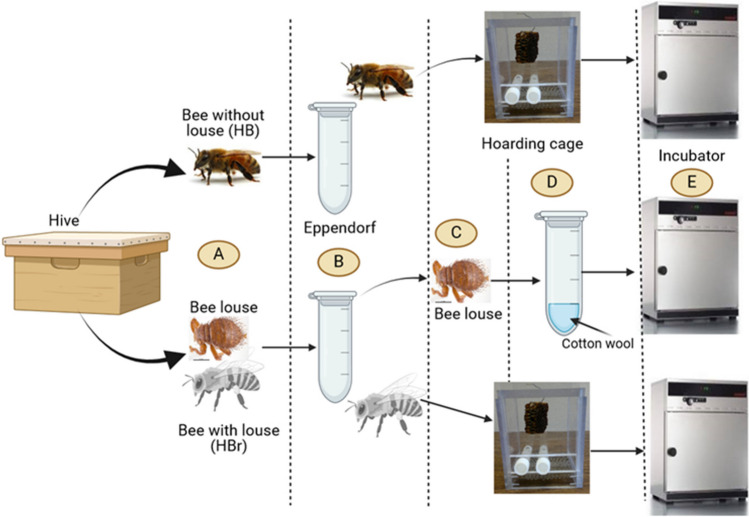 Figure 1
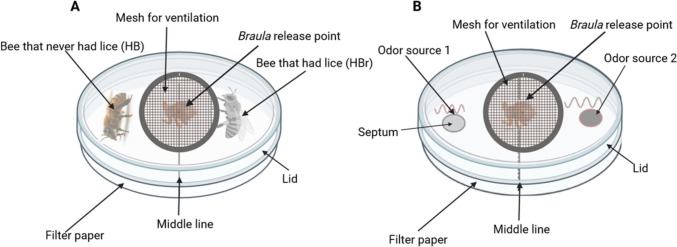 Figure 2
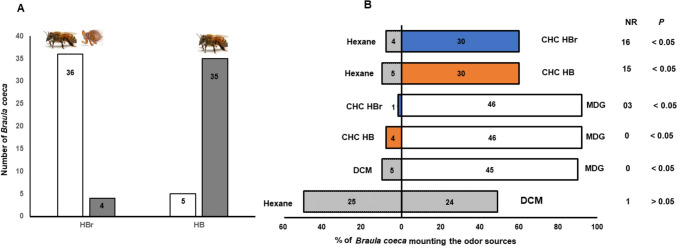 Figure 3
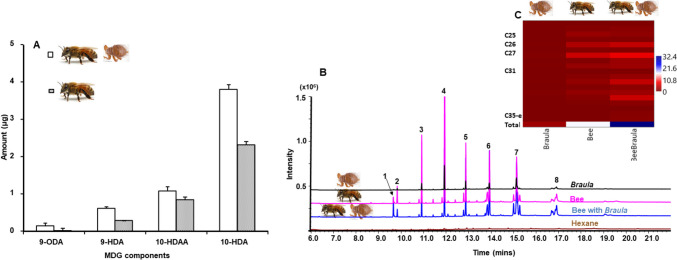 Figure 4
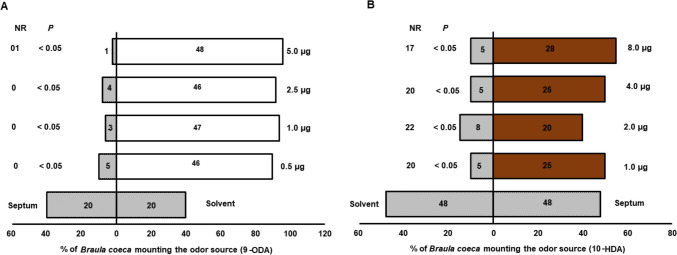 Figure 5
Peer Reviews
No public reviews on file for this paper yet. If you reviewed it on a platform where reviews are public (OpenReview, ICLR, NeurIPS, ICML), you can paste yours below so the community can read it here.
Videos
No videos yet. Explain this paper in a talk, walkthrough, or lecture? Add one.
Taxonomy
TopicsInsect and Pesticide Research · Plant and animal studies · Insect and Arachnid Ecology and Behavior