LDER-GE estimates phenotypic variance component of gene–environment interactions in human complex traits accurately with GE interaction summary statistics and full LD information
Zihan Dong, Wei Jiang, Hongyu Li, Andrew T DeWan, Hongyu Zhao

TL;DR
This paper introduces LDER-GE, a new method that improves the accuracy of estimating how gene-environment interactions affect human traits using large-scale genetic data.
Contribution
LDER-GE is a novel statistical method that uses full linkage disequilibrium information to more accurately estimate phenotypic variance from gene-environment interactions.
Findings
LDER-GE outperforms LDSC-based methods by ~23% in statistical efficiency, equivalent to a 51% sample size increase.
LDER-GE identified 34 significant environmental-phenotype pairs in UK Biobank data compared to 23 by LDSC-based methods.
Incorporating GE interactions increases explained phenotypic variance compared to considering genetic effects alone.
Abstract
Gene–environment (GE) interactions are essential in understanding human complex traits. Identifying these interactions is necessary for deciphering the biological basis of such traits. In this study, we review state-of-art methods for estimating the proportion of phenotypic variance explained by genome-wide GE interactions and introduce a novel statistical method Linkage-Disequilibrium Eigenvalue Regression for Gene–Environment interactions (LDER-GE). LDER-GE improves the accuracy of estimating the phenotypic variance component explained by genome-wide GE interactions using large-scale biobank association summary statistics. LDER-GE leverages the complete Linkage Disequilibrium (LD) matrix, as opposed to only the diagonal squared LD matrix utilized by LDSC (Linkage Disequilibrium Score)-based methods. Our extensive simulation studies demonstrate that LDER-GE performs better than…
Genes, proteins, chemicals, diseases, species, mutations and cell lines named across the full text — each resolved to its canonical identifier and authoritative record.
Click any figure to enlarge with its caption.
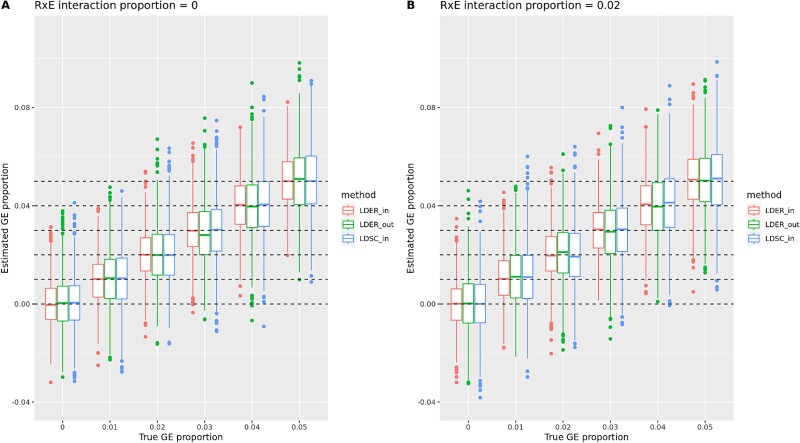 Figure 1
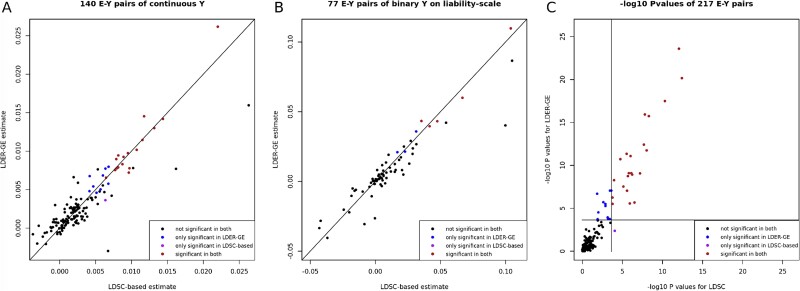 Figure 2
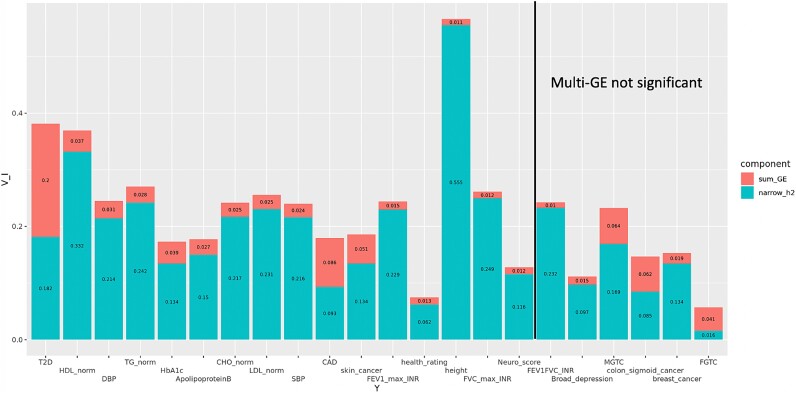 Figure 3
Peer Reviews
No public reviews on file for this paper yet. If you reviewed it on a platform where reviews are public (OpenReview, ICLR, NeurIPS, ICML), you can paste yours below so the community can read it here.
Videos
No videos yet. Explain this paper in a talk, walkthrough, or lecture? Add one.
Taxonomy
TopicsGenetic Associations and Epidemiology · Genetic Mapping and Diversity in Plants and Animals · Genetic and phenotypic traits in livestock