Stromal lymphocytes are associated with upgrade of B3 breast lesions
Tanjina Kader, Elena Provenzano, Madawa W. Jayawardana, Shona Hendry, Jia-Min Pang, Kenneth Elder, David J. Byrne, Lauren Tjoeka, Helen ML. Frazer, Eloise House, Sureshni I. Jayasinghe, Holly Keane, Anand Murugasu, Neeha Rajan, Islam M. Miligy, Michael Toss, Andrew R. Green

TL;DR
Stromal lymphocytes in breast lesions may help predict which cases will upgrade to cancer, potentially reducing unnecessary surgeries.
Contribution
A predictive model combining stromal lymphocyte counts, age, and lesion type was developed to identify upgrade risk in B3 breast lesions.
Findings
Upgraded B3 lesions showed significantly higher stromal lymphocyte counts than non-upgraded ones (p < 0.01).
A predictive model using lymphocytes, age, and lesion type achieved an area under the curve of 0.82 for upgrade prediction.
The model has high sensitivity but limited specificity for identifying upgrade risk.
Abstract
Various histopathological, clinical and imaging parameters have been evaluated to identify a subset of women diagnosed with lesions with uncertain malignant potential (B3 or BIRADS 3/4A lesions) who could safely be observed rather than being treated with surgical excision, with little impact on clinical practice. The primary reason for surgery is to rule out an upgrade to either ductal carcinoma in situ or invasive breast cancer, which occurs in up to 30% of patients. We hypothesised that the stromal immune microenvironment could indicate the presence of carcinoma associated with a ductal B3 lesion and that this could be detected in biopsies by counting lymphocytes as a predictive biomarker for upgrade. A higher number of lymphocytes in the surrounding specialised stroma was observed in upgraded ductal and papillary B3 lesions than non-upgraded (p < 0.01, negative binomial model, n =…
Genes, proteins, chemicals, diseases, species, mutations and cell lines named across the full text — each resolved to its canonical identifier and authoritative record.
Click any figure to enlarge with its caption.
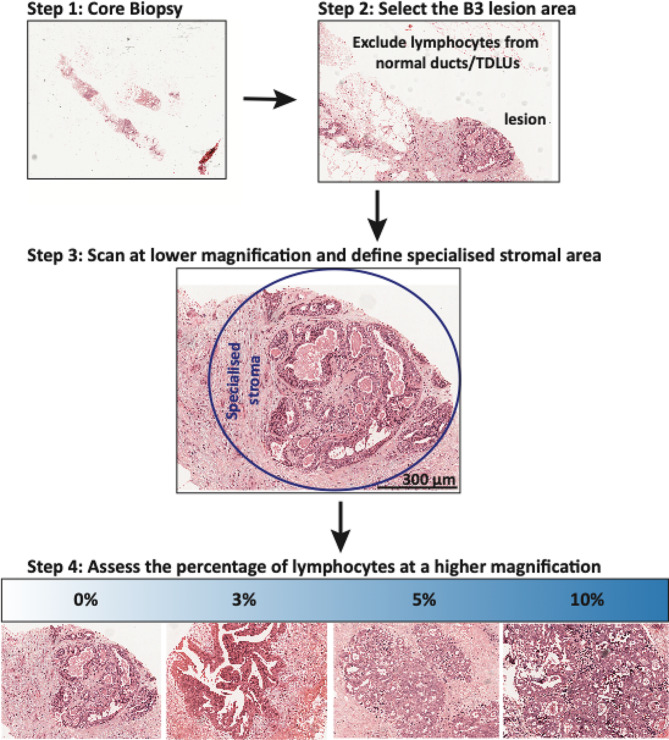 Figure 1
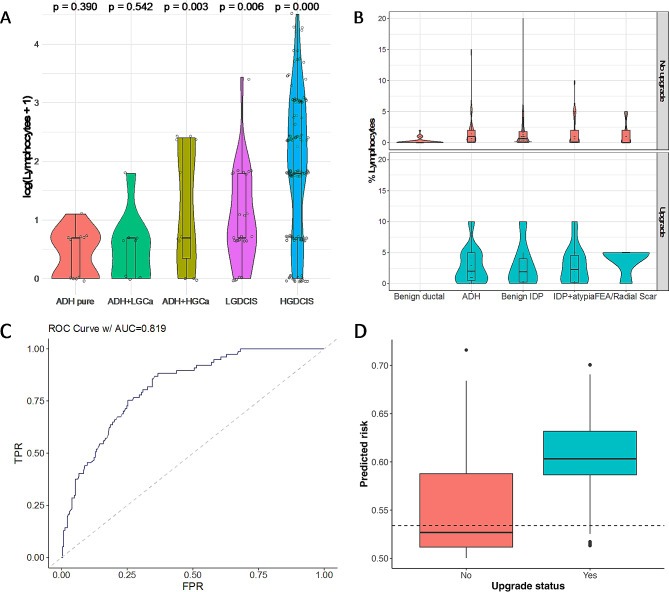 Figure 2
Peer Reviews
No public reviews on file for this paper yet. If you reviewed it on a platform where reviews are public (OpenReview, ICLR, NeurIPS, ICML), you can paste yours below so the community can read it here.
Videos
No videos yet. Explain this paper in a talk, walkthrough, or lecture? Add one.
Taxonomy
TopicsBreast Cancer Treatment Studies · Inflammatory Biomarkers in Disease Prognosis · Cancer Genomics and Diagnostics