
TL;DR
Jiaohong pills reduce brain inflammation and improve memory in a mouse model of Alzheimer's disease by affecting a key signaling pathway.
Contribution
The study shows Jiaohong pills can modulate the MAPK/NF-κB pathway to alleviate Alzheimer's-related neuroinflammation.
Findings
Jiaohong pills reduced neuroinflammation in Alzheimer's disease mice.
The pills improved cognitive deficits caused by amyloid-β protein.
The MAPK/NF-κB pathway was identified as the mechanism of action.
Abstract
The cover image is based on the article ‘Jiaohong pills attenuate neuroinflammation and amyloid‐β protein‐induced cognitive deficits by modulating the mitogen‐activated protein kinase/nuclear factor kappa‐B pathway’ (DOI 10.1002/ame2.12369) reported by Hong Zhang et al. Neuroinflammation is the primary cause of learning and memory impairment in Alzheimer's disease. Jiaohong pills, composed of Pericarpium Zanthoxyli and Radix Rehmanniae, can alleviate neuroinflammation in amyloid‐β protein‐induced‐Alzheimer's disease mice model by modulating the mitogen‐ activated protein kinase/nuclear factor kappa‐ B pathway signaling pathway, thereby further improving symptoms of learning and memory deficits.
Genes, proteins, chemicals, diseases, species, mutations and cell lines named across the full text — each resolved to its canonical identifier and authoritative record.
Click any figure to enlarge with its caption.
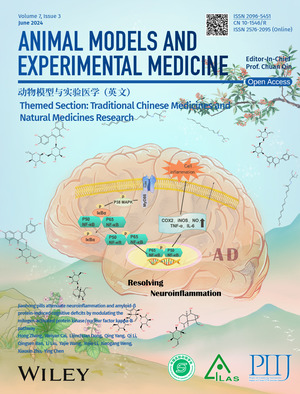 Figure 1
Peer Reviews
No public reviews on file for this paper yet. If you reviewed it on a platform where reviews are public (OpenReview, ICLR, NeurIPS, ICML), you can paste yours below so the community can read it here.
Videos
No videos yet. Explain this paper in a talk, walkthrough, or lecture? Add one.
Taxonomy
TopicsNeurological Disease Mechanisms and Treatments · Neuroinflammation and Neurodegeneration Mechanisms · Alzheimer's disease research and treatments