Taxonomic notes on the collection of the tribe Lamiini (Coleoptera, Cerambycidae) housed in the Natural History Museum, London

Abstract
Genes, proteins, chemicals, diseases, species, mutations and cell lines named across the full text — each resolved to its canonical identifier and authoritative record.
Click any figure to enlarge with its caption.
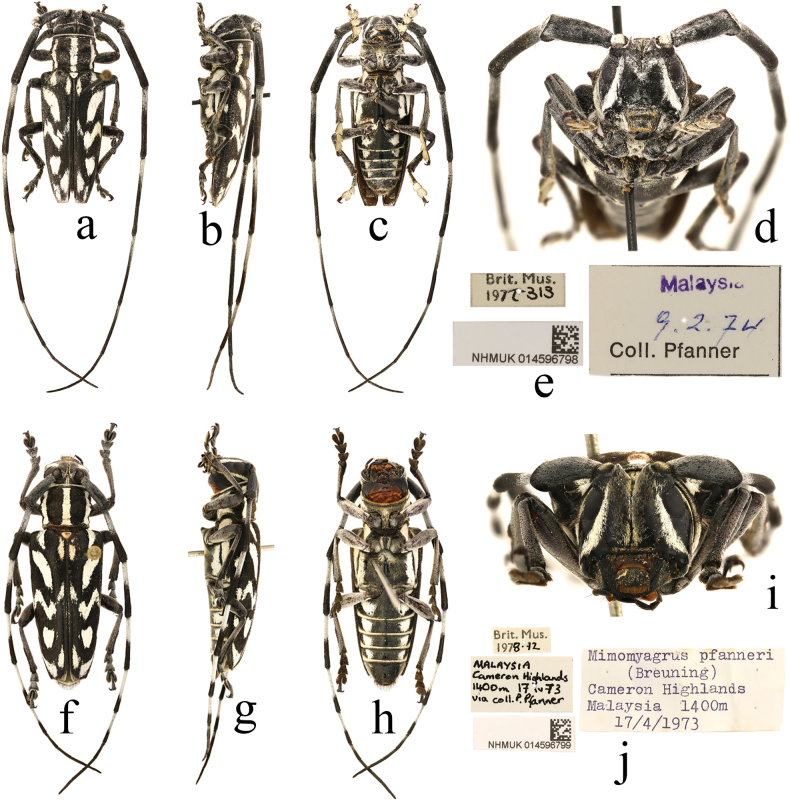 Figure 1
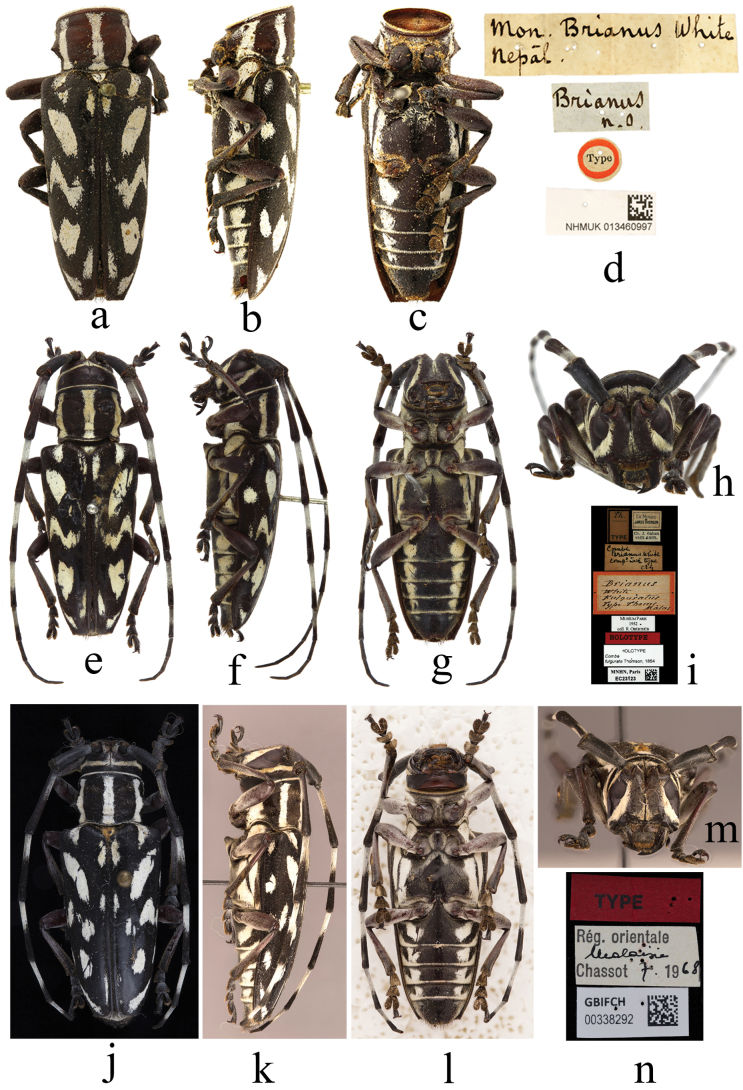 Figure 2
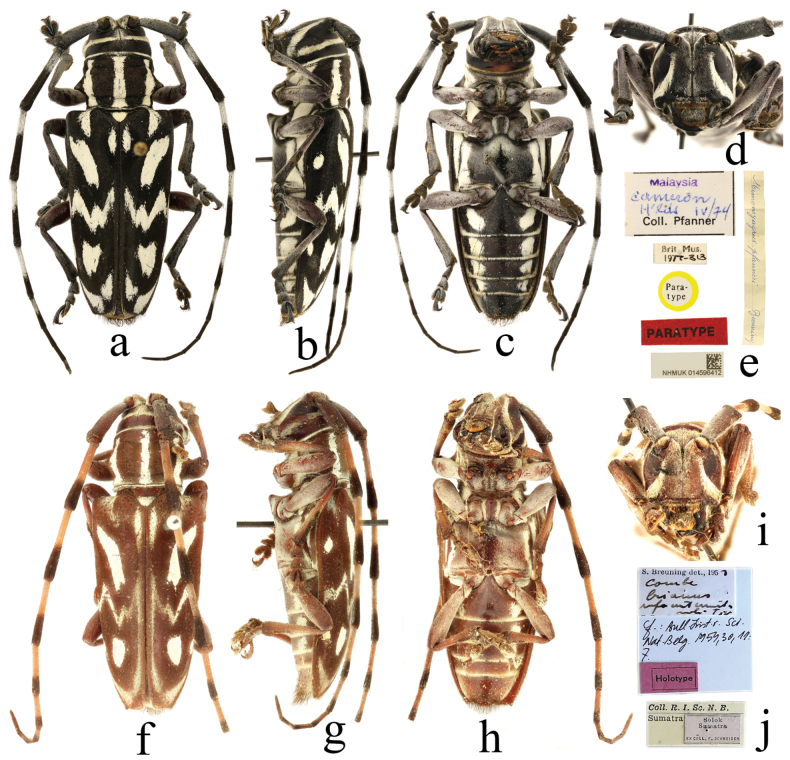 Figure 3
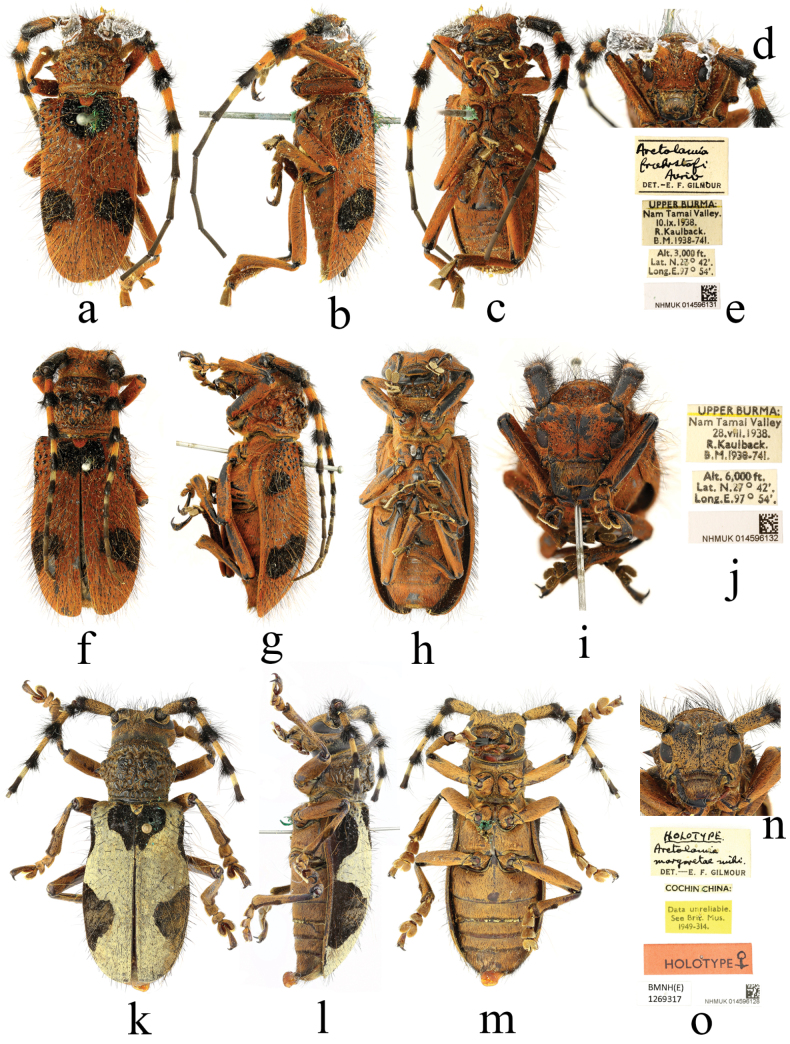 Figure 4
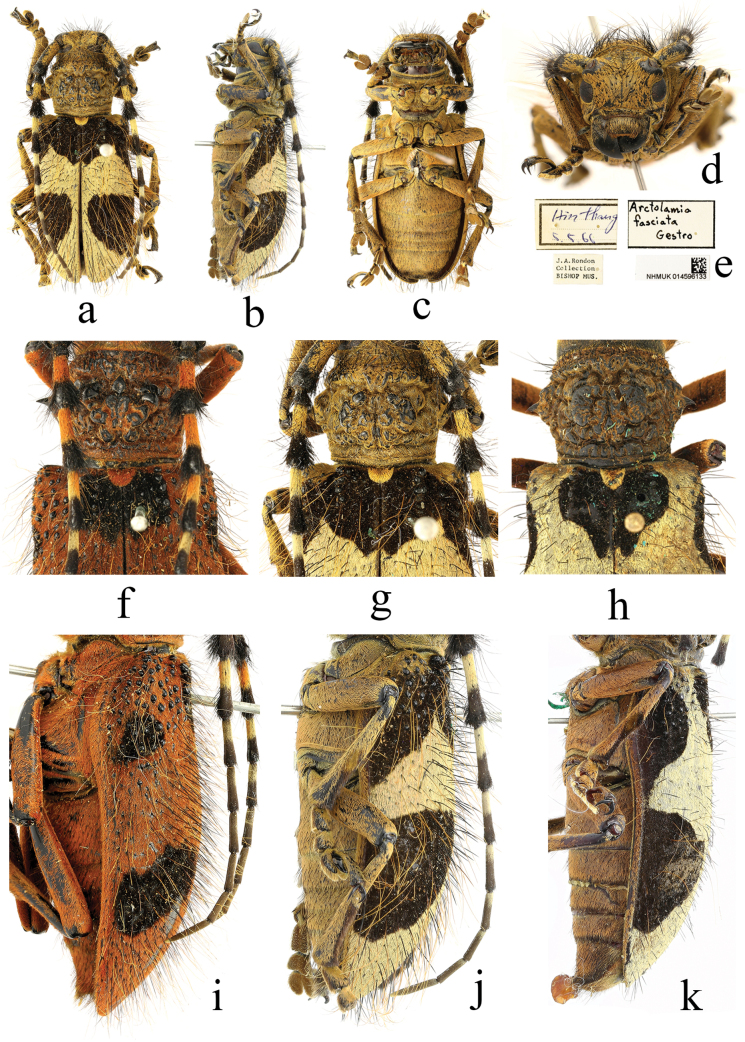 Figure 5
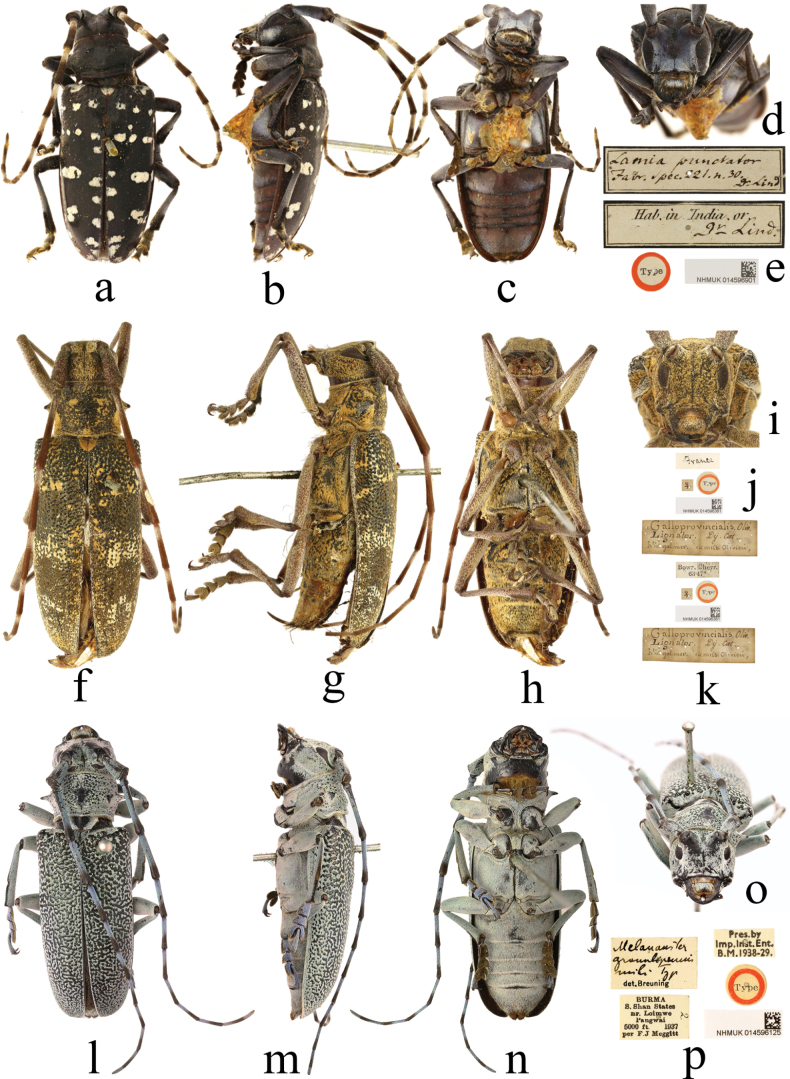 Figure 6
Peer Reviews
No public reviews on file for this paper yet. If you reviewed it on a platform where reviews are public (OpenReview, ICLR, NeurIPS, ICML), you can paste yours below so the community can read it here.
Videos
No videos yet. Explain this paper in a talk, walkthrough, or lecture? Add one.
Taxonomy
TopicsColeoptera: Cerambycidae studies · Forest Insect Ecology and Management · Coleoptera Taxonomy and Distribution
Introduction
As one of the largest natural history museums, the Natural History Museum, London [formerly British Museum, Natural History (BMNH), and hereafter NHMUK] houses abundant specimens of longhorn beetles from all over the world.
The first author had an opportunity to visit the NHMUK in 2022, and carried out research related to Cerambycidae for one year under the direction of the second author, Maxwell V. L. Barclay, the Senior Curator in Charge of Coleoptera at the NHMUK; the current paper is part of the research findings, together with four other separately published papers.
On the basis of the study of specimens of the tribe Lamiini preserved in the NHMUK, we propose a genus-level and a species-level new synonymy and confirm that the type material of three species, considered to be ‘lost’ and marked as ‘depositary not known’ (Tavakilian and Chevillotte 2023), are in fact deposited in the NHMUK.
Material and methods
The material examined in this study is deposited in the NHMUK, and has already been identified by earlier specialists, except for the holotypes of Combefulgurata Thomson, 1864, Mimomyagruspfanneri Breuning, 1970 and Combebrianus m. rufoantennatus Breuning, 1954 used for comparison in this study, which are deposited in the Muséum national d’Histoire naturelle, Paris, Muséum cantonal des sciences naturelles, Lausanne and Royal Belgian Institute of natural sciences, Brussels, respectively.
The label text, which is reproduced verbatim without corrections or additions, is given in single quotation marks for all studied specimens. Individual labels are separated by a semicolon, and data on different rows by a single slash. Additional and explanatory comments by the authors are given in square brackets.
Photographs were taken using a Canon 7D Mark II DSLR camera with a Canon EFS 100 mm lens and edited using Adobe Photoshop 2020 release. Extended depth of field at magnifications was achieved by combining multiple images from a range of focal planes using Combine ZP or Helicon Focus software.
Results
Based on our study on the tribe Lamiini preserved in the NHMUK, one genus-level synonym and one species-level synonym have been found, the female of one species is newly described with a new distribution record, and the type material of three species previously thought to be lost, has been confirmed to be preserved in the NHMUK. The details are as follows:
Combe
Taxon classificationAnimaliaColeopteraCerambycidae
Genus
Thomson, 1864
F87EA753-DC49-53B6-A5F0-27F9B1EA6B9A
Combe Thomson, 1864: 83; Pascoe 1866: 252; Lacordaire 1869: 344; Gemminger and Harold 1873: 3028; Aurivillius 1921: 119; Breuning 1961: 347. Type species:Combefulgurata Thomson, 1864 [= Combebrianus (White, 1858)]. Mimomyagrus Breuning, 1970: 88. Type species: Mimomyagruspfanneri Breuning, 1970. Syn. nov.
Combe
brianus
Taxon classificationAnimaliaColeopteraCerambycidae
(White, 1858)
1EC0BCA7-46CF-5B30-A51C-76D65E81CA8B
Monohammus brianus White, 1858: 409. Type locality: Nepal. Combe Fulgurata [sic] Thomson, 1864: 83. Type locality: unspecified. Combe Brianus [sic]: Pascoe 1866: 244; Lacordaire 1869: 344; Gemminger and Harold 1873: 3028; Aurivillius 1921: 119. Combe brianus : Breuning 1961: 347; Weigel 2006: 502; Barševskis 2018: 288, 2020: 178. Combe brianus m. rufoantennatus Breuning, 1954: 7; 1961: 347. Type locality: Sumatra, Indonesia. Unavailable name. Mimomyagrus pfanneri Breuning, 1970: 88. Type locality: Cameron highlands, Malaysia. Syn. nov.
Type material examined.
Holotype of Monohammusbrianus White, 1858, female: ‘Type [p, label circular, red frame]; Brianus / n. o [h]; Mon. Brianus White / Nepal [h]; NHMUK013460997 [p]’; holotype of Combefulgurata Thomson, 1864, female: ‘HOLOTYPE [p, label rectangular, red]; Th. / TYPE [p, black frame]; Ex. Musaeo / JAMES THOMSON [p, black frame]; Ch. J. Gahan / vidit 1895. [p]; Combe / Brianus White / comp. with type / C. J. G. [h]; Brianus / White / Fulguratus / Type Thoms. / Malas. [h, label rectangular, red frame]; Muséum Paris / 1952 / coll. R. Oberthür [p]; HOLOTYPE / Combe / fulgurata Thomson, 1864 [p]; MNHN, Paris / EC23123 [p]’; holotype of Combebrianus m. rufoantennatus Breuning, 1954, female: ‘Holotype [p, label rectangular, red, black frame]; Solok / Sumatra / EX COLL. F. SCHNEIDER [p, black frame]; Coll. R. I. Sc. N. B. / Sumatra [p]; S. Breuning det., 195 [p] 4 [h] / Combe / brianus / rufoantennatus / mihi Typ [h]; L: Bull. Inst. r. sci. Nat. Belg. 1954, 30, 11: F. [h]’; holotype of Mimomyagruspfanneri Breuning, 1970, female: ‘TYPE [p,label rectangular, red]; Rég. Orientale / Malaisie [h] / Chassot [p] 7. 1968 [h]; GBIFCH / 00338292 [p]’; paratype of Mimomyagruspfanneri Breuning, 1970, female: ‘Para- / type [p, label circular, yellow frame]; PARATYPE [p, label rectangular, red]; Brit. Mus. / 19 [p] 77–313 [h]; Malaysia [p] / Cameron / h’lds iv/74 [h] / Coll. Pfanner [p]; Mimomyagruspfanneri Breuning [h]’.
Non-type material examined.
Thirteen specimens (5 males, 8 females) identified as ‘Combebrianus’ in NHMUK: Malaysia: 1 male: ‘MALAY PENIN: / Selangor. / Bukit Kutu / 3500 [h] ft. / 14 . 3. [h] 1931 [1 with handwriting] / H. M. Pendlebury. [p]; Ex Coll: / F. M. S. / Museum. [p, reverse side]; Ex F. M. S. Museum. B. M. 1955–354 [p, reverse side]] / NHMUK013461006 [p]’; 1 male: ‘Mal. / P. [h]; Pascoe / Coll. / 93–60 [p]; Combe / brianus / White [h, reverse side]; NHMUK013460999 [p]’; 1 male: ‘Penang [h, label circle]; Bowring. / 63. 47* [p] / Combe / brianus, White [h]; NHMUK013461002’; 1 male: ‘MALAY PENIN. / Kedah Perak. / 1000–2000 [h] ft. / 19 # March, 1928. [p]; Ex F. M. S. / Museum. / B. M. 1955–354 [p]; NHMUK 013461004 [p]’; 1 male: ‘MALAY PENIN [p] / Perak, F. M. S. / Maxwell Hill 3000 / June–July 1916 [h]; 332 [h]; Ex F. M. S. / Museum. / B. M. 1955–354. [p]; NHMUK013387052 [p]’; 1 female: ‘Rantau Panjang / Selangor. / H. C. Robinson. [p] / (12. 16 / V / 04) [h] / 1904–327.[p]; (4 / 1107)[p]; NHMUK013387035 [p]’; 1 female: ‘Malay / Penang [p]; Fry Coll. / 1905. 100. [p]; 17783 [h]; NHMUK013460998 [p]’; 1 female: ‘MALAY PENIN: [p] / Penang F. M. S. / Maxwell Hill 3000 / June–July 1916 [h]; 331 [h]; Ex F. M. S. / Museum. / B. M. 1955–354. [p]; Combe / Brianus, White / 2 [h]; NHMUK013387050 [p]’; 1 female: ‘Malay Penin / Panang, F. M. S. [p] j, / Gap / 2900 / May 1915 [h] 193 [p]2 [h] ; Ex F. M. S. / Museum. / B. M. 1955–354 [p]; NHMUK 013461000 [p]’; 1 female: ‘Malay / Penang [p]; Data unreliable / See Brit. Mus. / 1949–314. [p, label yellow]; Combe / brianus [h]; NHMUK013461003 [p]’; 1 female: ‘Malay / Penang / Batu Feringgi / catchment area [p] / 25 Aug 1963 [h] / H. T. Pagden; Pres by / Com Inst Ent / B. M. 1964-2 [p]; 119 [p]; Combe / brianus White [h] / E. A. J. Duffy det. 1964 [p]; NHMUK013461001 [p]’; 1 female: ‘MALAYA / Kuala Lumpur [p]/ Ampang Village [h] / Feb. 26^th^[h]19[p]35[h]; Ex F. M. S. / Museum. / B. M. 1955–354 [p]; NHMUK 013387047 [p]’;1 female: ‘MALAY PENIN: / Selangor. / Bukit Kutu / 3300–3500 [h] ft. / 14 . 3. [h] 1931. / H. M. Pendlebury. [p]; Ex Coll: / F. M. S. / Museum. [p, reverse side]; Ex F. M. S. Museum. M. 1955–354 [p, reverse side]; NHMUK013461005 [p]’.
Two specimens (1 male, 1 female) identified as ‘Mimomyagruspfanneri Breuning, 1970’ in NHMUK: Malaysia: 1 male (Fig. 1a–e): ‘Malaysia [p] / 9. 2. 74 [h] / Coll. Pfanner [p]; NHMUK014596798 [p]’; 1 female (Fig. 1f–j): ‘Malaysia / Cameron Highlands / 1400m 17 iv 73 / via coll. P. Pfanner [h]; Mimomyagruspfanneri / (Breuning) / Cameron Highlands / (Malaysia 1400 m / 17/4/1973) [p]; Brit. Mus. / 1978.72 [p]; NHMUK014596799 [p]’.
Habitus of Combebrianus (White, 1858) a–d male f–i female e, j labels.
Comments.
White (1858) described Monohammusbrianus (Fig. 2a–d) based on a female specimen without head from Nepal. Thomson (1864) established the genus Combe for Combefulgurata (Fig. 2e–i) based on a female specimen without indicating locality. Pascoe (1866) transferred Monohammusbrianus to the genus.
Habitus of Combebrianus (White, 1858) a–c holotype of Monohammusbrianus White, 1858, female e–h holotype of Combefulgurata Thomson, 1864, female j–m holotype of Mimomyagruspfanneri Breuning, 1970, female d, i, n labels.
Combe and synonymized Combefulgurata with it based on the male and female specimens from Malacca, Malaysia. Breuning (1954) described a morph, Combebrianus m. rufoantennatus (Fig. 3f–j), based on a specimen of reddish-brown colour from Sumatra. Subsequently, Breuning (1970) described Mimomyagruspfanneri based on specimens from Cameron Highlands, Malaysia. Through studying these series of type and non-type specimens, we found that, in fact, they belong to the same species. Thus, here we propose the species Mimomyagruspfanneri as a junior synonym of Combebrianus.
Habitus of Combebrianus (White, 1858) a–d paratype of Mimomyagruspfanneri Breuning, 1970, female f–i holotype of Combebrianus m. rufoantennatus Breuning, 1954, female e, j labels.
Since Mimomyagruspfanneri is the type species of Mimomyagrus, this genus becomes a junior synonym of the genus Combe.
Breuning (1954) regarded the type specimen of Combebrianus m. rufoantennatus as a male. However, based on the ratio of the antennal length to body length, and the shape of the abdomen, it appears to be a female.
A questionable paratype of Mimomyagruspfanneri (Fig. 3a–e) is present in the collection of the NHMUK. According to the label, a handwritten collection date indicates that the specimen was collected in April, 1974 (Fig. 3e). The species was described in 1970 and the collection date was clearly recorded as ‘IV–V 1969’ in the original publication by Breuning, although on the label of the holotype a similarly handwritten date is given as ‘July 1968’. In any case, it is impossible for the collection date of the claimed paratype to appear after the publication date. Therefore, this specimen cannot be considered as a paratype.
Arctolamia
sinica
Taxon classificationAnimaliaColeopteraCerambycidae
Bi & Chen, 2022
9C5492C3-8B44-52BB-94B2-3633FB0CC6F4
Arctolamia sinica Bi & Chen, 2022: 199.
Description.
Female: similar to male, body length 33.5 mm, humeral width 12.0 mm. Body black, mostly densely clothed with reddish-brown pubescence, each puncture bearing a black or reddish-brown erect hair; glabrous areas showing black integument; elytra provided with five black pubescent patches. Frons, gena and vertex with black hairs, mouthparts with hairs lighter in colour, nearly yellowish-brown. Antennae with scape clothed with reddish-brown pubescence only on lateral margin; antennomeres III–V clothed with reddish-brown pubescence on basal half, antennomeres VI–VIII on basal half and antennomere XI on extreme apex clothed with greyish-yellow pubescence; antennomeres III–IV clothed with black pubescence on apical half, antennomeres V–VIII clothed with pubescence fading to chestnut on apical half; antennomeres IX–X and most of antennomere XI clothed with chestnut pubescence; scape and pedicel clothed with a black long hair on each puncture, denser on inferior margin; antennomeres III–VI fringed with long hairs below, reddish-brown on base and black on apex, antennomeres III–IV tufted with black hairs around apex. Pronotum clothed with black erect hairs on anterior, lateral and posterior margin, more on anterior margin; disc barely clothed with hairs on calli. Scutellum clothed with reddish-brown pubescence, without hairs. Elytra densely clothed with reddish-brown and black hairs, glabrous only on basal granules; each puncture bearing a long erect black or reddish-brown hair, black hairs short and stiff, reddish-brown hairs long and soft, arranged intermixed with each other; elytra with five black pubescent patches: a basal one located around scutellum, subangular; a lateral one on basal quarter after each humerus, smallest, oblique, not reaching the lateral margin; a large oblique one on each side behind the middle, not reaching suture and lateral margin. Underside densely clothed with reddish-brown pubescence, slightly greyish-yellow on mesosternum and mesoepisternum; ventrites furnished with greyish-yellow and black erect hairs. Legs mostly clothed with reddish-brown pubescence, tibiae and tarsi furnished with sparse black bristles.
Head sparsely punctate; frons transverse, slightly convex, with a distinct median sulcus extending to occiput. Eyes coarsely faceted, lower eye lobe transverse, about as long as gena; vertex uneven, with irregular wrinkles. Antennae distinctly shorter than body; antennal insertions conspicuously elevated, broadly separated; scape stout, gradually thickened apically, longest; antennomere III slightly shorter than antennomere IV, antennomere IV about as long as antennomere V, antennomeres V–X gradually shortened in length, antennomere XI about as long as antennomere VII. Pronotum transverse, with a pointed lateral spine on middle of each side; disc convex, coarsely rugose, with developed calli. Scutellum semicircular. Elytra broad, lateral margins gradually expanding outward at basal quarter after humeri, then convergent backward from middle to apices, apices conjointly rounded; about basal fourth provided the sparse, glabrous granules, of which several large granules regularly arranged in a row near the scutellum. Abdomen with first ventrite distinct longer than second and third ventrite, distal ventrite with apical centre slightly depressed, apical margin nearly straight. Legs moderately long and thick, metafemur reaching the middle of fourth ventrite.
Non-type material examined.
Myanmar: 1 male: ‘UPPER BURMA: / Nam Tamai Valley / 28. viii. 1938. / R. Kaulback. / B. M. 1938–741. [p]; Alt. 6,000 ft. / Lat. N. 27°42′. / Long. E. 97°54′. [p]; Arctolamia / fruhstorferi / Auriv [h] / DET. –E. F. GILMOUR [p]; NHMUK014596131’; 1 female: ‘UPPER BURMA: / Nam Tamai Valley / 28. viii. 1938. / R. Kaulback. / B. M. 1938–741. [p]; Alt. 6,000 ft. / Lat. N. 27°42′. / Long. E. 97°54′. [p]; NHMUK014596132’.
Comments.
Gilmour (1950) misidentified the above pair of specimens as Arctolamiafruhstorferi Aurivillius, 1902 (Fig. 4a–j) and, using this as a comparison, described another species, Arctolamiamargaretae Gilmour, 1950 (Fig. 4k–o). In fact, A.margaretae is a junior synonym of A.fruhstorferi, as shown by Pu (1981), whereas the specimens misidentified by Gilmour as A.fruhstorferi represent A.sinica Bi & Chen, 2022.
Habitus of Arctolamia spp. a–jArctolamiasinica Bi & Chen, 2022 k–o holotype of Arctolamiamargaretae Gilmour, 1950 a–d male f–i, k–n female e, j, o labels.
Bi and Chen (2022) indicated that A.sinica can be differentiated from A.fruhstorferi by the absence of light-coloured pubescence on the dorsal surface of the scape and numerous large granules on the base of elytra. However, a male specimen of A.sinica from Myanmar shows the scape distinctly clothed with reddish-brown pubescence on dorsal surface (Fig. 4a, b, d) and there is a female specimen in the NHMUK identified as A.fasciata Gestro, 1891 that is actually supposed to be A.fruhstorferi (maybe it is a transitional form), which also has some large granules on the elytral base (Fig. 4a–e). This seems to imply that, given current knowledge, the main feature that distinguishes A.sinica from A.fruhstorferi is the reddish-brown pubescence on its body.
Habitus of Arctolamia spp. a–d, g, jArctolamiafruhstorferi Aurivillius, 1902 f, iArctolamiasinica Bi & Chen, 2022 h, k holotype of Arctolamiamargaretae Gilmour, 1950 e labels a–d, f–k female.
Arctolamiasinica, is also recorded in Myanmar for the first time based on the pair of specimens mentioned above.
Additional discoveries
Type specimens of Lamiapunctator Fabricius, 1776 [= Anoplophorachinensis (Forster, 1771)] (Fig. 6a–e) and Cerambyxgalloprovincialis Olivier, 1800 [= Monochamusgalloprovincialis (Olivier, 1800)] (Fig. 6f–k) and the holotype of Melanaustergranulipennis Breuning, 1938 [= Monochamusguerryi Pic, 1903] (Fig. 6l–p) are confirmed to be preserved in the NHMUK; all were considered to be ‘lost’ and marked as ‘depositary not known’ (Tavakilian and Chevillotte 2023). Lamiapunctator Fabricius, 1776 and Cerambyxgalloprovincialis Olivier, 1800 are marked as having (missing) ‘holotypes’ by Tavakilian and Chevillotte (2023) and are labelled at the NHMUK with standard red framed ‘type’ discs, but there is no evidence of a holotype or of there being only one specimen in their original descriptions, so they are treated as syntypes. Melanaustergranulipennis Breuning, 1938 is described from a single female, and this specimen is a holotype.
a–d type specimen of Lamiapunctator Fabricius, 1776, female f–i type specimen of Cerambyxgalloprovincialis Olivier, 1800, female l–o holotype of Melanaustergranulipennis Breuning, 1938, female e, j, k, p labels.
Supplementary Material
XML Treatment for Combe
XML Treatment for Combe brianus
XML Treatment for Arctolamia sinica
The reference list from the paper itself. Each links out to its DOI / PubMed record.
- 1Aurivillius C (1921) Cerambycidae: Lamiinae I. Coleopterorum Catalogus auspiciis et auxilio W. Junk, pars 73, Schenkling S Ed., Berlin, 1–322. https://www.biodiversitylibrary.org/page/10202648
- 2Barševskis A (2018) To the knowledge of Long-Horned beetles (Coleoptera: Cerambycidae) of the Oriental Region. Part 1.Acta Biologica Universitatis Daugavpiliensis 18(2): 285–294.
- 3Barševskis A (2020) To the knowledge of Long-Horned Beetles (Coleoptera: Cerambycidae) of the Oriental Region. Part 3.Acta Biologica Universitatis Daugavpiliensis 20(2): 173–188.
- 4Bi WX Chen CC (2022) Description of one New Species of Arctolamia Gestro, 1888 from China (Coleoptera: Cerambycidae: Lamiinae).Japanese Journal of Systematic Entomology 28(2): 199–200.
- 5Breuning S (1938) Nouveaux Cerambycidæ (Col.).Novitates Entomologicae 9: 30–63.
- 6Breuning S (1954) Nouvelles formes de Lamiaires (cinquième partie).Bulletin de l’Institut Royal des Sciences Naturelles de Belgique 30(11): 1–23.
- 7Breuning S (1961) Catalogue des Lamiaires du Monde (Coleoptera, Cérambycidae). 5 Lieferung. Verlag des Museum G. Frey, Tutzing bei München, 96 pp [287–382].
- 8Breuning S (1970) Descriptions de nouveaux Lamiinae de la collection Chassot (Coleoptera Cerambycidae). Bulletin de la Societe Entomologique de Mulhouse (novembre-décembre), 87–90.