Cyrtomiumadenotrichum (Dryopteridaceae), a new species from Guangxi, China

Abstract
Genes, proteins, chemicals, diseases, species, mutations and cell lines named across the full text — each resolved to its canonical identifier and authoritative record.
Click any figure to enlarge with its caption.
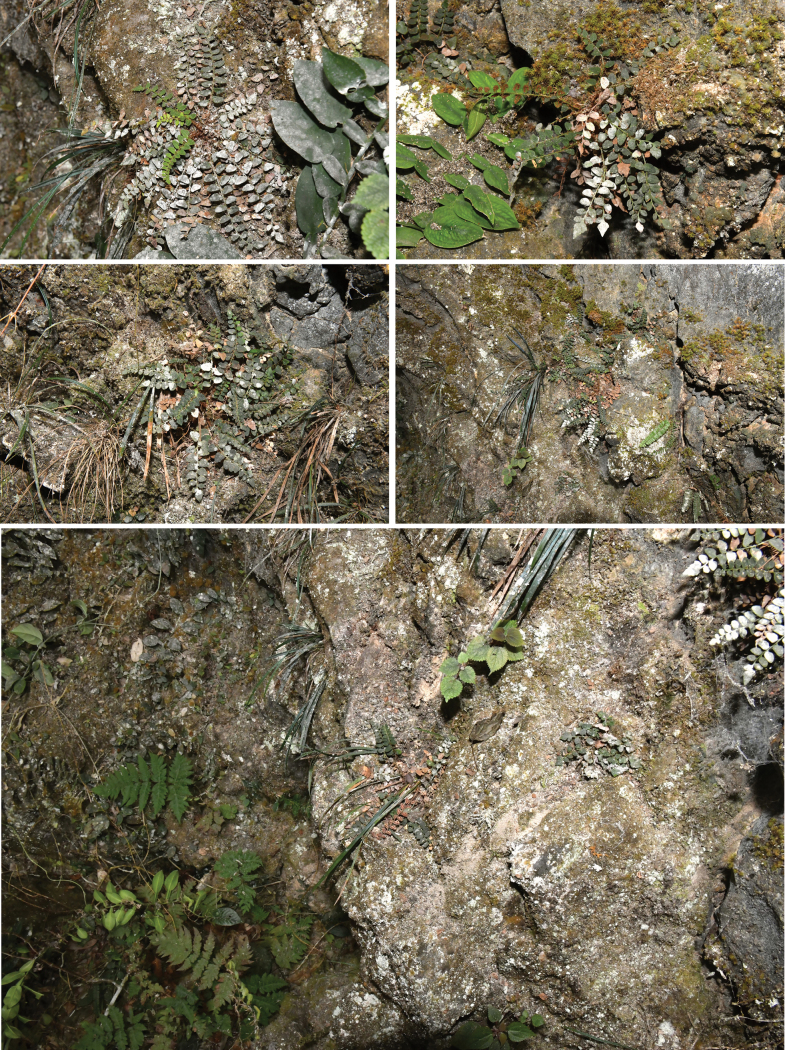 Figure 1
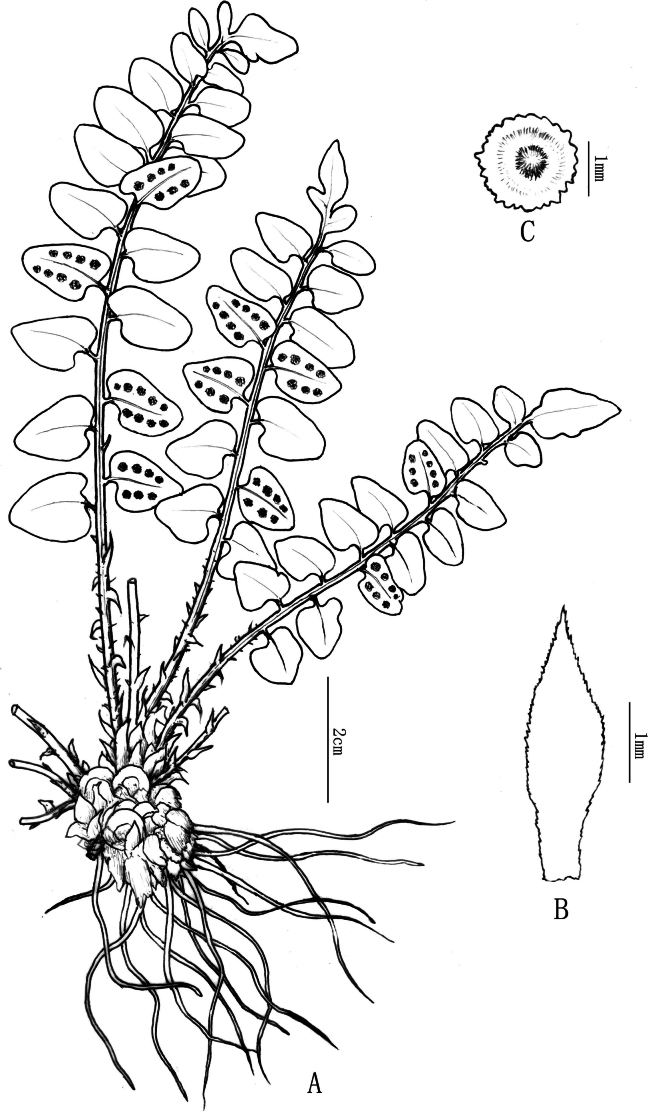 Figure 2
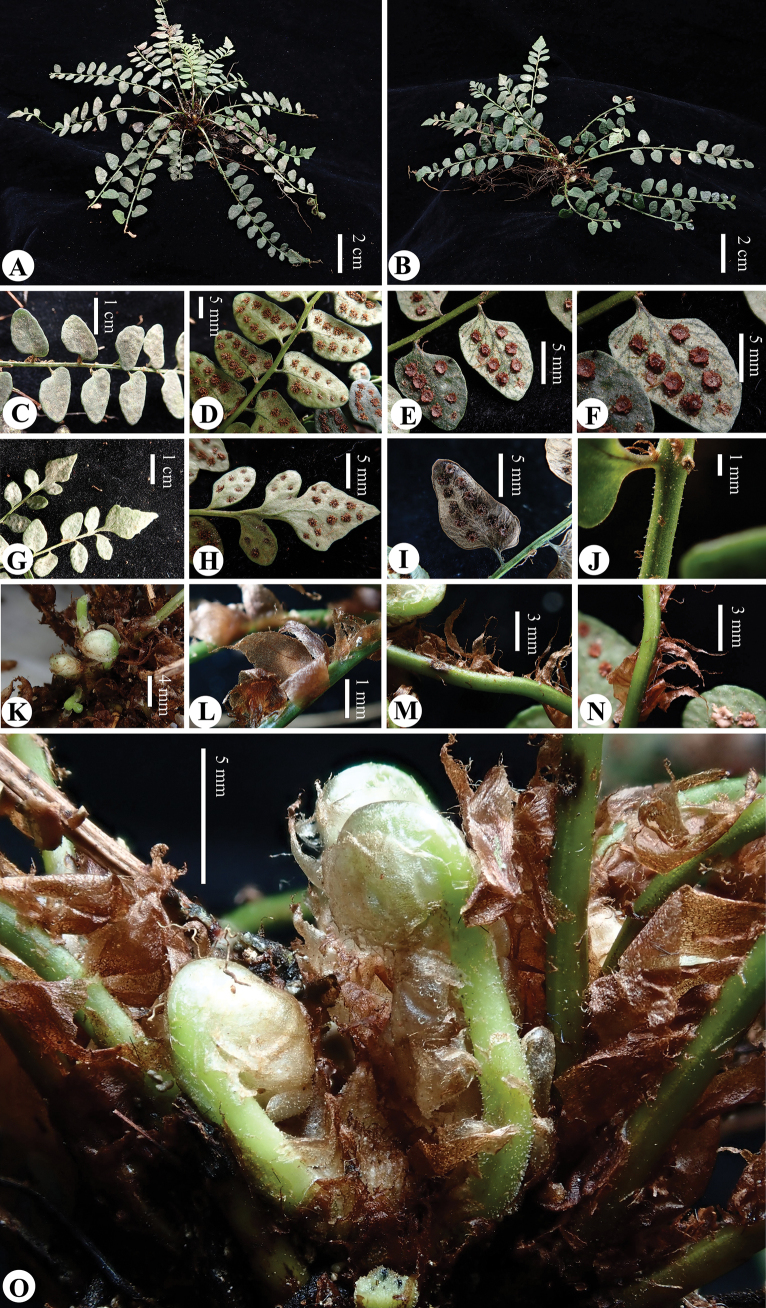 Figure 3
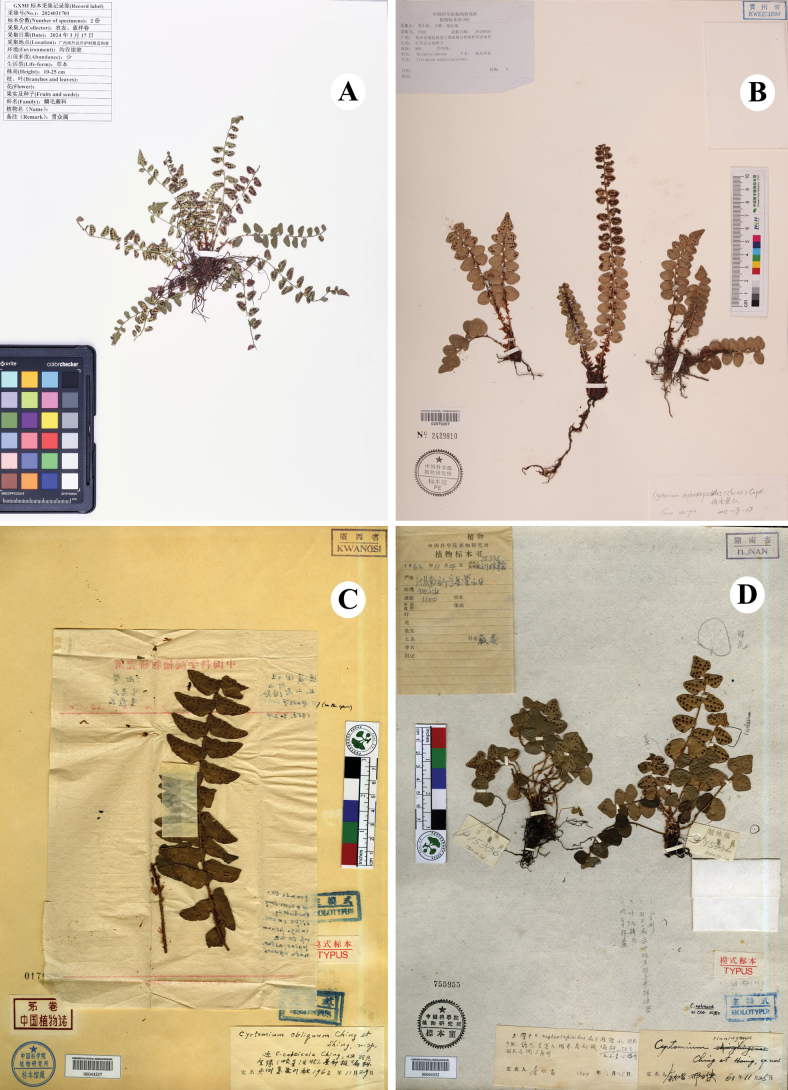 Figure 4
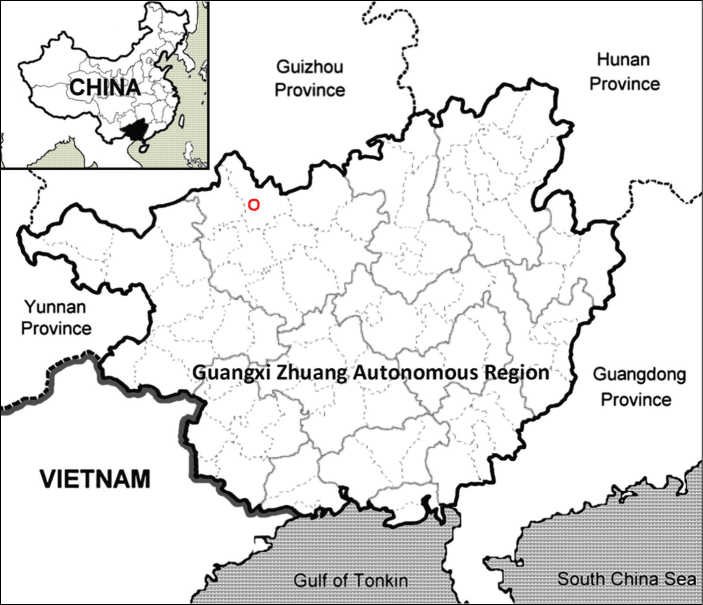 Figure 5
| Morphological traits |
|
|
|
|
|
|---|---|---|---|---|---|
| Plant height | 5–15 cm | 12–28 cm | 20–35 cm | 8–12 cm | 13–23 cm |
| Stipe | 3–10 cm, 1 mm in diam., sparsely glandular | 3–10 cm, 1–2 mm in diam., glabrous | 6–10 cm, 1–2 mm in diam., glabrous | 5–7 cm, 1 mm in diam., glabrous | 15 cm, 1–3 mm in diam., glabrous |
| Scales margins | fimbriate | fimbriate | dentate | Dentate | fimbriate-dentate |
| Lamina | linear-lanceolate, 5–10 × 1.5–2 cm | linear-lanceolate, 10–25 × 2–5 cm | lanceolate, 13–35 × 3–5 cm | ovate or oblong-lanceolate, 3–7 × 2.5–3 cm | lanceolate-oblong, 13–23 × 1.9 cm |
| Lateral pinnae | 5–10 pairs | 10–26 pairs | 12–21 pairs | 1–4 pairs | 9–14 pairs |
| Pinnae | 0.8–1 × 0.4–0.6 cm | 1–2.5 × 0.6–1.2 cm | 2–3 × 1–1.5 cm | 1.2–1.6 × 1–1.2 cm | 1.5–3.5 × 1.2–1.9 cm |
| Base | obvious oblique | cordate or sometimes obliquely cordate | oblique | broadly cuneate | cordate to hastate |
| Texture | thin leathery | thick- leathery | leathery | Leathery | thick leathery |
| Venation | midrib flat or slightly concave on both surfaces | midrib concave on both surfaces | slightly raised abaxially, slightly concave adaxially | indistinct on both surfaces | obscure |
| Rows of areolae | 1 or 2 | 2 or 3 | 2 | 2 or 3 | 2, 3, rarely to 4 |
| Indusia margins | dentate | subentire | entire | subentire | dentate |
Peer Reviews
No public reviews on file for this paper yet. If you reviewed it on a platform where reviews are public (OpenReview, ICLR, NeurIPS, ICML), you can paste yours below so the community can read it here.
Videos
No videos yet. Explain this paper in a talk, walkthrough, or lecture? Add one.
Taxonomy
TopicsFern and Epiphyte Biology · Plant Parasitism and Resistance · Plant and Fungal Species Descriptions
Introduction
Cyrtomium (Presl 1836) was founded upon the basis of Polypodiumfalcatum (Linnaeus 1781), originating from Japan. It comprises approximately 40 recognized species, the majority of which are found in East Asia, with a particular concentration of diversity centered in Southwest China. Within this group, 31 species are native to China (Zhang and Barrington 2013). Cyrtomiumser.Falcata Ching & Shing (Shing 1965), which was not confirmed as monophyletic in an earlier molecular study conducted (Lu et al. 2005), is distinguished by its leathery leaves and pinnae, which possess intact (occasionally repand) and thickened margins. Notably, all species belonging to this series can be located in China, except for C.elongatum S.K.Wu & P.K.Lôc (Wu et al 2005) and most of them are naturally distributed in limestone regions. Within the past decade, more new species of Cyrtomium have been discovered in Vietnam and China (Lu et al 2023; Nong et al. 2023).
During our field surveys conducted in Nandan County, Guangxi, in March 2024, we encountered a unique population of Cyrtomium that exhibited morphological similarities to the species C.nephrolepioides (Christ) Copel.(Copeland 1929), C.obliquum Ching & K. H. Shing ex K. H. Shing (Shing 1965), C.sinningense Ching & K. H. Shing ex K. H. Shing (Shing 1965) and C.calcis Liang Zhang, N.T.Lu & Li Bing Zhang (Lu et al 2023) in having erect rhizomes, dense, leathery lamina, and rounded sori, but it can be easily distinguished by its stipe sparsely glandular, base obvious oblique, basiscopic base truncate, acroscopic base auriculate or ovate. We hypothesize that this unique population may represent a previously unrecognized species due to these distinct morphological characteristics. To further validate our findings, we conducted additional observations and examined numerous specimens of Cyrtomium housed in various herbaria. We also consulted relevant literature to ensure the accuracy of our identification and to gain a deeper understanding of the taxonomic status of this potential new species (Lu et al 2023; Nong et al. 2023). We describe this population as a new morphologically distinct species.
Materials and methods
The new species was described based on field observations made in March and examination of herbarium specimens at GXMI. Other related Cyrtomium species were examined based on online images from Kew Herbarium Catalogue (http://apps.kew.org/herbcat/gotoHomePage.do) and JSTOR Global Plants (http://plants.jstor.org/) and PE, IBK and KUN. Morphological characters that distinguish it from all other species in the genus of Cyrtomium are used. We also observed living plants of the new species. We observed characters of rhizome, leaves, pedicels, stipe, lamina, scales, sori, indusia.
Descriptions were written from herbarium specimens. Measurements were made with a tape–measure and callipers. The structure of the indumentum and its distribution was observed and described under a dissecting microscope at magnifications of more than 20×. Additional information on locality, habitat, ecology, plant form and fruits were collected in the field and taken from herbarium labels. Conservation threat assessment followed IUCN Categories and Criteria (IUCN 2022).
Results and discussion
Taxonomy
Cyrtomium
adenotrichum
Taxon classificationPlantaePolypodialesDryopteridaceae
Y.Nong & R.H.Jiang sp. nov.
3B59821A-2F1F-5B8F-B8B7-4F04C25EB799
urn:lsid:ipni.org:names:77344264-1
Diagnosis.
Cyrtomiumadenotrichum is similar to C.nephrolepioides, C.obliquum, C.sinningense and C.calcis, but differs in its stipe sparsely glandular (vs. glabrous). In addition, it can be distinguished from C.sinningense by its scale margins fimbriate (vs. dentate), lateral pinnae 5–10 pairs (vs. 1–4 pairs), indusia margins dentate (vs. subentire); it can also be distinguished from C.nephrolepioides by its lateral pinnae 5–10 pairs (vs. 10–26 pairs), base obvious oblique (vs. cordate or sometimes obliquely cordate). It differs from C.obliquum by its scale margins fimbriate (vs. dentate), lateral pinnae 5–10 pairs (vs. 12–21 pairs), indusia margins dentate (vs. entire). It can be distinguished from C.calcis by its base obvious oblique (vs. cordate to hastate), lateral pinnae thin leathery (vs. thick leathery). Comparative morphological differences among all five species are presented in Table 1.
Habitat of Cyrtomiumadenotrichum Y. Nong & R.H. Jiang on cliffs at a gully (Photographed by YN).
Holotype.
China. Guangxi: Nandan, 24°48'47"N, 107°27'12"E, alt. 470 m, on the cliff at a gully; 17 March 2024; Y Nong NY2024031701 (GXMI!). (holotype: GXMI!; isotypes: IBK!).
Line drawing of Cyrtomiumadenotrichum Y. Nong & R.H. Jiang A plant B scale C indusium (Drawn by Xin–Cheng Qu).
Description.
Plants perennial, evergreen, 5–15 cm tall. Rhizome short and erect, together with basal stipe densely scaly. Scales brown, ovate; Leaves clustered, petiole 1–3 cm, stipe stramineous, 3–10 cm, 1 mm in diam, sparsely glandular, densely scaly; scales brown, ovate or lanceolate, margins fimbriate. scales on stipe base brown, ovate or lanceolate, membranous, ca. 8–12 × 1–3 mm, margin minutely denticulate and slightly long ciliate, upword gradually narrowed, subulate, linear-lanceolate. Lamina linear-lanceolate, 5–10 × 1.5–2 cm, base not contracted, 1-imparipinnate; Lateral pinnae 5–10 pairs, crowded, alternate, spreading or slightly ascendant, shortly stalked, ovate or rarely deltoid-lanceolate; lower and middle pinnae 8–10 × 4–6 mm, respectively, subopposite or alternate, apex rounded, base obvious oblique, basiscopic base truncate, acroscopic base auriculate or ovate, margins entire and often slightly reflexed, sparse hairlike scales adaxially and abaxially; terminal pinna ovate, with 1 or 2 connate lobes at base, 20–35 × 15–25 mm; rachis c. 1 mm in diam, sparsely glandular, grooved adaxially, scaly abaxially; scales on rachis brown, linear to subulate, margins sparsely toothed or fimbriate; frond texture thin leathery; venation pinnate, midrib flat or slightly concave on abaxially and adaxially, lateral vein connection, indistinct, lateral veins anastomosing to form 1 or 2 rows of areoles on each side of midrib. Sori 1 row on each side of midrib; indusia margins dentate.
Cyrtomiumadenotrichum Y. Nong & R.H. Jiang A, B plant C, D lamina (adaxially and abaxially view) E, F sori and indusia G, H terminal pinna (adaxially and abaxially view) I lateral pinnae (abaxially view, showing: margins entire and often slightly reflexed) J stipe (sparsely glandular) K curled leaves L, M, N scales O curled leaves (sparsely glandular) (Photographed and edited by You Nong).
Etymology.
The specific epithet refers to the stipe sparsely glandular of the new species.
Cyrtomium specimens of the new taxon and three morphologically related species A type specimen of CyrtomiumadenotrichumBC.nephrolepioidesC type specimen of C.obliquum, and D type specimen of C.sinningense.
Distribution and habit.
Known only from the north of Guangxi, China (Fig. 5). It has been mainly found on cliffs at a gully at elevations of 470 m. We found only one population with 10 individuals, and the habitat of Cyrtomiumadenotrichum is fragile because it could be submerged during the rainy season.
The distribution of Cyrtomiumadenotrichum (red circle) in Guangxi, China.
IUCN Red List Category.
Only one population with 10 individuals of Cyrtomiumadenotrichum is currently known from Nandan County, Guangxi China. Due to its rarity, the low number of individuals and habitat vulnerability, C.adenotrichum is considered to be Critically Endangered (CR), according to the IUCN (IUCN 2022).
Supplementary Material
XML Treatment for Cyrtomium adenotrichum
The reference list from the paper itself. Each links out to its DOI / PubMed record.
- 1Copeland EB (1929) New or interesting ferns.Philippine Journal of Science 38(1): 131–156.
- 2IUCN (2022) Guidelines for using the IUCN Red List categories and criteria, version 14. Prepared by the Standards and Petitions Committee. https://www.iucnredlist.org/resources/redlistguidelines [Accessed 28 March 2024]
- 3Linnaeus C (1781) Supplementum Plantarum Systematis Vegetabilium Editionis Decimae Tertiae, Generum Plantarum Editiones Sextae, et Specierum Plantarum Editionis Secundae. Editum a Carolo a Linné. Impensis Orphanotrophei. Brunsvigae 446. 10.5962/bhl.title.555 · doi ↗
- 4Lu JM Li DZ Gao LL Cheng X Wu D (2005) Paraphyly of Cyrtomium (Dryopteridaceae): Evidence from rbc L and trn L-F sequence data.Journal of Plant Research 118(2): 129–135. 10.1007/s 10265-005-0201-y 15818470 · doi ↗ · pubmed ↗
- 5Lu NT Wei HJ Vuong LD Toan LC Zhang LB Zhang L (2023) Cyrtomiumcalcis sp. nov. and six new records of the shield fern family (Dryopteridaceae) from Vietnam.Phytotaxa 358(1): 15–26. 10.11646/phytotaxa.583.1.2 · doi ↗
- 6Nong SY Liu Y Yan KJ Wei HJ (2023) Cyrtomiumremotipinnum (Dryopteridaceae), a new species from karst area in Guangxi, China.Phytotaxa 607(2): 133–141. 10.11646/phytotaxa.607.2.2 · doi ↗
- 7Presl KB (1836) Tentamen pteridographiae, seu genera filicacearum praesertim juxta venarum decursum et distributionem exposita. Typis Filiorum Theophili Haase. Pragae 86. 10.5962/bhl.title.630 · doi ↗
- 8Shing KH (1965) A taxonomical study of the genus Cyrtomium Presl.Acta Phytotaxonomica Sinica Addit 1: 1–48.