Early effect of different bifurcation techniques on left ventricular mechanics in elective percutaneous coronary intervention
Amr Nasser Elsheikh, Ayman Elsaeid, Samia Sharafeldin, Sahar Elshedoudy, Ehab ElGendy

TL;DR
This study examines how different stent techniques during heart procedures affect heart muscle function, finding both methods improve heart mechanics without changing overall heart pumping efficiency.
Contribution
The study provides new insights into the immediate effects of one-stent versus two-stent bifurcation techniques on left ventricular mechanics using speckle tracking echocardiography.
Findings
Both one-stent and two-stent techniques improved left ventricular mechanical properties without changing ejection fraction.
The provisional one-stent technique showed greater improvement in longitudinal strain in the LAD territory compared to the two-stent technique.
Improvements in strain correlated inversely with disease severity scores in the provisional group and number of diseased vessels in the two-stent group.
Abstract
Bifurcation lesions are prevalent amongst patients with symptomatic coronary artery disease subjected to percutaneous coronary intervention (PCI). Recent consensus commends a conservative (provisional) approach when managing the side branch. Here, the aim was to explore the immediate impact of different bifurcation techniques (one stent and two stent strategies) on left ventricular LV) myocardial functions using speckle tracking echocardiography in patients subjected to elective PCI. Sixty two consecutive patients diagnosed with coronary bifurcation lesion (CBL) were enrolled. Patients were categorized into: one-stent strategy (Provisional group, n = 44) and a two-stent strategy (TAP, DK crush, or Culotte technique, n = 18), based on the coronary bifurcation site, angle, side branch diameter and Medina classification. LVEF%, regional and global longitudinal strain (GLS), and E/E' were…
Genes, proteins, chemicals, diseases, species, mutations and cell lines named across the full text — each resolved to its canonical identifier and authoritative record.
Click any figure to enlarge with its caption.
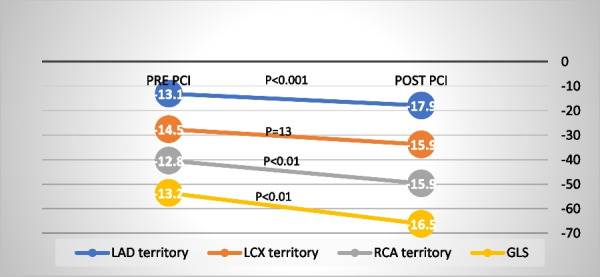 Figure 1
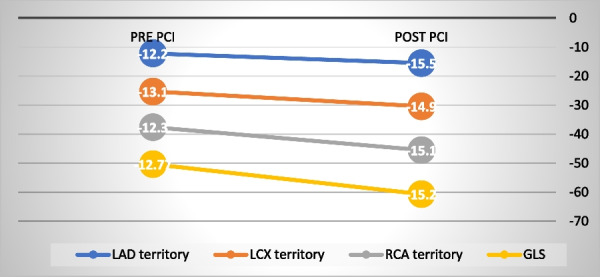 Figure 2
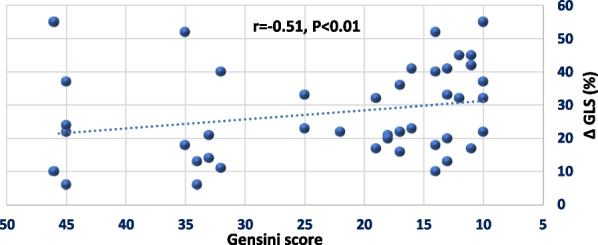 Figure 3
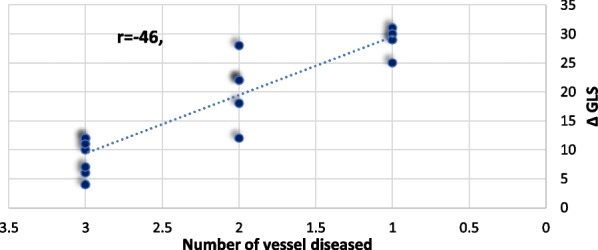 Figure 4
Peer Reviews
No public reviews on file for this paper yet. If you reviewed it on a platform where reviews are public (OpenReview, ICLR, NeurIPS, ICML), you can paste yours below so the community can read it here.
Videos
No videos yet. Explain this paper in a talk, walkthrough, or lecture? Add one.
Taxonomy
TopicsCoronary Interventions and Diagnostics · Cardiac Imaging and Diagnostics · Acute Myocardial Infarction Research