Grazing impact of the calanoid copepods Acartia spp. on the toxic dinoflagellate Alexandrium pseudogonyaulax in the western coastal waters of Korea
Moo Joon Lee, Yeong Jong Hwang, Yong Bum Choi, Yeong Du Yoo

TL;DR
This study examines how the copepods Acartia spp. graze on the toxic dinoflagellate Alexandrium pseudogonyaulax in Korean coastal waters.
Contribution
The study provides new insights into the grazing impact of Acartia spp. on A. pseudogonyaulax, including ingestion rates and grazing coefficients.
Findings
Ingestion rates of Acartia spp. on A. pseudogonyaulax increased with higher prey concentration.
The highest ingestion rate was 3,407 cells predator−1 d−1 at a given prey concentration.
Grazing coefficients in Shiwha Bay reached up to 0.073 d−1.
Abstract
Marine dinoflagellate species in the genus Alexandrium are well known to produce paralytic shellfish poison as well as common coastal species with cosmopolitan distribution. However, few studies on the feeding of copepods on Alexandrium species have been conducted. The toxic dinoflagellate Alexandrium pseudogonyaulax contains goniodomin A and causes red tides in many countries. To investigate the relationship between the toxic dinoflagellate A. pseudogonyaulax and the calanoid copepods Acartia spp., we quantified the ingestion rates of Acartia spp. feeding on A. pseudogonyaulax as a function of prey concentration. Additionally, we estimated grazing coefficients by integrating data from field observations of Acartia spp. and coexisting A. pseudogonyaulax with laboratory measurements of ingestion rates obtained during this investigation. Furthermore, we compared the ingestion rates of…
Genes, proteins, chemicals, diseases, species, mutations and cell lines named across the full text — each resolved to its canonical identifier and authoritative record.
Click any figure to enlarge with its caption.
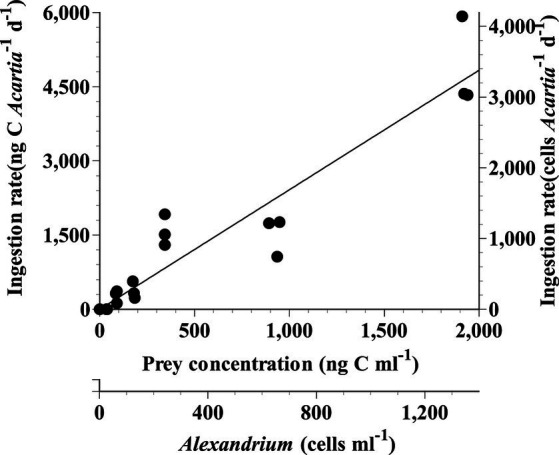 Figure 1
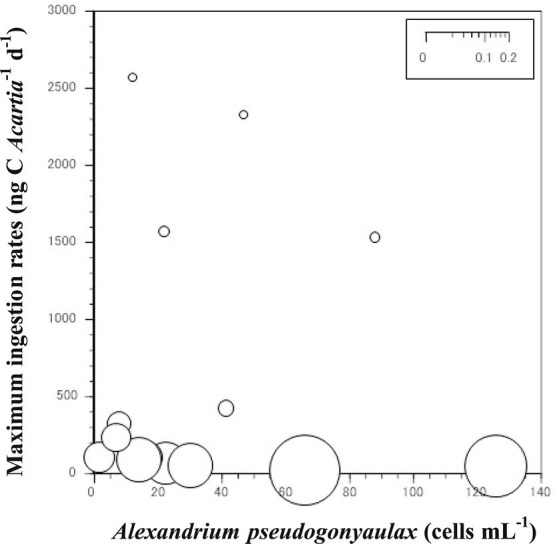 Figure 2
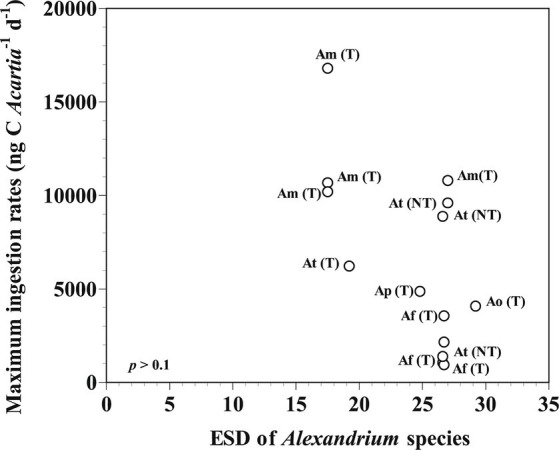 Figure 3
Peer Reviews
No public reviews on file for this paper yet. If you reviewed it on a platform where reviews are public (OpenReview, ICLR, NeurIPS, ICML), you can paste yours below so the community can read it here.
Videos
No videos yet. Explain this paper in a talk, walkthrough, or lecture? Add one.
Taxonomy
TopicsMarine and coastal ecosystems · Marine Toxins and Detection Methods · Isotope Analysis in Ecology