Toxic tasting: how capuchin monkeys avoid grasshoppers’ chemical defenses
Henrique P. Rufo, Luiza G. Ferreira, Eduardo B. Ottoni, Tiago Falótico

TL;DR
Capuchin monkeys avoid eating the toxic parts of grasshoppers, with adults being more efficient than younger ones in processing them.
Contribution
The study reveals learned behavior in capuchin monkeys to avoid toxic grasshopper parts, with age-related differences in processing.
Findings
Capuchin monkeys predominantly avoid eating the toxic digestive tract of stick grasshoppers.
Younger capuchins take longer to process stick grasshoppers compared to adults.
The behavior suggests learned avoidance of toxic prey components in wild capuchin monkeys.
Abstract
Platyrrhines consume many species of arthropods in the order Orthoptera. Some species of orthopterans can produce chemical defenses that render them toxic or unpalatable and thus act as predator deterrents. These species include the stick grasshoppers (family Proscopiidae), which are widely distributed in the Caatinga biome in northeastern Brazil, which comprises part of the distribution of capuchin monkeys. Capuchin monkeys are omnivores and consume a wide variety of foods, including unpleasant-tasting, potentially toxic items, which they need to learn how to process. We describe the processing of stick grasshoppers (Stiphra sp.) by wild capuchin monkeys (Sapajus libidinosus) that live in Serra da Capivara National Park, Brazil, and compare how individuals of different age classes handle these potentially toxic food items. S. libidinosus predominantly avoided consuming the digestive…
Genes, proteins, chemicals, diseases, species, mutations and cell lines named across the full text — each resolved to its canonical identifier and authoritative record.
Click any figure to enlarge with its caption.
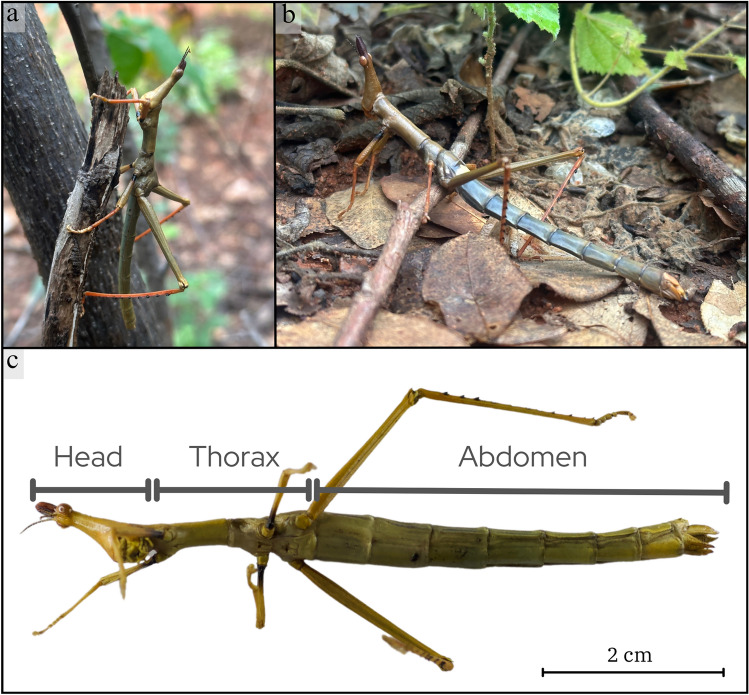 Figure 1
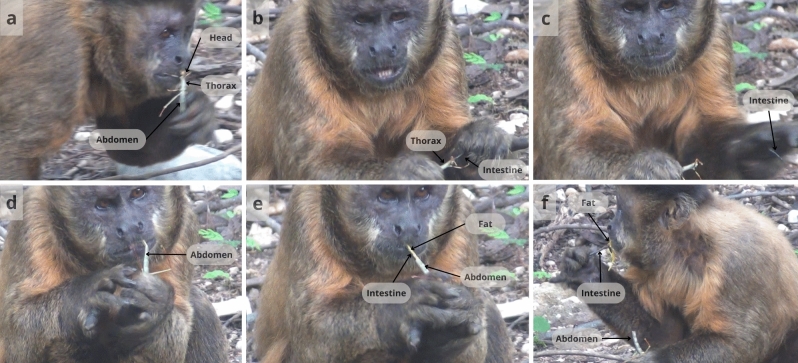 Figure 2
Peer Reviews
No public reviews on file for this paper yet. If you reviewed it on a platform where reviews are public (OpenReview, ICLR, NeurIPS, ICML), you can paste yours below so the community can read it here.
Videos
No videos yet. Explain this paper in a talk, walkthrough, or lecture? Add one.
Taxonomy
TopicsPrimate Behavior and Ecology · Animal Behavior and Reproduction · Animal Vocal Communication and Behavior