Radial extracorporeal shock wave therapy for the management of spasticity in cerebral palsy: study protocol for a randomized controlled trial
Míriam Tur Segura, Francisca Gimeno Esteve, Tamara Biedermann Villagra, Jordi Jiménez Redondo, Nicolás García Rodríguez, Raimon Milà Villarroel

TL;DR
This study tests if increasing the time between shock wave therapy sessions can prolong benefits for cerebral palsy patients with spasticity.
Contribution
The study investigates the effect of extending intervals between radial extracorporeal shock wave therapy sessions on spasticity in cerebral palsy.
Findings
The study will compare three rESWT protocols with different session intervals to assess spasticity outcomes.
It aims to determine if longer intervals between sessions can prolong therapeutic benefits.
Findings could influence clinical guidelines for rESWT treatment in cerebral palsy.
Abstract
Spasticity is the most common motor disorder in cerebral palsy (CP), and its management is complex, posing a significant challenge for the rehabilitation team. Radial extracorporeal shock wave therapy (rESWT) has emerged in recent years as an effective, non-invasive, and low-risk alternative for the management of spasticity in CP patients, with only minor side effects such as small bruises or discomfort during application. There is great variability in rESWT administration protocols, ranging from a single session up to the 12 sessions. The most extensively studied protocol involves 3 rESWT sessions with a one-week interval between session. According to current literature, the effect of rESWT has not been investigated by extending the time interval between sessions beyond 1 week to determine if therapeutic effects on spasticity can be prolonged over time. Following a power calculation…
Genes, proteins, chemicals, diseases, species, mutations and cell lines named across the full text — each resolved to its canonical identifier and authoritative record.
Click any figure to enlarge with its caption.
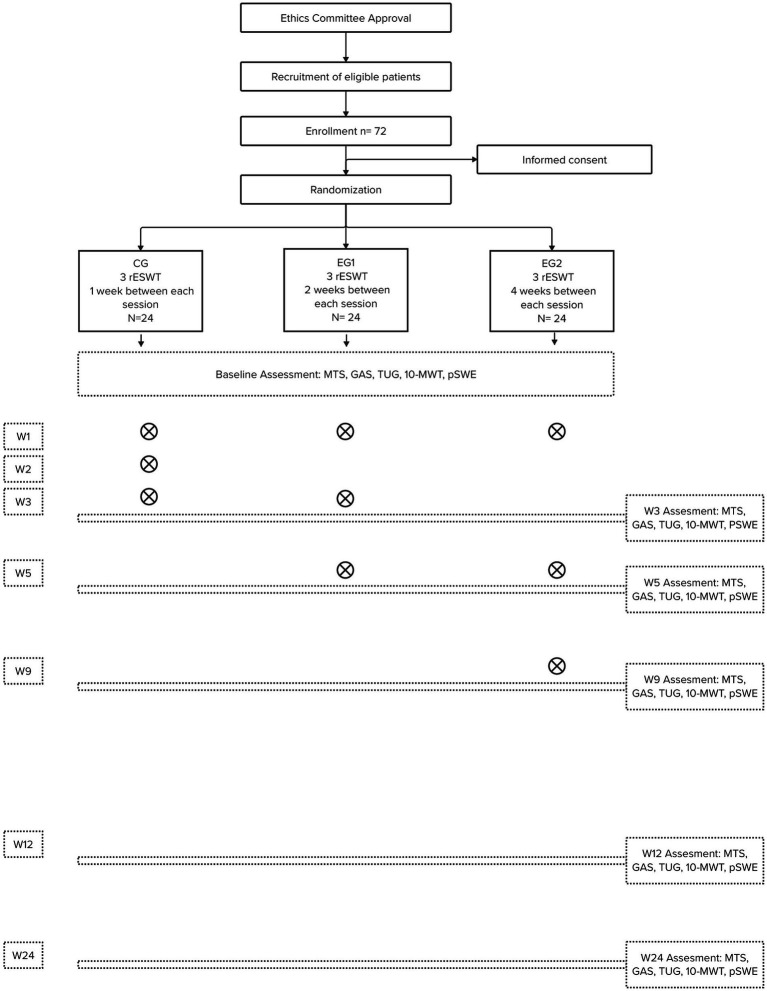 Figure 1
Peer Reviews
No public reviews on file for this paper yet. If you reviewed it on a platform where reviews are public (OpenReview, ICLR, NeurIPS, ICML), you can paste yours below so the community can read it here.
Videos
No videos yet. Explain this paper in a talk, walkthrough, or lecture? Add one.
Taxonomy
TopicsDiverse Scientific and Economic Studies · Human auditory perception and evaluation