Pityriasis Rosea-Like Eruption following anti-fatigue traditional herbs: Aconitum carmichaelii Debx and Panax Ginseng suspected
Xueyan Zeng, Xin Zhou, Aiping Zhang, Yanqin Zhu, Bin Lu, Feiqin Zhu, Mengqi Wu, Riyang Lin

TL;DR
A patient developed a skin rash similar to pityriasis rosea after taking anti-fatigue herbs containing Aconitum carmichaelii Debx and Panax Ginseng.
Contribution
This case report highlights a rare adverse effect of anti-fatigue herbs, specifically PR-LE, and emphasizes the need for monitoring.
Findings
PR-LE developed 6 days after taking anti-fatigue herbs.
The rash faded after 17 days of discontinuing Aconitum carmichaelii Debx and Panax Ginseng.
Abstract
Traditional herbs have a history of clinical use in anti-fatigue. However, several adverse effects of herbs have been identified. Pityriasis rosea-like eruption (PR-LE) is a rare cutaneous complication of herbs. To the best of our knowledge, there have been few reports of PR-LE following herbs. Here, we described a case of PR-LE that developed 6 days after taking anti-fatigue herbs. After the 17 days of stopping Aconitum carmichaelii Debx and Panax Ginseng, it notably faded. So, when anti-fatigue herbs being authorized for fatigue use, monitoring for potential adverse effects is necessary. The online version contains supplementary material available at 10.1186/s12906-024-04556-5.
Genes, proteins, chemicals, diseases, species, mutations and cell lines named across the full text — each resolved to its canonical identifier and authoritative record.
Click any figure to enlarge with its caption.
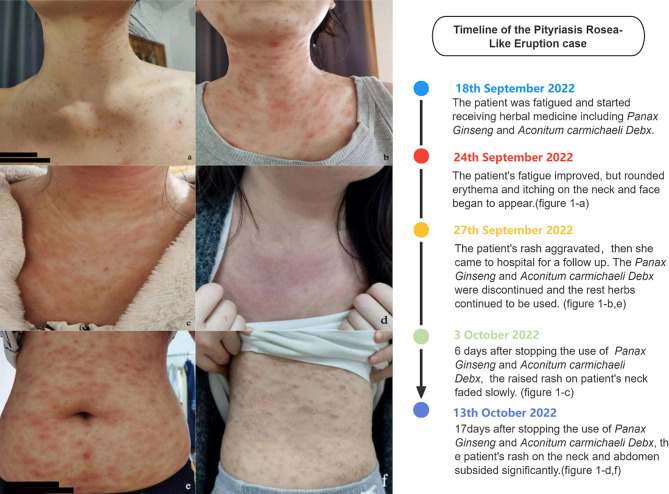 Figure 1
Peer Reviews
No public reviews on file for this paper yet. If you reviewed it on a platform where reviews are public (OpenReview, ICLR, NeurIPS, ICML), you can paste yours below so the community can read it here.
Videos
No videos yet. Explain this paper in a talk, walkthrough, or lecture? Add one.
Taxonomy
TopicsUrban, Neighborhood, and Segregation Studies