Early cognitive assessment in premature infants: the discriminatory value of eye-tracking vs. Bayley Scales
Maria Kaltsa, Evgenia Babacheva, Georgia Fotiadou, Evanthia Goutsiou, Katerina Kantziou, Katerina Nicolaidis, Vasiliki Soubasi

TL;DR
Eye-tracking can detect cognitive differences in premature infants as early as 8-9 months, offering a more sensitive tool than traditional assessments like the Bayley Scales.
Contribution
A novel eye-tracking paradigm for assessing visual working memory and attention in infants, showing higher discriminatory power than Bayley Scales for preterm infants.
Findings
Eye-tracking data showed significant group differences in visual working memory between preterm and full-term infants.
Preterm infants with fetal growth restriction had measurable eye-tracking performance effects not captured by Bayley scores.
Eye-tracking is a non-intrusive, short-duration method for early cognitive assessment in preterm infants.
Abstract
The testing of visuocognitive development in preterm infants shows strong interactions between perinatal characteristics and cognition, learning and overall neurodevelopment evolution. The assessment of anticipatory gaze data of object-location bindings via eye-tracking can predict the neurodevelopment of preterm infants at the age of 3 years; little is known, however, about the early cognitive function and its assessment methods during the first year of life. The current study presents data from a novel assessment tool, a Delayed Match Retrieval (DMR) paradigm via eye-tracking was used to measure visual working memory (VWM) and attention skills. The eye-tracking task that was designed to measure infants’ ability to actively localize objects and to make online predictions of object-location bindings. 63 infants participated in the study, 39 preterm infants and 24 healthy full term…
Genes, proteins, chemicals, diseases, species, mutations and cell lines named across the full text — each resolved to its canonical identifier and authoritative record.
Click any figure to enlarge with its caption.
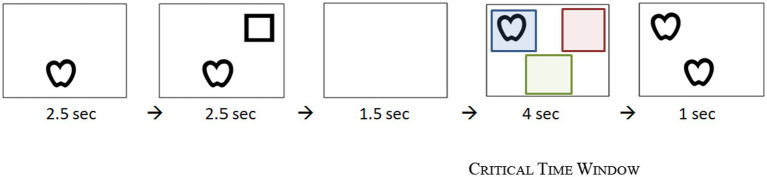 Figure 1
Peer Reviews
No public reviews on file for this paper yet. If you reviewed it on a platform where reviews are public (OpenReview, ICLR, NeurIPS, ICML), you can paste yours below so the community can read it here.
Videos
No videos yet. Explain this paper in a talk, walkthrough, or lecture? Add one.
Taxonomy
TopicsInfant Development and Preterm Care · Neonatal and fetal brain pathology · Neonatal Respiratory Health Research