Biomechanical analysis of a trans-discal, multi-level stabilization screw (MLSS) at the upper instrumented vertebra (UIV) of long posterior thoracolumbar instrumentations
Andrew P. Collins, Anoli A. Shah, Niloufar Shekouhi, Vijay K. Goel, Alekos A. Theologis

TL;DR
This study compares a new screw design with traditional screws in spinal surgery, finding changes in stress and motion at different spinal levels.
Contribution
The study introduces a biomechanical evaluation of a trans-discal, multi-level stabilization screw in thoracolumbar instrumentation.
Findings
The MLSS increased T10 and T11 bone stresses by 46% and 98% compared to traditional screws.
The MLSS reduced annular stress and intradiscal pressure at T10-11 by 29% and 48%, respectively.
The MLSS increased ROM at T10-11 by 39% and decreased it at T11-12 by 23%.
Abstract
To evaluate proximal junctional biomechanics of a MLSS relative to traditional pedicle screw fixation at the proximal extent of T10-pelvis posterior instrumentation constructs (T10-p PSF). A previously validated three-dimensional osseoligamentous spinopelvic finite element (FE) model was used to compare proximal junctional range-of-motion (ROM), vertebral body stresses, and discal biomechanics between two groups: (1) T10-p with a T10-11 MLSS (“T10-11 MLSS”) and (2) T10-p with a traditional T10 pedicle screw (“Traditional T10-PS”). The T10-11 MLSS had a 5% decrease in T9 cortical bone stress compared to Traditional T10-PS. Conversely, the T10 and T11 bone stresses increased by 46% and 98%, respectively, with T10-11 MLSS compared to Traditional T10-PS. Annular stresses and intradiscal pressures (IDP) were similar at T9-T10 between constructs. At the T10-11 disc, T10-11 MLSS decreased…
Genes, proteins, chemicals, diseases, species, mutations and cell lines named across the full text — each resolved to its canonical identifier and authoritative record.
Click any figure to enlarge with its caption.
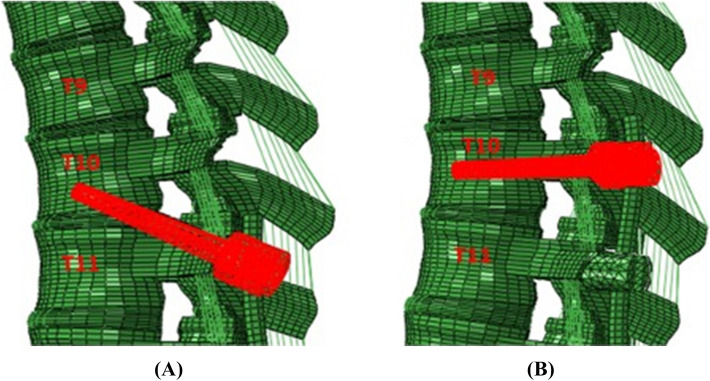 Figure 1
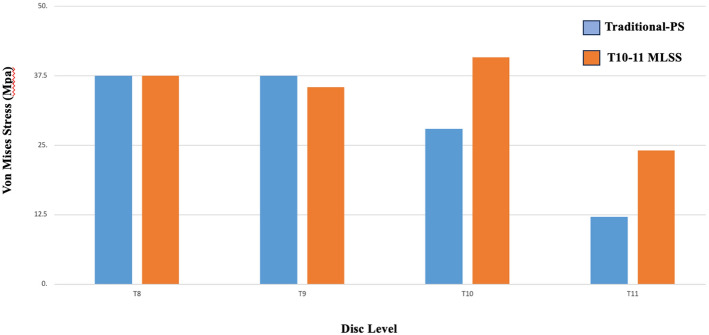 Figure 2
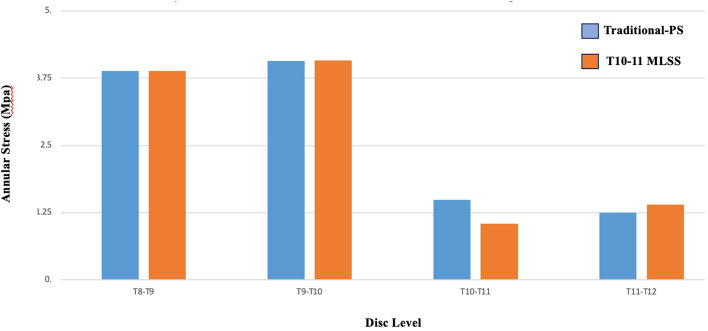 Figure 3
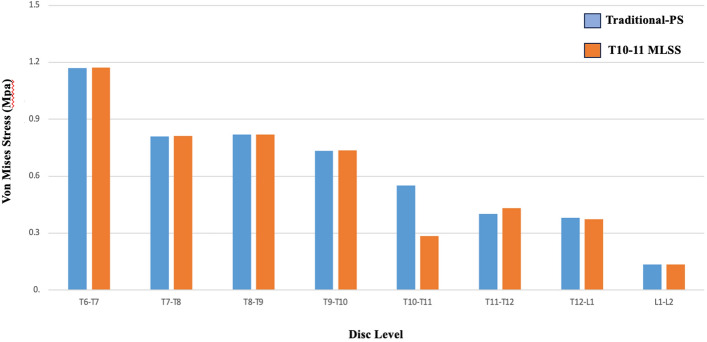 Figure 4
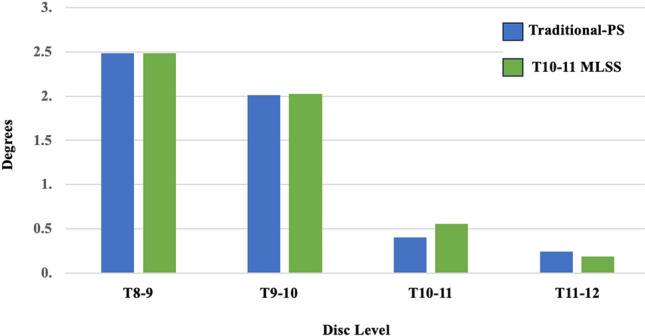 Figure 5
Peer Reviews
No public reviews on file for this paper yet. If you reviewed it on a platform where reviews are public (OpenReview, ICLR, NeurIPS, ICML), you can paste yours below so the community can read it here.
Videos
No videos yet. Explain this paper in a talk, walkthrough, or lecture? Add one.
Taxonomy
TopicsSpine and Intervertebral Disc Pathology · Spinal Fractures and Fixation Techniques · Scoliosis diagnosis and treatment