Haplotype-resolved assembly of the mule duck genome using high-fidelity sequencing technology
Tiandong Che, Jing Li, Xiaobo Li, Zhongsi Wang, Xuemei Zhang, Weifei Yang, Tao Liu, Yan Wang, Kaiqian Wang, Tian Gao, Guangqiang Shen, Wanling Qiu, Zhimin Li, Wenguang Zhang

TL;DR
This paper presents high-quality haplotype assemblies of a female mule duck genome, revealing structural variations and gene expression differences that could aid in duck breeding and functional genomics.
Contribution
The study provides the first haplotype-resolved genome assembly of a mule duck with high continuity and completeness, along with insights into structural variations and haplotype-specific gene expression.
Findings
The mule duck genome assemblies show high continuity and completeness, outperforming existing duck genomes.
Structural variations correlate with autosome length, and haplotype-specific genes are involved in muscle-related biological processes.
Haplotype-specific expression genes were identified, with similar biological functions in both haplotypes.
Abstract
Mule duck is vitally important to the production of global duck meat. Here, we present two high-quality haplotypes of a female mule duck (haplotype 1 (H1):1.28 Gb, haplotype 2 (H2): 1.40 Gb). The continuity (H1: contig N50 = 14.90 Mb, H2: contig N50 = 15.70 Mb) and completeness (BUSCO: H1 = 96.9%, H2 = 97.3%) are substantially better than those of other duck genomes. We detected the structural variations (SVs) in H1 and H2. We observed a positive correlation between autosome length and the number of SVs. Z chromosome was some deficient in deletions and insertions, but W chromosome was some excessive. A total of 1,451 genes were haplotype specific expression (HSEs). Among them, 737 specifically expressed in H1, and 714 specifically expressed in H2. We found that H1 and H2 HSEs tended to be involved in similar biological processes, such as myometrial relaxation and contraction pathways,…
Genes, proteins, chemicals, diseases, species, mutations and cell lines named across the full text — each resolved to its canonical identifier and authoritative record.
Click any figure to enlarge with its caption.
 Figure 1
 Figure 2
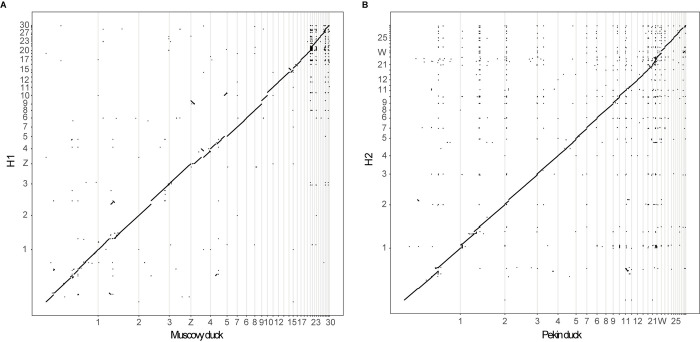 Figure 3
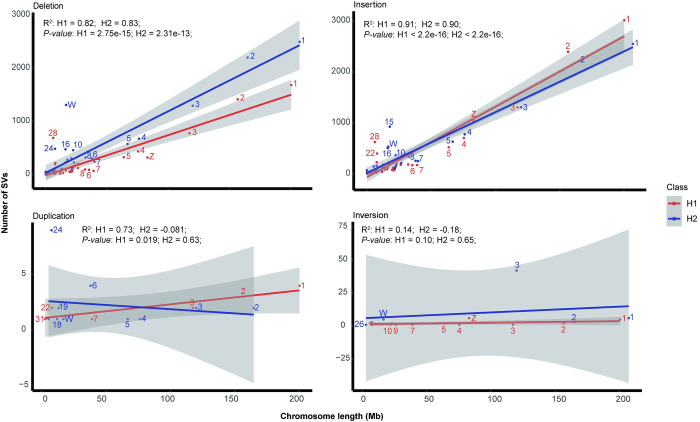 Figure 4
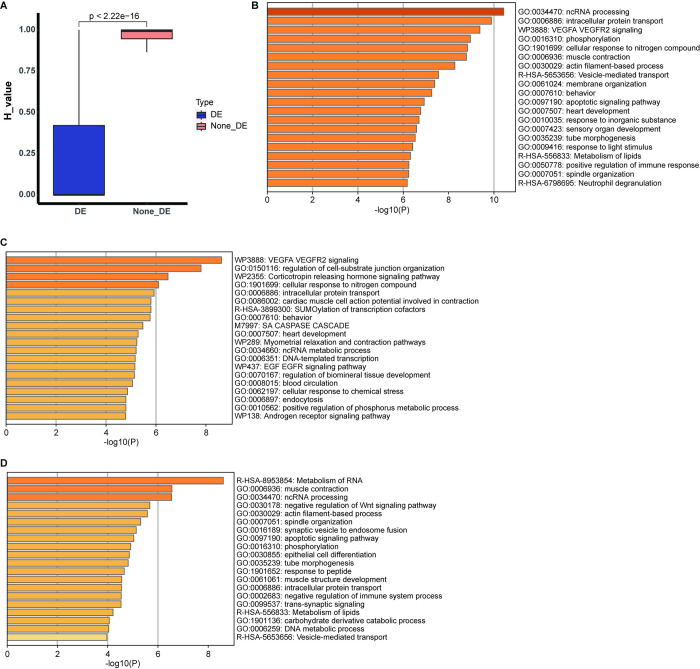 Figure 5
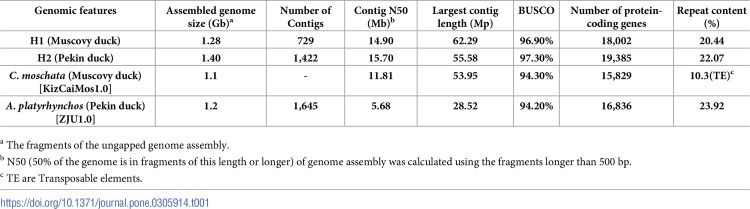 Figure 6
Peer Reviews
No public reviews on file for this paper yet. If you reviewed it on a platform where reviews are public (OpenReview, ICLR, NeurIPS, ICML), you can paste yours below so the community can read it here.
Videos
No videos yet. Explain this paper in a talk, walkthrough, or lecture? Add one.
Taxonomy
TopicsGenomics and Phylogenetic Studies · Genetic and phenotypic traits in livestock · Molecular Biology Techniques and Applications