Tracking the shift in enteric fever trends and evolving antibiotic sensitivity patterns
Yoganathan Chidambaram, Clement J Dhas, R Juhi, Velammal Petchiappan, S Sujithkumar

TL;DR
This study tracks changes in enteric fever trends and antibiotic resistance in Salmonella species over 12 years.
Contribution
The study documents a shift from Salmonella Paratyphi to Typhi and highlights current antibiotic susceptibility patterns.
Findings
Salmonella Typhi caused 89.62% of enteric fever cases compared to 10.38% by Paratyphi A.
Azithromycin and ceftriaxone showed high effectiveness against Salmonella isolates.
Nalidixic acid resistance was observed in 4.72% of isolates.
Abstract
This study aims to examine the frequency of Salmonella Paratyphi found in blood cultures and evaluate the antibiotic susceptibility pattern of Salmonella isolates to different antibiotics. Additionally, the study aims to assess the paradigm shift in the trend of enteric fever caused by Salmonella Typhi (S. Typhi) to Salmonella Paratyphi(S. Paratyphi) . Retrospective study The study enrolled patients aged 12 years and above diagnosed with enteric fever (positive blood culture) and admitted to Peelamedu Samanaidu Govindasamy Naidu (PSG) Hospital. The study analyzed demographic and antibiotic susceptibility profiles of Salmonella isolates collected from 106 enteric fever patients in the hospital between 2010 and 2022. The susceptibility profiles of Salmonella isolates to multiple antibiotics were assessed. There were 106 participants, and 95 (89.62%) of them had enteric fever linked to…
Genes, proteins, chemicals, diseases, species, mutations and cell lines named across the full text — each resolved to its canonical identifier and authoritative record.
Click any figure to enlarge with its caption.
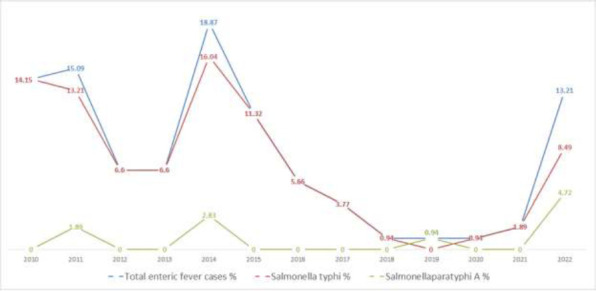 Figure 1
| Antibiotics | Sensitivity | n (%) |
|
|
|
|
|
|
| |
|
|
|
|
|
|
| |
|
|
|
|
|
|
| |
|
|
|
|
|
|
| |
|
|
|
|
|
|
| |
|
|
|
|
|
|
| |
|
|
|
|
|
|
|
Peer Reviews
No public reviews on file for this paper yet. If you reviewed it on a platform where reviews are public (OpenReview, ICLR, NeurIPS, ICML), you can paste yours below so the community can read it here.
Videos
No videos yet. Explain this paper in a talk, walkthrough, or lecture? Add one.
Taxonomy
TopicsSalmonella and Campylobacter epidemiology · Viral gastroenteritis research and epidemiology · Hepatitis Viruses Studies and Epidemiology
Introduction
Gram-negative bacteria, notably S. Typhi (typhoid fever) and S. Paratyphi (paratyphoid fever) are the source of enteric fever, an infectious disease that can be caught by tainted food and water. Poor hygiene habits, poor sanitation, low socioeconomic level, and consuming food or water contaminated with faeces from either acutely infected individuals or chronic, asymptomatic carriers are the key risk factors for this illness.1,2
Earlier research has established enteric fever as a crucial public health concern worldwide, with yearly records of more than 21.6 million cases and no less than 250,000 fatalities. Previous studies have shown that enteric fever is a serious public health issue that affects the entire world, with annual records of more than 21.6 million cases and at least 250,000 fatalities. In underdeveloped countries like India, the disease prevalence ranges from 102 to 2,219 per 100,000 people. In Nigeria, typhoid fever remains a significant issue due to urbanization, limited clean water, immigrant worker mobility, poor waste management, strained healthcare, and antibiotic overuse fostering antibiotic-resistant S. Typhi. Yet, research indicates varying prevalence, from 0.071% in Oyo to 47.1% in Osun.3,4,5,6
Systemic febrile sickness typhoid fever requires prompt antibiotic treatment. In the past few decades, Typhi bacteria have become increasingly resistant to first-line antibiotics such as chloramphenicol, ampicillin, and trimethoprim-sulfamethoxazole, leading to the use of fluoroquinolones like ciprofloxacin as the primary treatment option. However, since the early 2000s, there has been a surge in fluoroquinolone non-susceptibility, including intermediate or complete resistance to ciprofloxacin, particularly in South Asia.
As a result, third-generation cephalosporins, such as ceftriaxone, are now recommended as the new first-line treatment. In Pakistan, a typhoid fever outbreak caused by Salmonella enterica serotype Typhi occurred in February 2018. The bacteria were resistant to several antibiotics, such as ampicillin, chloramphenicol, fluoroquinolones, trimethoprim-sulfamethoxazole, and third-generation cephalosporins. The emergence of fluoroquinolone non-susceptible strains resistant to third-generation cephalosporins like ceftriaxone further complicated this outbreak. As a result, typhoid illness has become more difficult worldwide and not only in Pakistan.7,8,9
The rise of the novel, extensively drug-resistant (XDR) strains of S. Typhi is alarming, with reports of them appearing for the first time in Pakistan. These strains have expanded globally, including in the USA, and are resistant to first-line medications such as ciprofloxacin and ceftriaxone.10,11 Typhoid fever treatment costs, mortality, and morbidity have all increased as a result of the rise in antibiotic resistance. However, these pricey carbapenems and azithromycin, which continue to be the backbone of treatment for infected patients, are effective against these XDR strains of Salmonella.12,13,14,15
The ever-evolving antimicrobial resistance patterns of Salmonella Typhi in typhoid fever necessitate frequent studies to identify new resistant strains in different regions on time. Our investigation seeks to evaluate the incidence and antibiotic sensitivity patterns of Salmonella isolates collected from patients with enteric fever.
Methods
Study population
A retrospective analysis was carried out with patients admitted to Peelamedu Samanaidu Govindasamy Naidu (PSG) Hospital between January 2010 and December 2022. The study comprised patients over 12 years old who were admitted to PSG Hospital with enteric fever (positive Blood culture). Case records of about 132 patients with enteric fever were scrutinized. Among them, 26 were excluded because of the lack of blood culture (a clinical diagnosis of enteric fever was made).
Study design and methodology
Between 2010 and 2016, conventional blood culture bottles were used to culture all collected blood samples, while the BACTEC blood culture system was adopted from 2017 onwards for the purpose of Salmonella isolation. The Salmonella serotype was identified through the triple sugar iron test (based on H_2_S production) from 2010 to 2018 and the VITEK method from 2019 onwards. Investigation of the trend of Salmonella species causing enteric fever between 2010 and 2022, as well as the susceptibility of identified serotypes to a range of antibiotics, including trimethoprim + sulfamethoxazole, ceftriaxone, nalidixic acid, fluoroquinolones, azithromycin, ampicillin, and chloramphenicol was also performed. Data were entered in Excel, and statistical analysis was done in SPSS version 28. The frequency and percentage were used to explain the categorical variables, whereas the continuous variables were presented in terms of mean, standard deviation, minimum, and maximum values.
Ethical clearance
Ethics approval was obtained from Institutional Human Ethics Committee (IHEC), PSG IMS&R (Ref. No. PSG/IHEC/2023/Appr/Exp/006) on January 05, 2023
Results
Among 106 participants, incidences of S. Typhi-associated enteric fever were observed in 95 (89.62%) participants, whereas only 11(10.38%) participants showed S. Paratyphi A associated enteric fever with a male preponderance (80 males and 26 females). The study showed a decreased rate of total enteric fever cases from 2011 (15.09 %) to 2013 (6.60%) and from 2014 (18.87%) to 2020 (0.94%). However, there was a significant increase in the overall number of cases of enteric fever between 2013 (6.60%) and 2014 (18.87%) and 2021 (1.89%) and 2022 (13.21%). S. Typhi and S. Paratyphi infections escalated from 2013 (6.60% and 0.0%) to 2014 (16.04% and 2.83%, respectively), and from 2021 (1.89% and 0.0%) to 2022 (8.49% and 4.72%, respectively). From 2011 (13.21% and 1.89%, respectively) to 2013 (6.60% and 0.0%, respectively) and from 2014 (16.04% and 2.83%, respectively) to 2021 (1.89% and 0.0%, respectively), there was a decline in the infection rate for both S. Typhi and S. Paratyphi infections (Figure 1).
Trend of Salmonella species causing enteric fever over a period between 2010 to 2022
The sensitivity of the Salmonella isolates (S. Typhi and Paratyphi) to various antibiotics was evaluated. Table 1 compiles the antimicrobial susceptibility profile of all isolates to the seven antimicrobial drugs. Both strains of Salmonella exhibited perfect resistance to nalidixic acid (95.28%) and the highest sensitivity to azithromycin (100%) followed by ceftriaxone (99%).
All patients were discharged after an afebrile period of at least 48 hours
Discussion
The current study concentrated on the presence of S. Typhi and S. Paratyphi in blood cultures obtained from patients with enteric fever and their susceptibility to various antimicrobial drug classes, such as combination of trimethoprim and sulfamethoxazole, ceftriaxone, nalidixic acid, fluoroquinolones, azithromycin, ampicillin, and chloramphenicol.
In this study, we observed that S. Typhi infection was prevalent in most patients (89.62%) diagnosed with enteric fever, with men being the more commonly affected gender. The higher incidence of enteric fever among men could be attributed to variations in S. Typhi exposure, potentially linked to gender-related differences in dietary practices and hygiene habits. Additionally, the male predominance in typhoid fever might be influenced by differences in the inflammatory response patterns within host Peyer's patches triggered by S. Typhi or the natural exposure of Peyer's patches to S. Typhi, considering sexual dimorphism. These findings align with similar results reported by Umair and Siddiqui, 2020, where S. Typhi was isolated in 79.5% of cases and S. Paratyphi in 20.5%, with a male-to-female ratio of nearly 2:1.
Among these cases, males constituted 66.3%, while females accounted for 33.7%.16,17,18
The 12-year analysis of the trajectory of enteric fever cases caused by Salmonella species revealed a sharp increase in cases from 2013 to 2014 (12.27%) and from 2021 to 2022 (11.32%). Furthermore, in cases where the isolated strains are nalidixic acid-resistant, the majority of Salmonella isolates exhibited sensitivity to azithromycin, ceftriaxone, and chloramphenicol. One of the primary causes of quinolone resistance is thought to include mutations in the quinolone resistance-determining region (QRDR) of gyrA, a subunit of the DNA gyrase enzyme.19 Another explanation may include transferable plasmid-mediated quinolone resistance (PMQR) genes such as pentapeptide repeat protein-encoding qnrA, qnrB, and qnrS; an efflux-pump-encoding qepA; and an aminoglycoside acetyltransferase-encoding enzyme variant aac(6′)-Ib-cr which may cause low-level fluoroquinolones resistance.20,21,22,23 In instances of S. Pratyphi in India, as noted in the study by Sharvani et al., 2016 the presence of Nalidixic Acid Resistance (NAR) signifies a form of reduced resistance to ciprofloxacin, potentially leading to treatment ineffectiveness.
Strains that are initially resistant to Nalidixic Acid may necessitate fewer exposures to fluoroquinolones (FQ) to develop strong resistance to ciprofloxacin compared to strains that are initially susceptible to ciprofloxacin.20,24,25,26 In another study conducted by Adabara, et al., 2012 in a Military Hospital in Minna, Nigeria, it was found that S. Typhi isolates exhibited resistance to key antibiotics commonly prescribed in the study region for treating typhoid fever, including ceftriaxone, cefuroxime, amoxicillin, ampicillin, ciprofloxacin, and combination of amoxicillin and clavulanic acid (augmentin).
Interestingly, they showed sensitivity to chloramphenicol and ofloxacin, but these antibiotics were not typically utilized for typhoid fever treatment in that area. The study identified the presence of multiple drug-resistant (MDR) strains of S. Typhi, which could be attributed to the overuse of a limited selection of antibiotics and potential issues with an accurate diagnosis, leading to the emergence and dissemination of resistant S. Typhi strains. Consequently, the study underscores the importance of a collaborative effort between physicians and laboratories when selecting antibiotics for bacterial disease treatment, aiming to curb the development of antibiotic-resistant bacterial pathogens.27
There is a trend of changes in enteric fever from S. Typhi to S. Paratyphi over the years. Zellweger et al., 2017 have discussed the possible reasons behind this as various environmental, ecological, or epidemiological factors.28 Another explanation is that there are currently two vaccines available for the protection of typhoid fever. The parenteral Vi vaccine is based on the S. Typhi Vi antigen, whereas the live attenuated oral Ty21a vaccine contains the S. Typhi strain Ty21a. Since S. Paratyphi A lacks the Vi- polysaccharide capsule antigen, Vi-based vaccines are unlikely to protect against paratyphoid fever.29
The retrospective approach of the current study, which relies on previously gathered data, may be subjected to information and selection biases, imposing constraints on its scope. The research was restricted to a single centre, further limiting the generalizability of the results to other settings. Additionally, the absence of follow-up details hinders the assessment of long-term outcomes and the establishment of causal relationships. Future research should address these limitations to provide a more comprehensive understanding of the topic. Another drawback of the study is that the vaccination status of the study participants was not included.
Conclusion
In this study, S. Typhi was the most common cause of enteric fever, and it mostly affected men. Both Salmonella strains showed susceptibility against traditional first-line antibiotics but resistance to quinolone antibiotics such as nalidixic acid. It is also suggested that to treat salmonellosis cases caused by ciprofloxacin (fluoroquinolones) resistant Salmonella strains, a third-generation cephalosporin, such as cefotaxime or ceftriaxone, is the first choice.
However, if resistance to these antibiotics develops, the available treatment options will be carbapenems or fourth generation cephalosporins, tigecycline, or a combination antibiotic therapy. In view of the constantly shifting environment, this study emphasizes the necessity for ongoing evaluation and prudent antimicrobial use. For the primary prevention of illness, public health awareness efforts and immunization programs against Salmonella should also be taken into consideration.
The reference list from the paper itself. Each links out to its DOI / PubMed record.
- 1Patil N Mule P Sensitivity Pattern Of Salmonella typhi And Paratyphi A Isolates To Chloramphenicol And Other Anti-Typhoid Drugs: An In Vitro Study Infect Drug Resist 20191232173225 doi:10.2147/IDR.S 2046183168687210.2147/IDR.S 204618 PMC 6800285 · doi ↗ · pubmed ↗
- 2Mogasale V Maskery B Ochiai RL Lee JS Mogasale VV Ramani E Kim YE Park JK Wierzba TF Burden of typhoid fever in low-income and middle-income countries: a systematic, literature-based update with risk- factor adjustment Lancet Glob Health 2014 Oct 210e 570e 580doi:10.1016/S 2214-109X(14)70301-82530463310.1016/S 2214-109X(14)70301-8 · doi ↗ · pubmed ↗
- 3Zaki SA Karande S Multidrug-resistant typhoid fever: a review J Infect Dev Ctries 201155324337 doi:10.3855/jidc.14052162880810.3855/jidc.1405 · doi ↗ · pubmed ↗
- 4Crump JA Luby SP Mintz ED The global burden of typhoid fever Bull World Health Organ 2004 May 82534635315298225 PMC 2622843 · pubmed ↗
- 5Kothari A Pruthi A Chugh TD The burden of enteric fever J Infect Dev Ctries 2008 Aug 3024253259 doi:10.3855/jidc.2181974128510.3855/jidc.218 · doi ↗ · pubmed ↗
- 6Akinyemi KO Oyefolu AOB Mutiu WB Typhoid Fever: Tracking the Trend in Nigeria Am J Trop Med Hyg 2018993_Suppl 4147 doi:10.4269/ajtmh.18-00453004736210.4269/ajtmh.18-0045 PMC 6128359 · doi ↗ · pubmed ↗
- 7Chatham-Stephens K Medalla F Hughes M Emergence of Extensively Drug-Resistant Salmonella Typhi Infections Among Travelers to or from Pakistan - United States, 2016-2018 MMWR Morb Mortal Wkly Rep 20196811113 doi:10.15585/mmwr.mm 6801 a 33062957310.15585/mmwr.mm 6801 a 3PMC 6342547 · doi ↗ · pubmed ↗
- 8Centre for Disease Control and Prevention Symptoms and Treatment 2022 Available on: https://www.cdc.gov/typhoid-fever/symptoms.html