Impact of haemoglobin variants on the diagnostic sensitivity of glycated haemoglobin (HbA1c) assay methodologies in sub-Saharan Africa: a laboratory-based method validation study
Priscilla Agatha Balungi, Anxious Jackson Niwaha, Rachel Nice, Lauren Rodgers, Nathan Mubiru, Rogers Mukasa, Angus Jones, Andrew Hattersley, Beverley Shields, Moffat Nyirenda, Timothy J McDonald

TL;DR
This study shows that HbA1c testing methods work reliably for diabetes diagnosis in sub-Saharan Africa, even in people with common haemoglobin variants like HbAS.
Contribution
Demonstrates that major HbA1c assay methods are accurate and comparable in populations with high HbAS prevalence.
Findings
All HbA1c methods strongly correlated with continuous glucose monitoring (CGM) average glucose levels.
Presence of HbAS did not affect the relationship between HbA1c and CGM glucose for any method.
Diagnostic accuracy was similar across methods for key glucose thresholds.
Abstract
the utility of glycated haemoglobin (HbA1c) for the diagnosis and monitoring of diabetes in sub-Saharan Africa is uncertain due to limited data on the performance of the available HbA1c assay methods in this population, which has a high prevalence of haemoglobin variants. We aimed to compare the diagnostic accuracy of the major HbA1c methodologies (Boronate Affinity, Capillary Electrophoresis, High Performance Liquid Chromatography, Immunoassay) in an African population, and assess the impact of the common haemoglobin variant HbAS (sickle cell trait). whole blood samples were obtained from 182 individuals living with type 2 diabetes in Uganda. HbA1c values for each method were compared to average glucose measured over 14 days by continuous glucose monitoring (CGM). To determine concordance, the three HbA1c assay methods were compared to the capillary electrophoresis method. there was…
Genes, proteins, chemicals, diseases, species, mutations and cell lines named across the full text — each resolved to its canonical identifier and authoritative record.
Click any figure to enlarge with its caption.
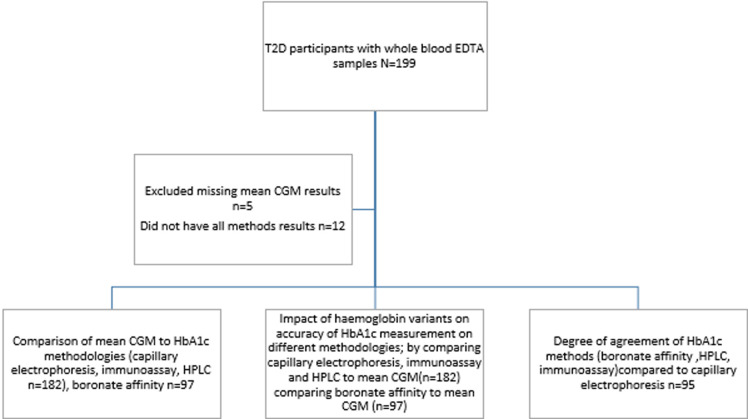 Figure 1
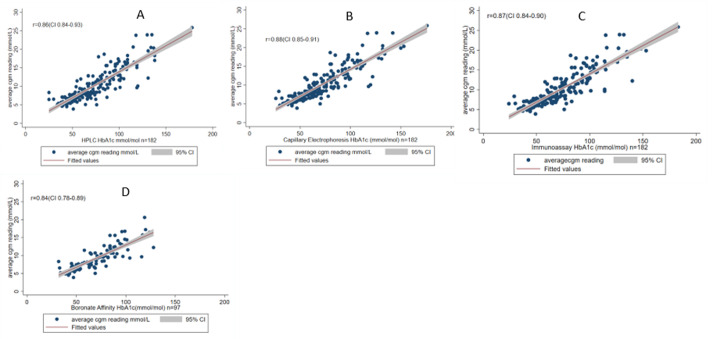 Figure 2
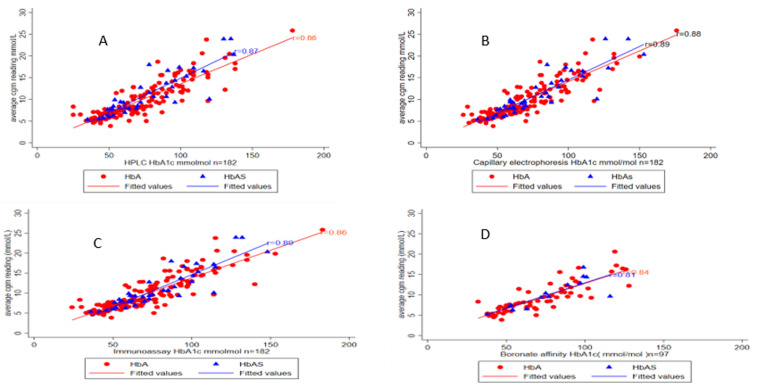 Figure 3
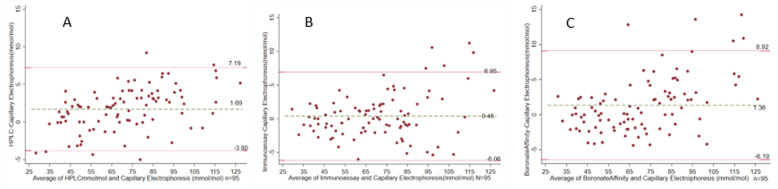 Figure 4
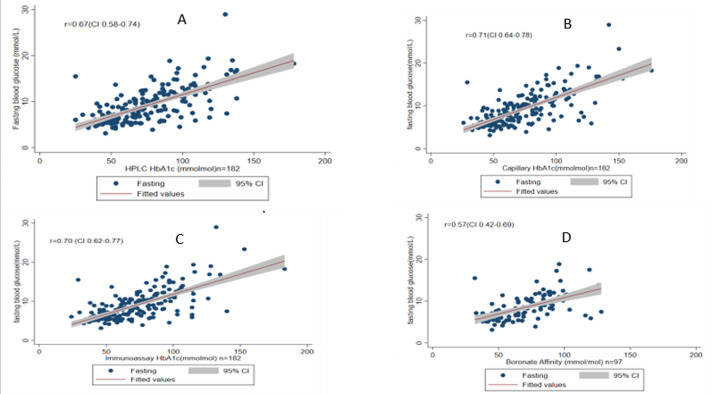 Figure 5
| Instrument | Methodology | Hb variant information | Advantages |
|---|---|---|---|
| Roche Hitachi cobas 6000 | Immunoassay | No | High throughput. Not largely affected by variant AS, AD, AE, AC |
| Sebia flexi minicap piercing | Capillary electrophoresis | Yes | Information on presence variants Hb, Electrophoresis module on instrument |
| Afinion AS100 (point of care) | Boronate affinity | No | Ease of use, Quick turnaround time, Point of care |
| G8 Tosoh | Anion exchange high performance liquid chromatography | Yes | Information on HB fractions |
| Description | Mean (±SD b), n(%) |
|---|---|
| Age-years | 56 (±9.7) |
| Diabetes duration years mean | 7.9(±6.2) |
| Female | 125(58.7) |
|
| |
| Rural | 103(56.5) |
| Urban | 79(43.4) |
| Mean Haemoglobin (g/dl) | 14.1 |
|
| |
| HbA | 143(78.5) |
| HbAS a | 39(21.4) |
|
|
|
| HbA | 12(8.4) |
| HbAS | 4(10.3) |
|
| |
| Boronate Affinity | 70.9 (±23.2) |
| Anion high performance liquid chromatography | 73.1(±27.3) |
| Immunoassay | 72.8(±27.1) |
| Capillary Electrophoresis | 71.4(±27.2) |
| Average glucose from CGM reader (mmol/L) | 10.1 (±4.5) |
| HbA1c assay methodology | HbA | HbA | HbAS | HbAS | p-value |
|---|---|---|---|---|---|
| HPLCa | 0.86(0.82,0.90) | 19.2+ 5.65*CGM | 0.87(0.76,0.93) | 21.7+ 4.86*CGM | 0.26 |
| Capillary Electrophoresis | 0.88(0.83,0.91) | 15.0±5.63*CGM | 0.89(0.79,0.94) | 19.4±5.24*CGM | 0.69 |
| Immunoassay | 0.86(0.82,0.90) | 17.0 ± 5.59*CGM | 0.89(0.79,0.94) | 22.5+ 4.99*CGM | 0.44 |
| Boronate Affinity | 0.84(0.77,0.90) | 18.7+ 5.73*CGM | 0.81(0.53,0.93) | 22.6+ 5.39*CGM | 0.37 |
| Average glucose results CGM reader(mmol/L) (HbA1c) | HPLCa | Immunoassay | Boronate Affinity | Capillary Electrophoresis |
|---|---|---|---|---|
| > 7.0 mmol/L (53) mmol/mol | 0.80(0.74,0.87) | 0.83(0.77,0.89) | 0.83(0.74,0.92) | 0.84 (0.77,0.90) |
| > 10.0 mmol/L (63) mmol/mol | 0.82(0.77,0.87) | 0.82(0.77,0.87) | 0.76(0.69,0.82) | 0.84(0.80,0.89) |
Peer Reviews
No public reviews on file for this paper yet. If you reviewed it on a platform where reviews are public (OpenReview, ICLR, NeurIPS, ICML), you can paste yours below so the community can read it here.
Videos
No videos yet. Explain this paper in a talk, walkthrough, or lecture? Add one.
Taxonomy
TopicsDiabetes, Cardiovascular Risks, and Lipoproteins · Hemoglobinopathies and Related Disorders · Artificial Intelligence in Healthcare
Introduction
Glycated haemoglobin (HbA1c) is the glycated portion of the haemoglobin compound formed through a non- enzymatic process during the life cycle of a red blood cell (~120 days). Stable HbA1c is proportional to the individual´s average glucose exposure over the preceding 90 days, which is clinically useful for the diagnosis and monitoring of diabetes mellitus [1]. HbA1c is measured by a number of methodologies, each exploiting differences in properties such as affinity, charge and immune-reactivity of the glycated haemoglobin molecule [2]. Changes in the amino acid sequence of the haemoglobin molecule caused by genetic mutations lead to presence of haemoglobin variants (for example amino acid substitution at position 6 (HbS), position 26 (HbE), and position 121 (HbD) [3,4]. The presence of these haemoglobin variants may interfere with the reliability of the HbA1c measurement [5]. The exact mechanisms leading to unreliable HbA1c measures in the presence of a haemoglobin variant are variable, but include alteration of glycation rates, red cell half-life or direct assay interference [6]. Modern HbA1c methodologies utilising chromatography or separation to quantify HbA1c are able to detect the presence of haemoglobin variants and validation calculators have been developed to correct for some of the more common variants [7,8]. Conversely, technologies that quantify HbA1c using the dye detection method (boronate affinity), or immuno reactivity method (immunoassay) do not offer information regarding the presence of the haemoglobin variants [5]. Up to 80% of the world haemoglobin variants are found in the sub-Saharan area of the African continent [9], but studies assessing performances of these HbA1c methodologies in this population are lacking. Therefore, it remains uncertain if the widely used HbA1c methodologies such as immunoassay, boronate affinity are reliable for diabetes diagnosis and monitoring within this population [10]. In this study, we aimed to assess the diagnostic sensitivity of the main HbA1c assays (Anion exchange High Performance Liquid Chromatography (HPLC), Capillary Electrophoresis, Immunoassay and Boronate Affinity) in the presence of haemoglobin variants, by comparison to the average glucose results calculated from Continuous Glucose Monitoring (CGM) device, and also to understand the degree of agreement between the three technologies (HPLC, immunoassay, boronate) in comparison to the capillary electrophoresis method which was used as the reference method.
Methods
Study setting and design: this was a laboratory-based study which utilised samples from individuals participating in the Ugandan-based Optimal study. The optimal study was a cross sectional multicentre study that recruited type 2 diabetes patients from a rural based hospital (Masaka Regional Referral Hospital) and an urban based hospital (St. Francis Nsambya) who met the following inclusion criteria; diagnosed at the age of 18 years and above, more than 12 months´ diabetes duration, no initial insulin requirement for at least 1 year since the time of diagnosis, no change in glucose lowering therapy 3 months prior, and able to give informed consent [11]. The study received ethical review and approval from Uganda Virus Research Institution Review Board, Uganda National Council of Science and Technology (UNCST) and London School of Hygiene and Tropical Medicine ethics board (LEO).
Laboratory testing: blood was collected at clinic into Ethylene Diamine Tetra Acetic Acid (EDTA) blood collection tubes and then shipped to the testing laboratory within 6 hours at ambient temperature. All samples were tested same day on the immunoassay, capillary electrophoresis method before storage as whole blood at -80°C (for shipment to the United Kingdom for testing on the HPLC method).
HbA1c measurement and detection of a haemoglobin variant: HbA1c measurement was carried out at the Medical Research Council, Uganda Virus Research Institute & London School of Hygiene and Tropical Medicine (MRC/UVRI&LSHTM ) Uganda Research Unit, clinical diagnostics laboratory, on three different platforms: A) Capillary Electrophoresis on the Sebia flexi minicap piercing SN 94173 (Sebia technologies, Evry, France), manufacturer intra and inter assay precision; CV 1.2%; 1.5% respectively, B) Immunoassay method on Cobas 6000, c- model, SN 1493-16 (Hitachi high technologies corporation, Tokyo, Japan), manufacturer intra and inter assay precision; CV 1.1%, 1.5%, C) Boronate affinity method on the point of care instrument Afinion As100 analyzer 8; SN AS0024283 (Abbott rapid diagnostics technologies As, Oslo, Norway), manufacturer intra and inter assay precision; CV 1.2%,1.4%. In addition, samples were shipped to the Academic Department of Blood Sciences Laboratory, Royal Devon and Exeter NHS Foundation Trust, UK for a fourth methodology testing, on the Anion Exchange High Performance Liquid Chromatography method (HPLC) on the Tosoh G8 HPLC -723G8 (TOSOH, Tokyo, Japan), manufacturer intra and inter assay precision CV 0.4%, <2%, a method unavailable in Uganda. The choice of HbA1c methodology /instrument was based on; main detection method principle and also in country availability as shown in Table 1. All methods chosen for the study were standardised against the approved International Federation of Clinical Chemistry (IFCC) reference method for HbA1c measurement in human whole blood, which are traceable to DCCT/NGSP by calculation [12].
Stability testing: in a sub study a set of whole blood samples (n=99) were tested for HbA1c before storage and after storage at -80 °C for one year to determine if the freeze thaw cycle would affect the stability of HbA1c analyte for samples that needed to be tested in a laboratory outside the country after a one-year storage.
Continuous glucose monitor (CGM): continuous glucose monitoring was carried out using the Freestyle Libre Pro Flash Glucose Monitoring System (Abbott Laboratories, IIinois, USA) a professional continuous glucose monitoring device as previously described in the optimal study [13]. Interstitial glucose was recorded every 15 minutes for up to two weeks and raw glucose readings were downloaded from the Libreview software. Sensor data was considered for analysis if the total duration of CGM wear was at least 5 days. This test was used as the reference method since it is an independent marker of glycaemia which follows a different principle from the HbA1c methodologies.
Outcome data: the average glucose data from the continuous glucose monitor (minimum of 5 days) was used as a comparator to the HbA1c results from the four instruments as shown in “Figure 1” flow chart. Out of 199 participants whose whole blood samples were available for Hba1c measurement,17 participants were excluded from analysis due to missing data (Figure 1). A total of 182 EDTA whole blood samples were available for HbA1c method comparison. Only 95 participants had HbA1c measurements assessed on the Point of Care Testing (POCT) from the Boronate Affinity method.
sample testing flow chart of studies on the impact of haemoglobin variants on accuracy of HbA1c results when compared to average glucose CGM results and diagnostic accuracy studies between the index methodologies being compared to a reference method
Statistical analysis: data was analysed using Stata V16.1 (stataCorp LLC, USA) software. Description of the participant baseline characteristics were expressed as mean (±SD) and proportions. We used scatterplots and Pearson correlation coefficients (r) to assess the association between HbA1c assay on each of the platforms to the average glucose readings from the Continuous Blood Glucose monitoring device. Lines of best fit for individuals with the variant and individuals without the variant were determined using linear regression analysis. To assess whether the slopes for those with the variant HbAS and those without were statistically different, an interaction term was used in the model (CGM glucose ~ HbA1c+ variant + (HbA1c*variant)). A two-tailed P<0.05 was considered statistically significant. We used the Bland Altman plots to examine the agreement between HbA1c results on three index methods i.e. Immunoassay, Boronate Affinity, HPLC as compared to the Capillary method which was selected as the reference method [14,15]. Acceptability of the HbA1c differences between the index and reference method were set at 3% (6.6%;48 mmol /mol) reference to total allowable limits according to NGSP [16,17] and at 6% which is the target value for CAP scheme for accuracy based studies (8.8%;73mmol/mol) [16].
Results
Baseline participant characteristics are shown in Table 2. HbA1c values of included participants ranged from 24 to 183 mmol/mol, mean (SD); 72.1(±26.2) mmol/mol, aged 56 (±9.6) years. Sickle cell trait (HbAS) was present in 20.3% (37/182) of participants, and HbAE, HbAC was present in 0.5% (2/182) respectively.
Effect of freeze storage on the performance of HbA1c results: after one year of storage at -80 °C HbA1c increased modestly with a mean (SD) rise of 1.06 (±3.28) mmol/mol (P=0.0012) (percentage change 1.57%) on the immunoassay platform and decreased modestly when analysed by the capillary electrophoresis method with a reduction mean (SD) of -0.6 (±3.08) mmol/mol (p=0.08) with a percentage change -0.99%. Stability data was not collected on the Boronate Affinity method since the instrument manufacturer product details, state freezing EDTA samples as a contraindication for analysis on the platform.
Correlation of average CGM glucose readings to HbA1c methodologies: all four HbA1c methodologies showed a strong correlation with average CGM glucose readings for n=95 whole samples: HPLC r=0.86 (95% CI 0.84, 0.93); Capillary Electrophoresis r=0.88 (CI 0.85, 0.9); Immunoassay r=0.87 (CI 0.84,0.90); Boronate Affinity r=0.84(CI 0.78,0.89) as seen in Figure 2. The analytical accuracy for each HbA1c method in identifying participants with CGM average glucose of >7 and >10mmol/L was broadly similar across assays, with AUC ROC ranging from 0.80 to 0.84 for CGM glucose >7 mmol/L and 0.76 to 0.84 for CGM glucose >10 mmol/L (see supplementary data; Table 3).
correlation graphs between the average CGM glucose results(mmol/L) and HbA1c(mmol/mol) of the different methodologies with a positive association represented by “R” and grey area representing 95% confidence interval for A) HPLC; B) capillary electrophoresis; C) Immunoassay; D) boronate affinity
Assessing the impact of a haemoglobin variant HbAS on the accuracy of HbA1c by assay methodology: HbA1c methodology accuracy was not different in those with and without Sickle cell trait when compared to the average continuous glucose results, with no significant difference seen in intercept and slope for individuals with or without an HbS variant as shown in Table 4 and Figure 3.
correlation graphs each having the Pearson correlation coefficients (R) value, between the average CGM glucose results(mmol/L) and different HbA1c methodologies (mmol/mol); A) HPLC, B) capillary electrophoresis, C) immunoassay, D) boronate affinity split by haemoglobin types “HbA and HbAS” whereby the circle represents the HbA type haemoglobin and triangle represents the HbAS
Concordance between HbA1c methodologies: all methods showed strong concordance when compared to the Capillary electrophoresis reference method; as shown in Figure 4. The maximum percentage difference/bias between the index methods and reference method was 2.1% which is less than the defined NGSP acceptable limits of performance (+/-3% for HbA1c values; 48 mmol/mol ~ 6.6%).
Bland Altman plots for A) HPLC B) immunoassay C) boronate affinity in comparison to capillary electrophoresis HbA1c method; the two straight lines represent the limits of agreement at 95%, and the dashed line represents the mean difference between the methods Supplementary data
correlation graphs with a Pearson correlation coefficient (r) value at 95% confidence interval between the fasting blood glucose(mmol/L) and HbA1c methodologies(mmol/mol) A) HPLC; B) capillary electrophoresis; C) immunoassay; D) boronate affinity
Discussion
In this study, all the major HbA1c methodologies we assessed showed good concordance with the HbA1c reference method and displayed a strong correlation to average CGM glucose values even in individuals with sickle cell trait. This data suggests that sickle cell trait, was the most common haemoglobin variant, and no impact on the diagnostic accuracy of these HbA1c methodologies was observed to assess glycaemia (as assessed by CGM). We observed minimal change in HbA1c concentration measured at baseline and after a one-year storage at -80°C on the capillary and immunoassay methods. These differences were within the manufacturer´s published batch to batch variations of these two methods (1.1-1.6% and 1.1-1.5% for capillary and immunoassay respectively). therefore, this difference is likely to be due to expected reagent batch to batch variation This implies that HbA1c can accurately be measured by capillary electrophoresis and immunoassay methods even after one year if the samples are appropriately stored at -80°C. Our study showed a good degree of agreement between HPLC, Immunoassay, Boronate Affinity HbA1c assay methods when compared to the capillary electrophoresis method among type 2 diabetes patients with a wide range of glycaemic burden (25-125 mmol/mol), with an average bias of < 2 mmol/mol (≤2.07%).
These results suggest that HbAS variant does not impact the accuracy of HbA1c assay methods and are in agreement with most studies performed in Caucasian populations as assessed by the HPLC, Capillary electrophoresis, immunoassay HbA1c assay methods[4,5], although the most common variants in this population are haemoglobin HbAS, C, D and E [18,19]. A study by Jaisson et al. did not observe any significant analytical interference from the presence of heterozygous C, S, E, D on the performance of HbA1c methodologies which use a separation technique (capillary electrophoresis, HPLC and affinity chromatography), when compared to a liquid chromatography mass spectrophotometry (LC-MS) reference method [20]. Similar findings were observed by Bouzid et al. in a study Tunisia, among individuals with sickle cell trait which demonstrated that sickle cell trait has no impact on the performance of HbA1c measured on a HPLC platform among individuals with type 2 diabetes which was a similar to our finding [20,21]. These findings were further confirmed in a similar experiment by Huang et al. HbA1c was strongly correlated to the average CGM even for individuals with sickle cell trait with a correlation of (r>0.80). In contrast to our study where we assessed the correlation of four major HbA1c assays including a point-of-care method, Huang et al. only compared HbA1c analysed with capillary electrophoresis to CGM [22].
In the current study, we have compared four HbA1c assays in the same study including a point-of-care method and more importantly against an independent measure of glycaemia. The major strength of our study in contrast to most previous studies is that we used CGM as an independent measure of glycaemic control burden to allow assessment of the relative performance of all the four HbA1c assay methods. A limitation of our study is that sickle cell trait was the predominant haemoglobin variant which was similarly observed in a study in Uganda [23] and our findings may not apply to sickle cell disease and other variants common in other parts of SSA. A further limitation in our study population was entirely those diagnosed with type 2 diabetes, with the majority having hyperglycaemia. It is possible that differences between assays may be more pronounced in those with normal glycaemia, and potentially impact utility of HbA1c for diabetes diagnosis for example a study in Tanzania by Kweka et al. showed that HbA1c underestimated the glycaemic burden for individuals with a sickle cell trait within the prediabetic range [24].
Our findings have general clinical implications especially for a region like Sub-Saharan Africa where haemoglobinopathies are common. For example the prevalence of sickle cell trait ranges from 10 to 40% of the sub-Saharan African population [9] with a high prevalence of sickle cell trait [25]. Although the Glycohaemoglobin Standardisation Program (NGSP) recommends that modern HbA1c immunoassays are not directly affected by the presence of haemoglobin variants like HbAS [26], further studies are needed to assess whether other haemoglobin variants such as HbC, HbF, HbE may affect the accuracy of HbA1c assays particularly those used in point-of-care devices. The good correlation and level of agreement displayed by the point of care device (using Boronate Affinity) versus the Capillary Electrophoresis method is reassuring and provides a pragmatic option to optimise glycaemic control assessment in a region where laboratory HbA1c accessibility is a challenge [27].
Conclusion
Our findings suggest that the common HbA1c laboratory methods and the point-of-care boronate affinity assay are reliable even in the presence of sickle cell trait and can be used for glycaemic control assessment in sub-Saharan Africa.
What is known about this topic
- Presence of haemoglobin variants (which is highly common within the sub-Saharan populations) is likely to impact on the diagnostic accuracy of HbA1c. Previous studies within the East African region have shown limited access to laboratory HbA1c testing services and the performance of the HbA1c point of care devices in SSA is still limited.
What this study adds
- The available laboratory HbA1c assay methods provide accurate HbA1c results for monitoring type 2 diabetes mellitus individuals and were not affected by the presence of heterozygous variant (HbAS);
- The HbA1c point-of-care method that utilises boronate affinity assay to measure HbA1c provides reliable results displaying a good agreement with the gold-standard laboratory methods and good correlation with average CGM glucose.
The reference list from the paper itself. Each links out to its DOI / PubMed record.
- 1Higgins T Hb A 1c--an analyte of increasing importance Clinical biochemistry 20124513-141038452270545110.1016/j.clinbiochem.2012.06.006 · doi ↗ · pubmed ↗
- 2Weykamp C Hb A 1c: a review of analytical and clinical aspects Annals of laboratory medicine 20133363934002420548610.3343/alm.2013.33.6.393PMC 3819436 · doi ↗ · pubmed ↗
- 3Weykamp CW Penders TJ Muskiet F Avan der Slik W Influence of hemoglobin variants and derivatives on glycohemoglobin determinations, as investigated by 102 laboratories using 16 methods Clinical Chemistry 20193981717237689046 · pubmed ↗
- 4Little RR Roberts WLA review of variant hemoglobins interfering with hemoglobin A 1c measurement J Diabetes Sci Technol 2009 May 133446512014428110.1177/193229680900300307 PMC 2769887 · doi ↗ · pubmed ↗
- 5Little RR La´ulu SL Hanson SE Rohlfing CL Schmidt RL Effects of 49 different rare Hb variants on Hb A 1c measurement in eight methods Journal of diabetes science and technology 201594849562569165710.1177/1932296815572367 PMC 4525651 · doi ↗ · pubmed ↗
- 6Thom CS Dickson CF Gell DA Weiss MJ Hemoglobin variants: biochemical properties and clinical correlates Cold Spring Harb Perspect Med 201333 a 011858 a 2338867410.1101/cshperspect.a 011858 PMC 3579210 · doi ↗ · pubmed ↗
- 7Marshall S Barth J Standardization of Hb A 1c measurements: a consensus statement Annals of clinical biochemistry 200037 pt 14561067237110.1258/0004563001901506 · doi ↗ · pubmed ↗
- 8Schnedl WJ Krause R Halwachs-Baumann G Trinker M Lipp RW Krejs GJ Evaluation of Hb A 1c determination methods in patients with hemoglobinopathies Diabetes care 2000233339441086886210.2337/diacare.23.3.339 · doi ↗ · pubmed ↗