
TL;DR
This paper discusses Marek Hampl's research on early embryogenesis in a mouse model to study facial clefts and cranial development.
Contribution
The study introduces a new mouse model to investigate craniofacial developmental defects.
Findings
The CHDFIDD mouse model reveals facial clefts during early embryogenesis.
Altered cranial neurogenesis is observed in the model.
Abstract
First Person is a series of interviews with the first authors of a selection of papers published in Disease Models & Mechanisms, helping researchers promote themselves alongside their papers. Marek Hampl is first author on ‘ Early embryogenesis in CHDFIDD mouse model reveals facial clefts and altered cranial neurogenesis’, published in DMM. Marek is a postdoc in the lab of Marcela Buchtová at the Institute of Animal Physiology and Genetics, Brno, Czech Republic, investigating developmental defects of craniofacial region and limbs.
Genes, proteins, chemicals, diseases, species, mutations and cell lines named across the full text — each resolved to its canonical identifier and authoritative record.
Click any figure to enlarge with its caption.
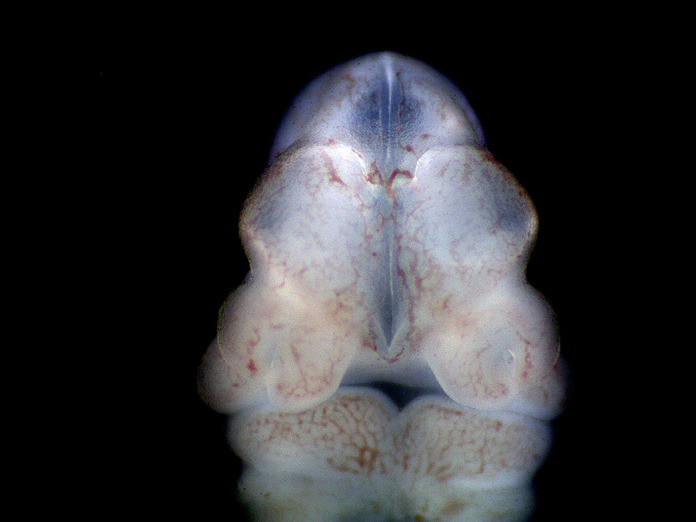 Figure 1
 Figure 2
Peer Reviews
No public reviews on file for this paper yet. If you reviewed it on a platform where reviews are public (OpenReview, ICLR, NeurIPS, ICML), you can paste yours below so the community can read it here.
Videos
No videos yet. Explain this paper in a talk, walkthrough, or lecture? Add one.
Taxonomy
TopicsCraniofacial Disorders and Treatments · Genetic Syndromes and Imprinting · Congenital limb and hand anomalies