Metabolic enzymes aldo-2 and pdhb-1 as potential epigenetic regulators during C. elegans embryogenesis
Sonia Ravanelli, Ji Young Cecilia Park, Chantal Wicky, Collin Y. Ewald, Ferdinand von Meyenn

TL;DR
This study shows that metabolic enzymes ALDO-2 and PDHB-1 may regulate epigenetics during C. elegans embryonic development.
Contribution
The study identifies ALDO-2 and PDHB-1 as novel epigenetic regulators in C. elegans embryogenesis.
Findings
RNAi screening revealed ALDO-2 and PDHB-1 as potential epigenetic regulators in C. elegans.
Reduced chromatin remodeler LET-418/Mi2 activity rescues embryonic lethality caused by enzyme suppression.
The findings suggest a link between glucose/pyruvate metabolism and chromatin remodeling during development.
Abstract
The intersection of metabolic processes and epigenetic regulation during embryogenesis is crucial yet not fully understood. Through a candidate RNAi screen in Caenorhabditis elegans , we identified metabolic enzymes ALDO-2 and PDHB-1 as potential epigenetic regulators. Mild alteration of the chromatin remodeler LET-418 /Mi2 activity rescues embryonic lethality induced by suppressing aldo-2 or pdhb-1 , suggesting a critical role for glucose and pyruvate metabolism in chromatin remodeling during embryogenesis. Given the conservation of central metabolic pathways and chromatin modifiers across species, our findings lay the foundation for future mechanistic investigations into the interplay between epigenetics and metabolism during development and upon disease.
Genes, proteins, chemicals, diseases, species, mutations and cell lines named across the full text — each resolved to its canonical identifier and authoritative record.
Click any figure to enlarge with its caption.
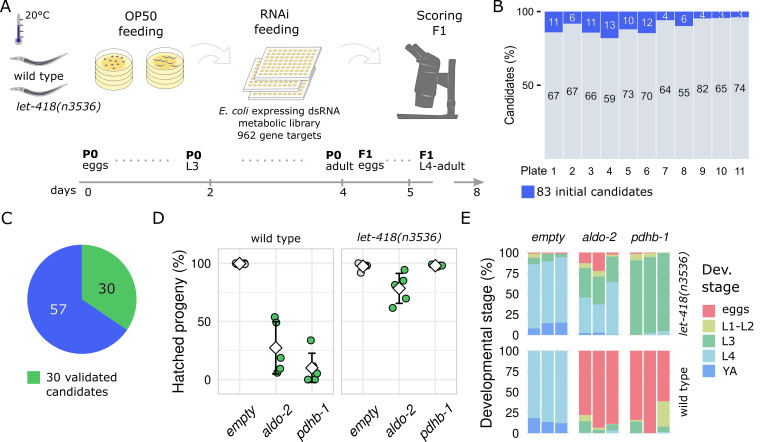 Figure 1
Peer Reviews
No public reviews on file for this paper yet. If you reviewed it on a platform where reviews are public (OpenReview, ICLR, NeurIPS, ICML), you can paste yours below so the community can read it here.
Videos
No videos yet. Explain this paper in a talk, walkthrough, or lecture? Add one.
Taxonomy
TopicsMetabolism and Genetic Disorders