Optimal sequencing budget allocation for trajectory reconstruction of single cells
Noa Moriel, Edvin Memet, Mor Nitzan

TL;DR
This paper explores how to best use a limited sequencing budget to accurately reconstruct cellular development paths from single-cell RNA-sequencing data.
Contribution
The study introduces a framework for optimally allocating sequencing budget between cell sampling breadth and sequencing depth to improve trajectory reconstruction.
Findings
Trajectory reconstruction accuracy scales logarithmically with sequencing breadth or depth.
Optimal cell sampling follows a power law relationship with sequencing budget.
Non-monotonic behavior in trajectory reconstruction can affect downstream analysis like expression pattern detection.
Abstract
Charting cellular trajectories over gene expression is key to understanding dynamic cellular processes and their underlying mechanisms. While advances in single-cell RNA-sequencing technologies and computational methods have pushed forward the recovery of such trajectories, trajectory inference remains a challenge due to the noisy, sparse, and high-dimensional nature of single-cell data. This challenge can be alleviated by increasing either the number of cells sampled along the trajectory (breadth) or the sequencing depth, i.e. the number of reads captured per cell (depth). Generally, these two factors are coupled due to an inherent breadth-depth tradeoff that arises when the sequencing budget is constrained due to financial or technical limitations. Here we study the optimal allocation of a fixed sequencing budget to optimize the recovery of trajectory attributes. Empirical results…
Genes, proteins, chemicals, diseases, species, mutations and cell lines named across the full text — each resolved to its canonical identifier and authoritative record.
Click any figure to enlarge with its caption.
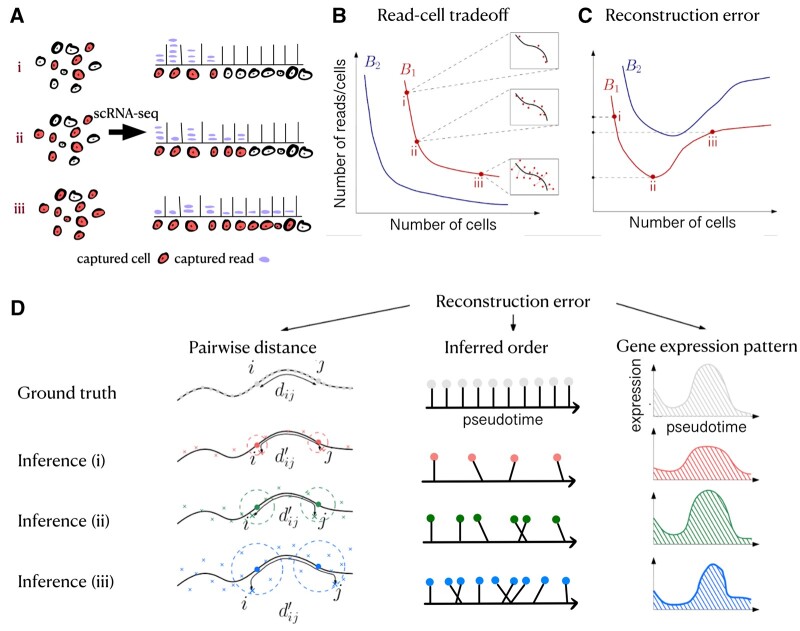 Figure 1
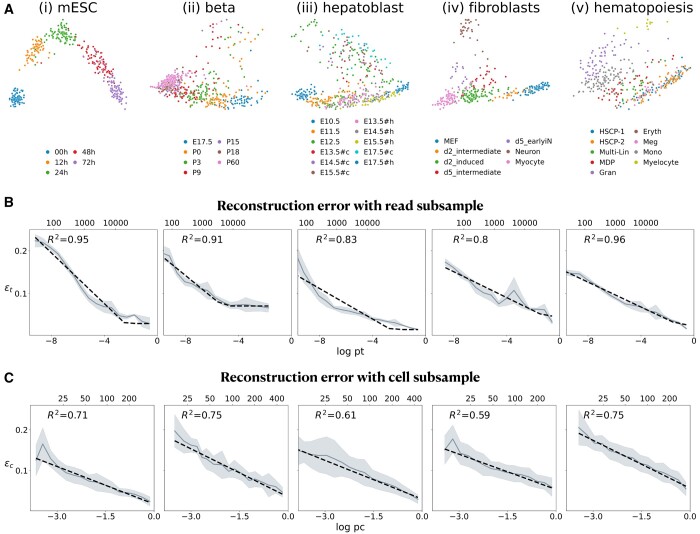 Figure 2
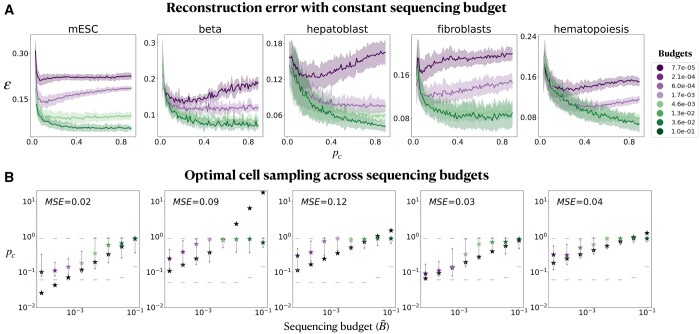 Figure 3
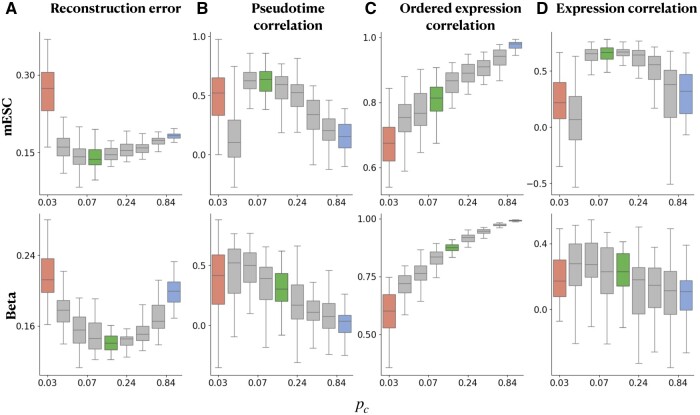 Figure 4
Peer Reviews
No public reviews on file for this paper yet. If you reviewed it on a platform where reviews are public (OpenReview, ICLR, NeurIPS, ICML), you can paste yours below so the community can read it here.
Videos
No videos yet. Explain this paper in a talk, walkthrough, or lecture? Add one.
Taxonomy
TopicsAging, Elder Care, and Social Issues · Health, Medicine and Society