Carica papaya L. sex chromosome review and physical mapping of the serk 2, svp-like and mdar 4 sequences
Adeilson Frias Dornela, Fernanda Aparecida Ferrari Soares, Jéssica Coutinho Silva, Mariana Cansian Sattler, Wellington Ronildo Clarindo

TL;DR
This study maps specific genes on the sex chromosomes of Carica papaya, confirming their location and contributing to understanding their structure and evolution.
Contribution
The study provides new physical mapping of the serk 2, svp-like, and mdar 4 genes on C. papaya sex chromosomes.
Findings
The diploidy of Carica papaya was confirmed, and mitotic chromosomes were characterized.
The serk 2 gene was mapped to the interstitial portion of the sex chromosome long arm with two fluorescence signals.
The svp-like and mdar 4 genes were mapped to the same region but showed only one fluorescence signal each.
Abstract
Physical mapping evidences the chromosome organization and structure. Despite the data about plant cytogenomics, physical mapping has been conducted from single-copy and/or low-copy genes for few species. Carica papaya cytogenomics has been accomplished from BAC-FISH and repeatome sequences. We aimed to map the serk 2, svp-like and mdar 4 sequences in C. papaya. The sequences were amplified and the amplicons sequenced, showing similarity in relation to serk 2, svp-like and mdar 4 genes. Carica papaya diploidy was confirmed and the mitotic chromosomes characterized. The chromosome 1 exhibited the secondary constriction pericentromeric to the centromere of the long arm. So, we concluded that it is the sex chromosomes. serk 2 was mapped in the long arm interstitial portion of the sex chromosomes, and the interphase nuclei showed two fluorescence signals. Considering these results and the…
Genes, proteins, chemicals, diseases, species, mutations and cell lines named across the full text — each resolved to its canonical identifier and authoritative record.
Click any figure to enlarge with its caption.
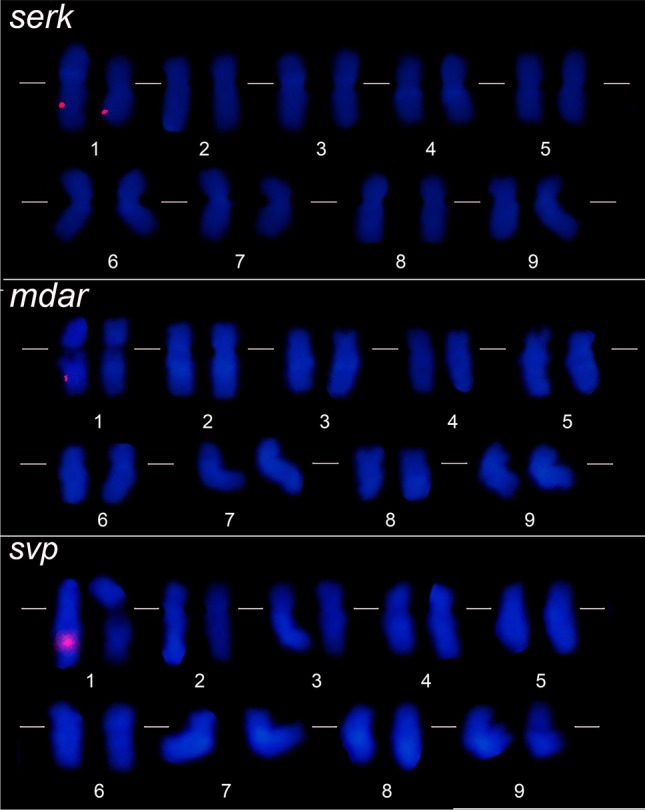 Figure 1
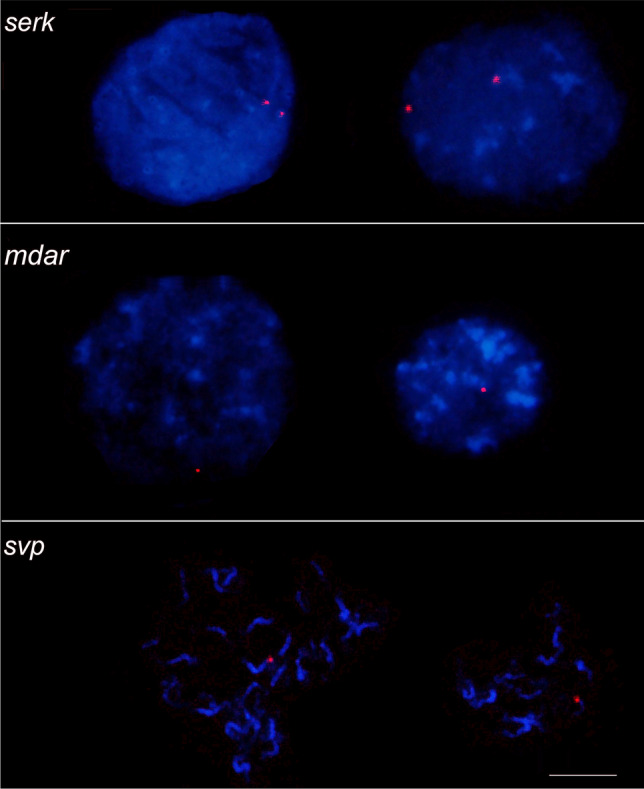 Figure 2
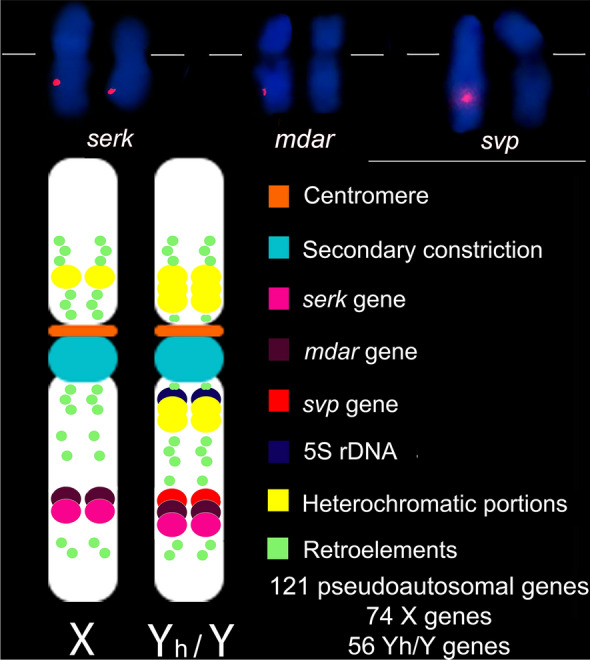 Figure 3
Peer Reviews
No public reviews on file for this paper yet. If you reviewed it on a platform where reviews are public (OpenReview, ICLR, NeurIPS, ICML), you can paste yours below so the community can read it here.
Videos
No videos yet. Explain this paper in a talk, walkthrough, or lecture? Add one.
Taxonomy
TopicsChromosomal and Genetic Variations · Genetic and Clinical Aspects of Sex Determination and Chromosomal Abnormalities · Genetic and Environmental Crop Studies