Sacred Foe: About the Face of Exemplary Evil
Massimo Leone

TL;DR
This essay examines the biblical story of Cain and Abel, focusing on the meanings of Cain's face and the sign given to him, through the lens of semiotics.
Contribution
It explores whether exegetical interpretations of biblical texts can be studied as objects of semiotics.
Findings
Cain's face has been interpreted in multiple ways across Jewish and Christian traditions.
The sign on Cain has been analyzed through both ancient and modern narrative lenses.
The essay questions the applicability of semiotics to biblical exegesis.
Abstract
This essay aims to summarize and explore two issues that, in the exegetical and representational traditions of the biblical text, have triggered a myriad of semiotic intelligences. First, the nature of Cain’s face at the moment of the sacrifice refused him by the Lord, a face variously interpreted as angry, sad, dejected, depressed, dark. Second, the nature of the sign imposed by God on Cain following Abel’s fratricide. After exploring Jewish and Christian exegesis, ancient and modern, with some reference to contemporary narrative versions (and especially to Saramago’s Cain), the reflection will turn to the question of whether this kind of exegetical questioning can be part of the objects of a discipline like semiotics, the modern science of signs.
Genes, proteins, chemicals, diseases, species, mutations and cell lines named across the full text — each resolved to its canonical identifier and authoritative record.
Click any figure to enlarge with its caption.
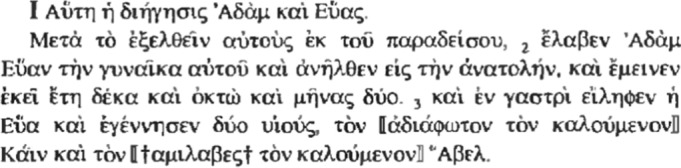 Figure 1
Peer Reviews
No public reviews on file for this paper yet. If you reviewed it on a platform where reviews are public (OpenReview, ICLR, NeurIPS, ICML), you can paste yours below so the community can read it here.
Videos
No videos yet. Explain this paper in a talk, walkthrough, or lecture? Add one.
Taxonomy
TopicsHistory, Culture, and Society