Cranial Nerve Palsy and Risk of Kidney Cancer: A Nationwide Population-Based Study
Dongyoung Lee, Kyungdo Han, Soolienah Rhiu, Jin-hyung Jung, Kyung-Ah Park, Sei Yeul Oh

TL;DR
This study finds that people with cranial nerve palsy may have a higher risk of developing kidney cancer.
Contribution
The study identifies cranial nerve palsy as a potential independent risk factor for kidney cancer using a large population-based cohort.
Findings
Participants with cranial nerve palsy had a 1.6-fold higher risk of kidney cancer compared to controls.
After a 3-year lag period, the risk increased to nearly 2-fold.
The association remained significant after adjusting for multiple confounding factors.
Abstract
Background and Objective: Understanding whether cranial nerve palsy (CNP) acts as an independent risk factor for kidney cancer could have important implications for patient care, early detection, and potentially the development of preventive strategies for this type of cancer in individuals with CNP. This study aimed to examine the risk of kidney cancer following the onset of ocular motor CNP and assess whether CNP could be considered an independent risk factor for kidney cancer. Materials and Methods: A population-based cohort study was conducted using data from the National Sample Cohort (NSC) database of Korea’s National Health Insurance Service which was collected from 2010 to 2017. Follow-up was until kidney cancer development, death, or 31 December 2018. Cox proportional hazard regression analysis was performed to determine hazard ratios (HRs) for kidney cancer according to CNP…
Genes, proteins, chemicals, diseases, species, mutations and cell lines named across the full text — each resolved to its canonical identifier and authoritative record.
Click any figure to enlarge with its caption.
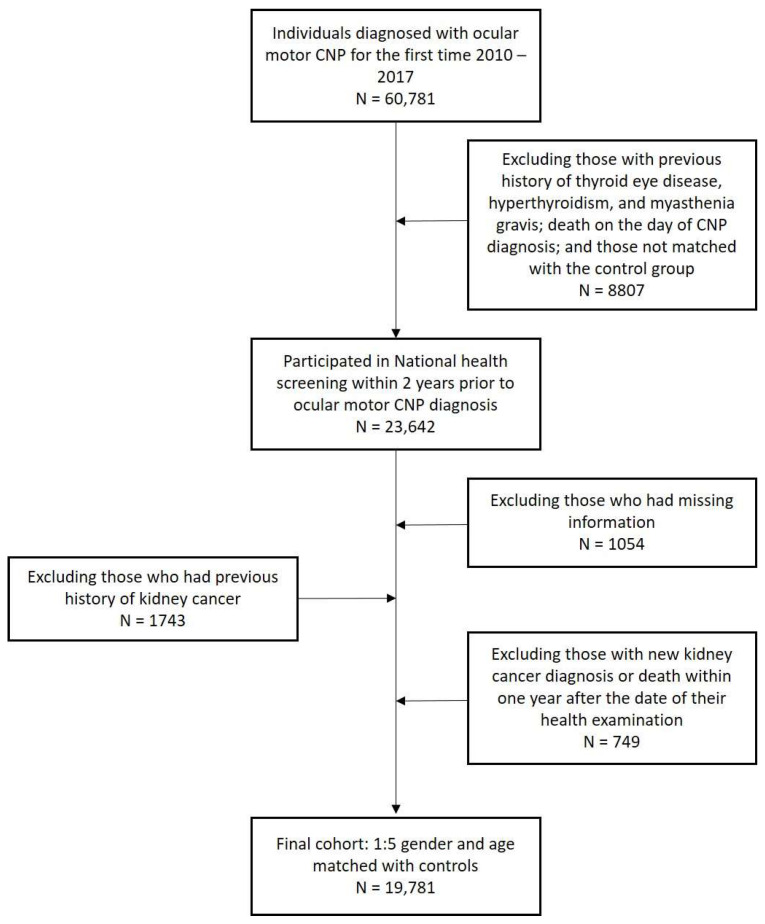 Figure 1
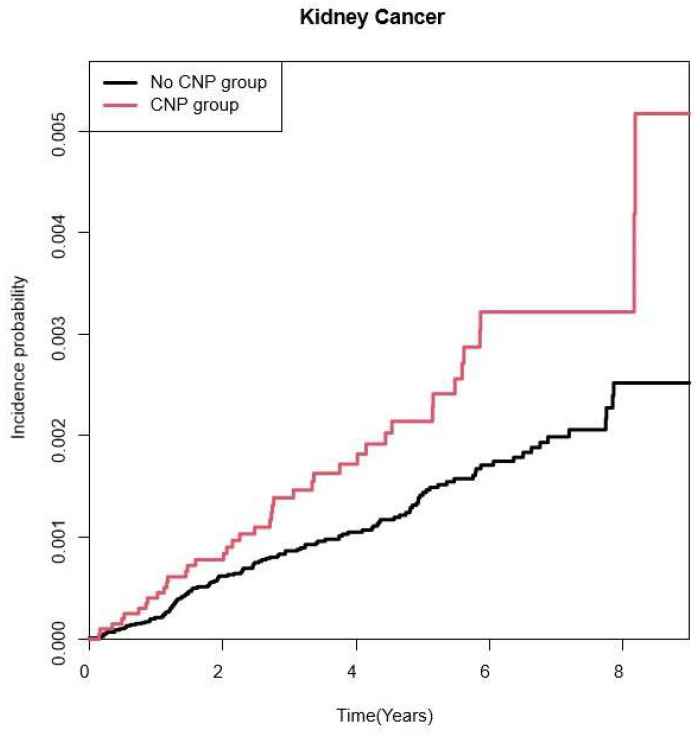 Figure 2
- —Ministry of Science and Information and Communication Technology (ICT)
- —Korean Society of Medical Oncology (KSMO) 2021
- —National Research Foundation of Korea (NRF)
Peer Reviews
No public reviews on file for this paper yet. If you reviewed it on a platform where reviews are public (OpenReview, ICLR, NeurIPS, ICML), you can paste yours below so the community can read it here.
Videos
No videos yet. Explain this paper in a talk, walkthrough, or lecture? Add one.
Taxonomy
TopicsMeningioma and schwannoma management · Ophthalmology and Eye Disorders · Head and Neck Surgical Oncology
1. Introduction
Ocular motor cranial nerve palsy (CNP), a condition that impairs the functioning of one or more of the cranial nerves governing ocular movement, is frequently encountered in neuro-ophthalmology practice [1,2,3,4,5], especially among the elderly population. This cranial nerve palsy results in ocular deviation, diplopia, abnormal head positioning, and various related symptoms depending on the etiology and the location of the lesion [2,6,7,8]. The condition can be caused by various factors, including head trauma, infections, tumors, and vascular disorders, and the main etiology is regarded as an atherosclerotic condition affecting small blood vessels [1,3,4,5,9]. Although ocular motor CNP itself is not usually considered a life-threatening condition, recent research has suggested a potential link between this condition and an increased risk of serious medical problems such as ischemic stroke [10,11,12]. Several studies have demonstrated an association between various metabolic risk factors, such as diabetes, hyperlipidemia, and obesity, and the development of renal cell carcinoma (RCC), the most common type of kidney cancer [13,14,15]. It is proposed that this association between these metabolic risk factors and kidney cancer may be a result of adipose dysfunction leading to the abnormal secretion of cytokines and the activation of insulin-like growth factor (IGF)-I, thereby promoting cellular proliferation and oxidative stress, factors conducive to kidney cancer development [13,14,15]. Given the shared common risk factors between these two medical conditions, it would be meaningful to investigate the potential relationship between ocular motor CNP and kidney cancer. The purpose of this study was to investigate the risk of kidney cancer subsequent to the onset of ocular motor CNP and to determine whether CNP serves as an independent risk factor for kidney cancer after adjusting for potential compounding factors. This was achieved using the National Sample Cohort (NSC) database from Korea’s National Health Insurance Service (KNHIS) with a specific focus on the adult Korean population.
2. Materials and Methods
2.1. Data Sources and Study Population
The data we used were obtained from Korea’s National Health Insurance (NHI), which are anonymized data including almost 97% of the whole Korean population and publicly available to all researchers who are approved by the Institutional Review Board (IRB). Codes for diagnosis were based on the International Classification of Diseases-10 (10th revision).
In this study, individuals aged 20 years or more who underwent KNHIS health examinations and were diagnosed as ICD-10 code of CNP (H49.0, H49.1, H49.2) from 1 January 2010 to 31 December 2017 were analyzed. A total of 60,781 CNP cases were diagnosed during this period. Study participants were followed up until the development of kidney cancer or death, or until 31 December 2018. The inclusion and exclusion criteria are shown in Table 1. Figure 1 shows the flow diagram of participant selection. We excluded participants who were diagnosed with dysthyroid exophthalmos, thyrotoxicosis, or myasthenia gravis before the diagnosis of CNP (n = 52,076); those who were unable to match with a control group (n = 51,975); those who died on the day of the diagnosis of CNP (n = 51,974); those who did not undergo a national health screening program within 2 years before the diagnosis of CNP (n = 23,642); individuals with missing health examination data (n = 22,588); those with any cancer history before cohort entry (20,845); and those who were newly diagnosed with any type of cancer within one year of their diagnosis with CNP (20,096). The reason we set the 1-year time lag was to avoid a situation where the causal relationship was reversed. After excluding these cases, 20,096 participants with CNP were left, and after age–sex matching in a 1:5 ratio with control cases, 19,781 CNP cases were included with an additional 98,905 control cases. Health examination data included smoking status, height, weight, body mass index (BMI), waist circumference, serum glucose level, cholesterol level, systolic blood pressure (SBP), and diastolic blood pressure (DBP).
The study adhered to the tenets of the Declaration of Helsinki and was approved by the Institutional Review Board (IRB) of Samsung Medical Center (IRB no. 2023-05-099).
2.2. Definitions of Kidney Cancer, Ocular Motor CNP, and Confounders
The study endpoint was kidney cancer occurrence from the index date up until the end of the year 2015. The confirmation of incident kidney cancer was made using the ICD-10-CM code C64 in conjunction with the registration code V193.
Ocular motor CNP was defined by the ICD-10 codes H49.0 (3rd CNP), H49.1 (4th CNP), or H49.2 (6th CNP). The ICD-10 codes of H06.2 (dysthyroid exophthalmos), E05 (thyrotoxicosis), or G70.0 (myasthenia gravis) were excluded. Variables like sex, age, smoking status, amount of alcohol consumption, regular exercise, income status, and obesity were considered as confounders. According to Mesh definitions, sex was stratified as male/female, as Korea’s social security numbers (SSNs) that start with 1 represent males and 2 females, and participants were automatically categorized by their SSN into the KNHIS.
Regarding smoking status, participants were divided into smokers versus non-smokers. Drinking was classified into non-drinkers, mild drinkers, and heavy drinkers according to the amount of alcohol consumption. We defined mild drinkers as those who consumed less than 30 g of alcohol and heavy drinkers as those who consumed 30 g or more. Regular exercise was defined as performing ≥20 min of vigorous-intensity physical activity at least 3 times per week or ≥30 min of moderate-intensity physical activity at least 5 times a week. Income status was divided into 4 quartiles (Q), with Q1 indicating the lowest and Q4 indicating the highest income. Obesity was defined as BMI ≥ 25 kg/m^2^ based on World Health Organization (WHO) recommendations for Asian populations.
Comorbidities like diabetes mellitus, hypertension, dyslipidemia, and chronic kidney disease were also included and adjusted in the analysis. Diabetes mellitus (DM) was defined as fasting glucose ≥126 mg/dL or was identified by using diagnostic codes E10-14. Hypertension (HTN) was defined when BP ≥ 140/90 mmHg or ICD-10-CM codes with a prescription for antihypertensive medications were present. Dyslipidemia was defined as serum total cholesterol levels ≥240 mg/dL or with the ICD-10-CM code E78 with the use of a lipid-lowering drug. Chronic kidney disease (CKD) was defined as an estimated glomerular filtration rate < 60 mL/min per 1.73 m^2^.
2.3. Statistical Analysis
Baseline characteristics were compared using Student’s t-test for continuous variables and the chi-square test for categorical variables. Data were mainly presented as a number of participants or mean ± SD. For the adjustment of confounders, four models were set and compared independently. Model 1 was analyzed without adjusting factors, while model 2 was adjusted for sex and age as confounders. Model 3 adjusted for variables including smoking, drinking amount, regularity of exercise, income status, and obesity in addition to model 2 confounders. Lastly, model 4 adjusted for DM, HTN, dyslipidemia, and CKD in addition to model 3 confounders. A Cox proportional hazard regression analysis was conducted to determine hazard ratios (HRs) and 95% CIs for kidney cancer according to CNP. All data analyses were performed using SAS version 9.4 (SAS Institute Inc., Cary, NC, USA), and a p-value < 0.05 was considered statistically significant.
3. Results
3.1. Baseline Characteristics of the Study Population
The general characteristics of the study population are shown in Table 2. Of the 118,686 participants in our study, 98,905 individuals were in the control group, and 19,781 individuals were in the CNP group. Compared with the control group, participants with CNP showed lower alcohol consumption; a lower percentage of Q1 income status; an increased likelihood of obesity, DM, HTN, dyslipidemia, and CKD; higher weight, BMI, waist circumference, glucose level, SBP, and DBP; and lower cholesterol levels.
3.2. Risk for Kidney Cancer According to CNP
In our study group, a total of 165 participants were diagnosed with kidney cancer during the follow-up period. Compared with the control groups, participants with CNP were at increased risk of kidney cancer (incidence rate, 0.473 versus 0.284 cases per 1000 person-years, respectively; adjusted HR in model 4, 1.599 [95% CI, 1.116–2.29]). Moreover, with a 3-year lag period, the CNP group had a higher risk of kidney cancer than the control group (incidence rate, 0.529 versus 0.265 cases per 1000 person-years, respectively; adjusted HR in model 4, 1.987 [95% CI, 1.252–3.154]) (Table 3).
The Kaplan–Meier curve for the incidence probability of kidney cancer with CNP is shown in Figure 2, indicating that the CNP group had more incidence probability of kidney cancer (p-value = 0.004).
3.3. Subgroup Analysis
In Table 4, the relative risks of kidney cancer stratified by sex, age, smoking, alcohol consumption, regular exercise, income status, obesity, DM, HTN, dyslipidemia, and CKD are shown. All subgroups showed no significantly different associations between CNP and the risk of kidney cancer, but the amount of alcohol consumption showed a marginal difference in that non-alcohol drinkers had a higher risk for kidney cancer.
4. Discussion
Acquired CNP can be attributed to various etiologies, including vascular diseases, trauma, neoplasms, aneurysms, and other miscellaneous causes [16,17]. An earlier investigation into a Korean cohort revealed that neoplasm being the cause of CNP included multiple neuromas in neurofibromatosis type 2, brain stem glioma, juxtasellar meningioma, intracranial invasion of nasopharyngeal cancer, and posterior fossa epidermoid cysts [16]. However, to the authors’ knowledge, there is no study analyzing the risk of new-onset cancer following CNP. This study is the first report to show that CNP patients have an increased rate of kidney cancer. An essential aspect of our study design was the incorporation of a 3-year lag period to minimize the risk of reverse causation, where the undiagnosed metastatic kidney cancer, which caused CNP, could be misinterpreted as occurring after the onset of CNP. Importantly, when we implemented this 3-year lag period, the association between CNP and kidney cancer risk was found to be stronger than with the 1-year lag period. This higher correlation further supports the hypothesized relationship between CNP and kidney cancer, suggesting that a prolonged duration between the occurrence of CNP and the detection of kidney cancer intensifies their interrelationship.
Kidney cancer ranks as the 12th most common malignant neoplasm, excluding blood cancers, and accounts for about 2.4% of all malignancies in adults, and the incidence has been increasing world-wide [18,19]. Based on 2020 estimates from GLOBOCAN data, North America had the highest incidence of age-standardized rate (ASR) at 12.2, followed by Australia and New Zealand at 10.0 and Europe at 9.5 [18,20]. Although ASRs in Asia were low at 2.8, those in Japan and South Korea were high at 7.6 and 6.5, suggesting that not only race but also lifestyle plays a role in their incidence [18,20].
Smoking, hypertension, and obesity are well-established risk factors for kidney cancer [13,14,15,18,19]. Tobacco smoke contains a mixture of carcinogens implicated in the etiology of kidney cancer, and there is a dose–response relationship between risk and the amount smoked per day [21,22]. Hypertension is independently associated with kidney cancer risk [22] and evidence has been reported that hypertension predisposes kidney cancer [18]. The biological mechanism underlying the relationship between hypertension and kidney cancer remains unclear, but is hypothesized to involve chronic renal hypoxia and lipid peroxidation due to the formation of reactive oxygen species [18,23,24].
Ocular motor CNP also has a close association with vasculopathic risk factors such as diabetes mellitus, hyperlipidemia, and hypertension, suggesting microvascular ischemia to be the main etiology of CNP [25,26,27]. Although the mechanism between CNP and kidney cancer needs further studies, we postulate that microvascular ischemia may contribute to chronic renal stress leading to kidney cancer.
This study has several limitations that need to be acknowledged. First, due to the retrospective nature of the study design, it was impossible to confirm a causal relationship between ocular motor CNP and kidney cancer, and we were only able to demonstrate an association. Second, our findings are based on data from Korea’s National Health Insurance Service, which may not be generalizable to populations in other countries with different health systems, lifestyle factors, and genetic backgrounds. More multicentric and multinational studies are needed to validate our findings and to ensure their generalizability. Third, this study relied on diagnostic codes to identify CNP and kidney cancer cases, and the potential for misclassification bias exists. Despite the accuracy of these codes, the potential for coding errors cannot be entirely ruled out. Furthermore, we were unable to evaluate the severity, specific subtype, or treatment details of both CNP and kidney cancer, which could influence the outcomes. Lastly, despite adjusting for multiple confounders, potential residual confounding from unmeasured or unknown factors, such as a family history of kidney cancer, environmental exposures, dietary factors, and other potential risk factors for kidney cancer, cannot be eliminated. This study also did not account for changes in lifestyle or medical interventions over time that may have affected the risk of kidney cancer. Therefore, further prospective studies are required to confirm these findings and to elucidate the underlying mechanisms behind this association.
In conclusion, this large-scale, retrospective study highlights a previously unreported association between ocular motor CNP and an increased risk of kidney cancer. The strength of this association was particularly amplified when a 3-year lag period was applied, thereby underlining the relevance of a temporal relationship between CNP and kidney cancer.
Importantly, our findings extend the current understanding of the potential complications associated with CNP, suggesting a broader systemic involvement beyond the ocular system. Clinicians should consider these findings when managing patients with CNP, as the monitoring and early detection of kidney cancer could be critical for such patients. However, given the observational nature of our study, future prospective research is required to confirm these associations and explore the underlying pathophysiological mechanisms. This work opens a new avenue for understanding the systemic implications of CNP and offers a foundation for further studies aiming at early detection and preventive strategies for kidney cancer in CNP patients.
The reference list from the paper itself. Each links out to its DOI / PubMed record.
- 1Jung E.H. Kim S.J. Lee J.Y. Cho B.J. The incidence and etiology of sixth cranial nerve palsy in Koreans: A 10-year nationwide cohort study Sci. Rep.201991841910.1038/s 41598-019-54975-531804597 PMC 6895183 · doi ↗ · pubmed ↗
- 2Dosunmu E.O. Hatt S.R. Leske D.A. Hodge D.O. Holmes J.M. Incidence and Etiology of Presumed Fourth Cranial Nerve Palsy: A Population-based Study Am. J. Ophthalmol.201818511011410.1016/j.ajo.2017.10.01929102606 PMC 5784757 · doi ↗ · pubmed ↗
- 3Fang C. Leavitt J.A. Hodge D.O. Holmes J.M. Mohney B.G. Chen J.J. Incidence and Etiologies of Acquired Third Nerve Palsy Using a Population-Based Method JAMA Ophthalmol.2017135232810.1001/jamaophthalmol.2016.445627893002 PMC 5462106 · doi ↗ · pubmed ↗
- 4Jung E.H. Kim S.J. Lee J.Y. Cho B.J. The Incidence and Etiologies of Third Cranial Nerve Palsy in Koreans: A 10-year Nationwide Cohort Study Ophthalmic Epidemiol.20202746046710.1080/09286586.2020.177387032506973 · doi ↗ · pubmed ↗
- 5Jung E.H. Kim S.J. Lee J.Y. Cho B.J. The incidence and presumed aetiologies of fourth cranial nerve palsy in Korea: A 10-year nationwide cohort study Eye 2021353012301910.1038/s 41433-020-01374-033414536 PMC 8526575 · doi ↗ · pubmed ↗
- 6Bagheri A. Fallahi M.R. Abrishami M. Salour H. Aletaha M. Clinical features and outcomes of treatment for fourth nerve palsy J. Ophthalmic Vis. Res.20105273122737323 PMC 3380667 · pubmed ↗
- 7Jacobson D.M. Relative pupil-sparing third nerve palsy: Etiology and clinical variables predictive of a mass Neurology 20015679779810.1212/WNL.56.6.79711274322 · doi ↗ · pubmed ↗
- 8Wilker S.C. Rucker J.C. Newman N.J. Biousse V. Tomsak R.L. Pain in ischaemic ocular motor cranial nerve palsies Br. J. Ophthalmol.2009931657165910.1136/bjo.2008.15515019570771 PMC 2998753 · doi ↗ · pubmed ↗