Reverse Shoulder Arthroplasty for Proximal Humeral Fractures: Is the Bigliani-Flatow Stem Suitable for Tuberosity Fixation and Healing?
Enrico Bellato, Valeria Fava, Andrea Arpaia, Michel Calò, Antonio Marmotti, Filippo Castoldi

TL;DR
This study examines the effectiveness of using the Bigliani-Flatow stem in treating shoulder fractures, finding good outcomes and high tuberosity healing rates.
Contribution
The study evaluates the suitability of a non-fracture-specific stem for tuberosity fixation and healing in proximal humeral fractures.
Findings
The Bigliani-Flatow stem achieved an 83% tuberosity healing rate.
Clinical outcomes were good with high Constant and Oxford Shoulder Scores.
Healed tuberosities showed better external rotation but longer surgery time.
Abstract
Background/Objectives: The aim of the study was to investigate the clinical, functional, and radiographic results of patients affected by three- or four-part proximal humeral fractures treated with reverse total shoulder arthroplasty, to investigate whether a prosthetic stem nonspecifically designed for fractures (i.e., the Bigliani-Flatow stem) promotes tuberosities’ healing, and to evaluate the impact of tuberosity fixation and healing on the outcomes. Methods: Patients’ data such as gender, age, side and dominancy, comorbidities, complications during or after surgery, and time lapse between trauma and surgery were prospectively collected. The type of fixation of the stem, the thickness and type of liner, and whether the tuberosities were fixed or not were also recorded. The Constant score weighted on the contralateral limb, QuickDASH, Oxford Shoulder Score, and Subjective Shoulder…
Genes, proteins, chemicals, diseases, species, mutations and cell lines named across the full text — each resolved to its canonical identifier and authoritative record.
Click any figure to enlarge with its caption.
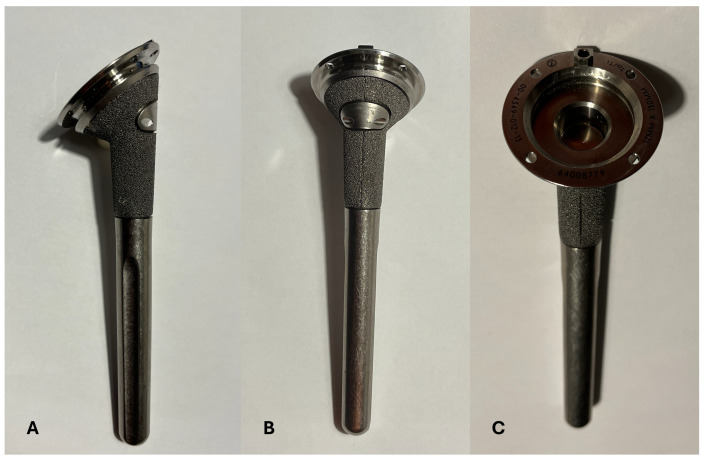 Figure 1
 Figure 2
Peer Reviews
No public reviews on file for this paper yet. If you reviewed it on a platform where reviews are public (OpenReview, ICLR, NeurIPS, ICML), you can paste yours below so the community can read it here.
Videos
No videos yet. Explain this paper in a talk, walkthrough, or lecture? Add one.
Taxonomy
TopicsShoulder Injury and Treatment · Shoulder and Clavicle Injuries · Trauma Management and Diagnosis