The Association between Socioeconomic Status and Race/Ethnicity with Home Evacuation of Lower Manhattan Residents following the 9/11/2001 World Trade Center Disaster
James E. Cone, Lucie Millien, Cristina Pollari, Jennifer Brite, Heather Badger, John Kubale, Grace Noppert, Sonia Hegde, Robert Brackbill, Mark Farfel

TL;DR
This study found that race, ethnicity, and lower socioeconomic status were linked to a higher risk of not evacuating Lower Manhattan after the 9/11 attacks.
Contribution
The study reveals socioeconomic and racial disparities in evacuation behavior following a major disaster.
Findings
Non-Hispanic Black, Asian/Pacific Islander, and Hispanic residents had higher risks of not evacuating compared to non-Hispanic White residents.
Residents with lower educational attainment and household income were more likely to not evacuate.
These findings highlight inequities in disaster response that need to be addressed in future emergency planning.
Abstract
On 11 September 2001, attacks on the World Trade Center (WTC) killed nearly three thousand people and exposed hundreds of thousands of rescue and recovery workers, passersby, area workers, and residents to varying amounts of dust and smoke. Former New York City Mayor Rudy Giuliani ordered the emergency evacuation of Lower Manhattan below Canal Street, but not all residents evacuated. Previous studies showed that those who did not evacuate had a higher incidence of newly diagnosed asthma. Among the 71,424 who enrolled in the WTC Health Registry in 2003–2004, we evaluated the bivariate association of educational attainment, household income, and race or ethnicity with reported evacuation on or after 9/11/01. We used log binomial regression to assess the relative risks of not evacuating from their home following the 9/11 attacks, adjusting for age, gender, and marital status. Out of a…
Genes, proteins, chemicals, diseases, species, mutations and cell lines named across the full text — each resolved to its canonical identifier and authoritative record.
Click any figure to enlarge with its caption.
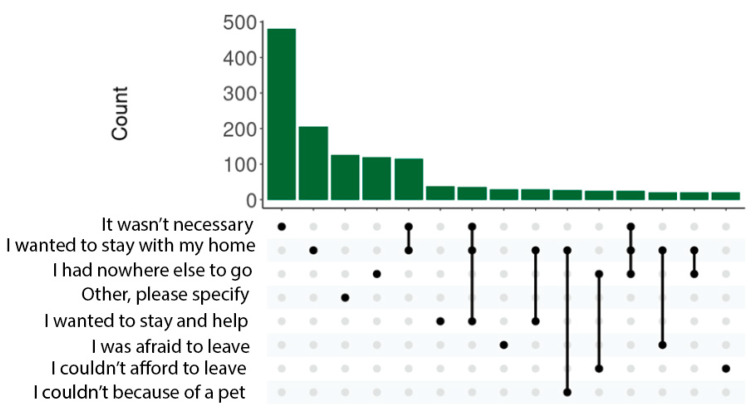 Figure 1
Peer Reviews
No public reviews on file for this paper yet. If you reviewed it on a platform where reviews are public (OpenReview, ICLR, NeurIPS, ICML), you can paste yours below so the community can read it here.
Videos
No videos yet. Explain this paper in a talk, walkthrough, or lecture? Add one.
Taxonomy
TopicsDisaster Management and Resilience · Injury Epidemiology and Prevention · Evacuation and Crowd Dynamics