Diffusion Tensor Imaging Identifies Cervical Spondylosis, Myelitis, and Spinal Cord Tumors
Jiyuan Wang, Jing Huang, Bixiao Cui, Hongwei Yang, Defeng Tian, Jie Ma, Wanru Duan, Huiqing Dong, Zan Chen, Jie Lu

TL;DR
This study shows that diffusion tensor imaging, especially fractional anisotropy, can help distinguish between cervical spondylosis, myelitis, and spinal tumors.
Contribution
The study demonstrates the diagnostic potential of DTI metrics, particularly FA, for differentiating spinal cord diseases.
Findings
FA values were significantly lower in tumor patients compared to spondylosis and myelitis.
FA showed strong discriminative performance with AUCs of 0.902 and 0.748 for differentiating tumors and myelitis from spondylosis.
FA correlated negatively with EDSS scores in myelitis and Ki-67 scores in tumors, indicating clinical relevance.
Abstract
Background: Diffusion tensor imaging (DTI) has been increasingly recognized for its capability to study microstructural changes in the neuropathology of brain diseases. However, the optimal DTI metric and its diagnostic utility for a variety of spinal cord diseases are still under investigation. Purpose: To evaluate the diagnostic efficacy of DTI metrics for differentiating between cervical spondylosis, myelitis, and spinal tumors. Methods: This retrospective study analyzed DTI scans from 68 patients (22 with cervical spondylosis, 23 with myelitis, and 23 with spinal tumors). DTI indicators, including fractional anisotropy (FA), mean diffusivity (MD), radial diffusivity (RD) and axial diffusivity (AD), were calculated. The Kruskal–Wallis test was used to compare these indicators, followed by Receiver Operating Characteristic (ROC) curve analysis, to evaluate the diagnostic efficacy of…
Genes, proteins, chemicals, diseases, species, mutations and cell lines named across the full text — each resolved to its canonical identifier and authoritative record.
Click any figure to enlarge with its caption.
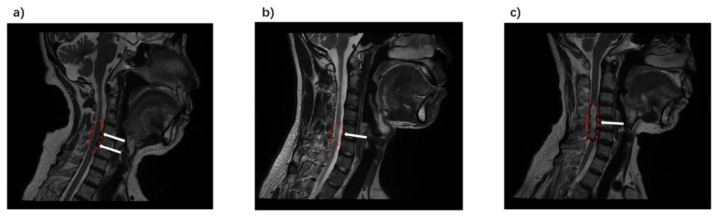 Figure 1
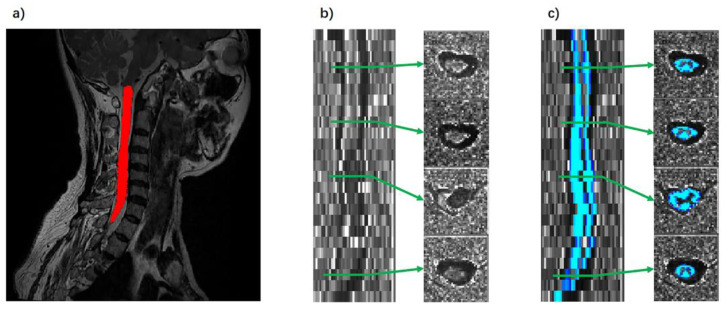 Figure 2
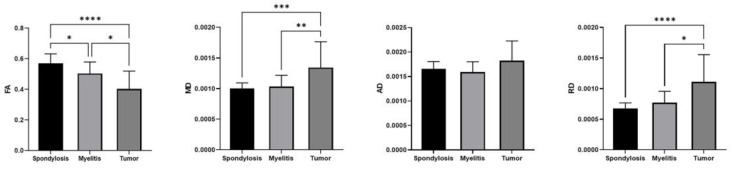 Figure 3
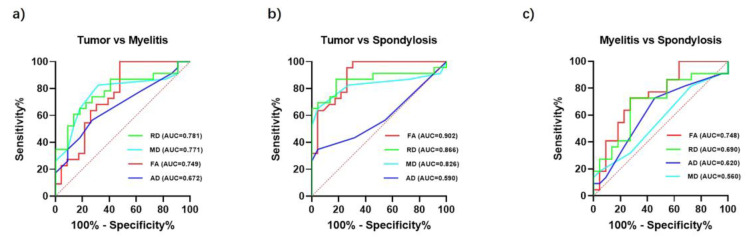 Figure 4
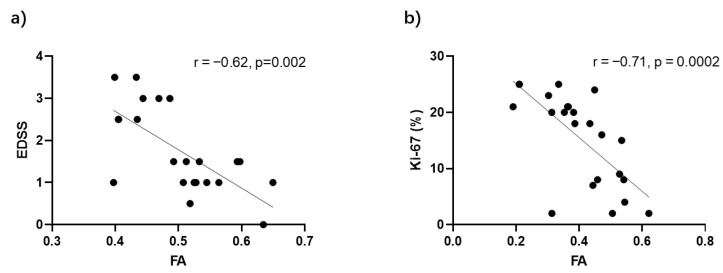 Figure 5
Peer Reviews
No public reviews on file for this paper yet. If you reviewed it on a platform where reviews are public (OpenReview, ICLR, NeurIPS, ICML), you can paste yours below so the community can read it here.
Videos
No videos yet. Explain this paper in a talk, walkthrough, or lecture? Add one.
Taxonomy
TopicsAdvanced Neuroimaging Techniques and Applications · Cervical and Thoracic Myelopathy · Medical Imaging and Analysis