Temporal Course of Interference Control from Early to Late Young Adulthood: An ERP Study
Martina Knežević

TL;DR
This study explores how interference control, a cognitive ability, develops from early to late young adulthood using brain activity measurements.
Contribution
The study reveals age-related differences in neural dynamics of interference control, showing continued development into early adulthood.
Findings
Younger participants made more errors on incongruent trials compared to those in their early 30s.
Higher P2 and N2 amplitudes in early 20s suggest limited top-down control resources.
Neural dynamics of interference control continue to develop into early adulthood.
Abstract
In the present study, we aimed to investigate the neural dynamics of interference control using event-related potentials (ERPs) to reveal time course of interference control from the beginning to the end of young adulthood. Three groups of participants aged 19–21, 23–27 and 28–44 performed a Stroop task. The results revealed age differences in both accuracy and ERP amplitudes during all aspects of interreference control processing that reflect selective attention (P2), conflict monitoring (N2), conflict evaluation (P3) and interference control (N450). Both younger groups made more errors on incongruent trials compared to participants in their early 30s. The presence of higher P2 and N2 amplitudes, diminished P3 and again higher N450 amplitudes in participants in their early 20s points to a shortage of available resources for top-down control at this age. These results are in accordance…
Genes, proteins, chemicals, diseases, species, mutations and cell lines named across the full text — each resolved to its canonical identifier and authoritative record.
Click any figure to enlarge with its caption.
 Figure 1
 Figure 2
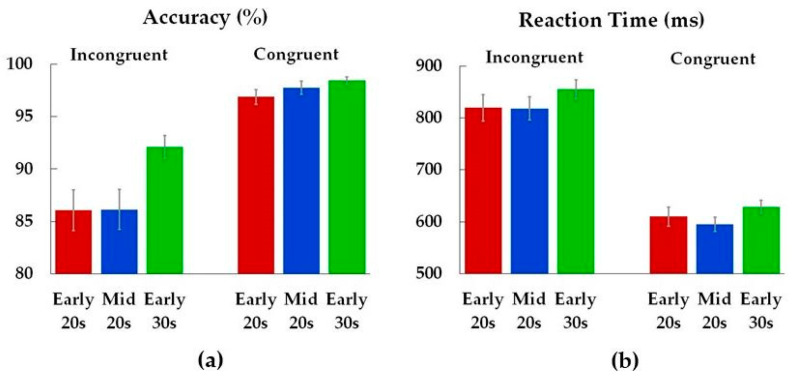 Figure 3
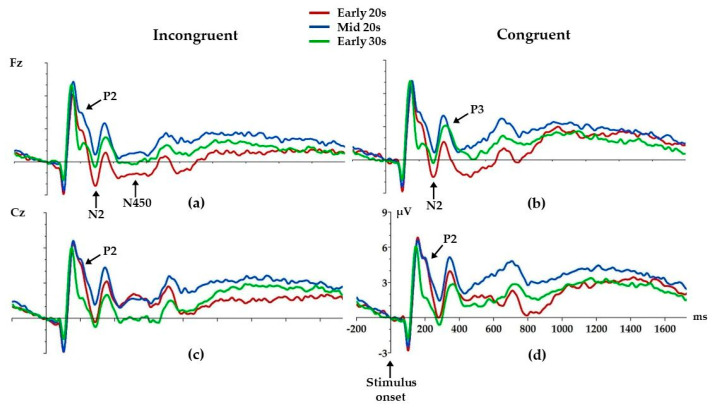 Figure 4
Peer Reviews
No public reviews on file for this paper yet. If you reviewed it on a platform where reviews are public (OpenReview, ICLR, NeurIPS, ICML), you can paste yours below so the community can read it here.
Videos
No videos yet. Explain this paper in a talk, walkthrough, or lecture? Add one.
Taxonomy
TopicsNeural and Behavioral Psychology Studies · EEG and Brain-Computer Interfaces · Neural dynamics and brain function