COVID-19 Infection in Autosomal Dominant Polycystic Kidney Disease and Chronic Kidney Disease Patients: Progression of Kidney Disease
Silvia Lai, Francesca Tinti, Adolfo Marco Perrotta, Luca Salomone, Rosario Cianci, Paolo Izzo, Sara Izzo, Luciano Izzo, Claudia De Intinis, Chiara Pellicano, Antonietta Gigante

TL;DR
This study examines how COVID-19 affects kidney function in patients with ADPKD and CKD, finding that ADPKD patients experience greater declines in kidney health after infection.
Contribution
The study provides new insights into the differential impact of SARS-CoV-2 on ADPKD and CKD patients, particularly those with reduced kidney function.
Findings
ADPKD patients showed significantly higher serum creatinine levels and lower eGFR after COVID-19 compared to CKD patients.
ADPKD–CKD patients had a greater variation in kidney function metrics post-infection than CKD patients alone.
Patients with ADPKD and eGFR < 60 mL/min experienced a significant worsening of renal function after a year of infection.
Abstract
Introduction: the COVID-19 pandemic has brought to light the intricate interplay between viral infections and preexisting health conditions. In the field of kidney diseases, patients with Autosomal Dominant Polycystic Kidney Disease (ADPKD) and Chronic Kidney Disease (CKD) face unique challenges when exposed to the SARS-CoV-2 virus. This study aims to evaluate whether SARS-CoV-2 virus infection impacts renal function differently in patients suffering from ADPKD and CKD when compared to patients suffering only from CKD. Materials and methods: clinical data from 103 patients were collected and retrospectively analyzed. We compared the renal function of ADPKD and CKD patients at two distinct time points: before COVID-19 infection (T0) and 1 year after the infection (T1). We studied also a subpopulation of 37 patients with an estimated glomerular filtration rate (eGFR) < 60 mL/min and…
Genes, proteins, chemicals, diseases, species, mutations and cell lines named across the full text — each resolved to its canonical identifier and authoritative record.
Click any figure to enlarge with its caption.
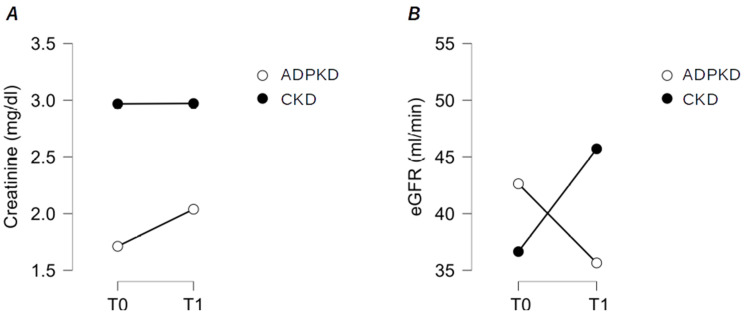 Figure 1
Peer Reviews
No public reviews on file for this paper yet. If you reviewed it on a platform where reviews are public (OpenReview, ICLR, NeurIPS, ICML), you can paste yours below so the community can read it here.
Videos
No videos yet. Explain this paper in a talk, walkthrough, or lecture? Add one.
Taxonomy
TopicsEducational Methods and Teacher Development · Central Asia Education and Culture