Fast and Simple Molecular Test for Sex Determination of the Monomorphic Eudromia elegans Individuals
Zuzana Majchrakova, Marcela Bielikova, Evelina Hrckova Turnova, Petra Gasparkova, Jan Turna, Andrej Dudas

TL;DR
This paper presents a new, fast, and simple molecular test to determine the sex of the monomorphic bird species Eudromia elegans using DNA from blood or feather samples.
Contribution
A novel, reliable, and efficient PCR-based method for sex determination specifically tailored for Eudromia elegans.
Findings
The PCR method successfully amplified two DNA fragments in females and one in males of E. elegans.
The test uses the CHD1 gene and sex-specific primers to distinguish between ZZ (male) and ZW (female) chromosomes.
The method is accurate, fast, and suitable for routine use with non-invasive samples like blood and feathers.
Abstract
A lot of avian species are morphologically monomorphic, and thus, sex determination is difficult if it is based only on their external examination. Molecular sex identification has become a crucial tool in various fields of biology, including ornithology. This non-invasive method used to determine the genetic sex of birds of any age, in our case, Eudromia elegans (Paleognathae, Tinamiformes), can proceed with regard to the differences between avian male (ZZ) and female (ZW) chromosomes. According to our experience, the other molecular methods failed in the sex determination of this exact species. The new test was designed to be reliable, fast, and simple to determine the sex of the individuals of E. elegans. Molecular sexing has significant implications for understanding various aspects of its biology, including mating systems, population genetics, and conservation strategies. By…
Genes, proteins, chemicals, diseases, species, mutations and cell lines named across the full text — each resolved to its canonical identifier and authoritative record.
Click any figure to enlarge with its caption.
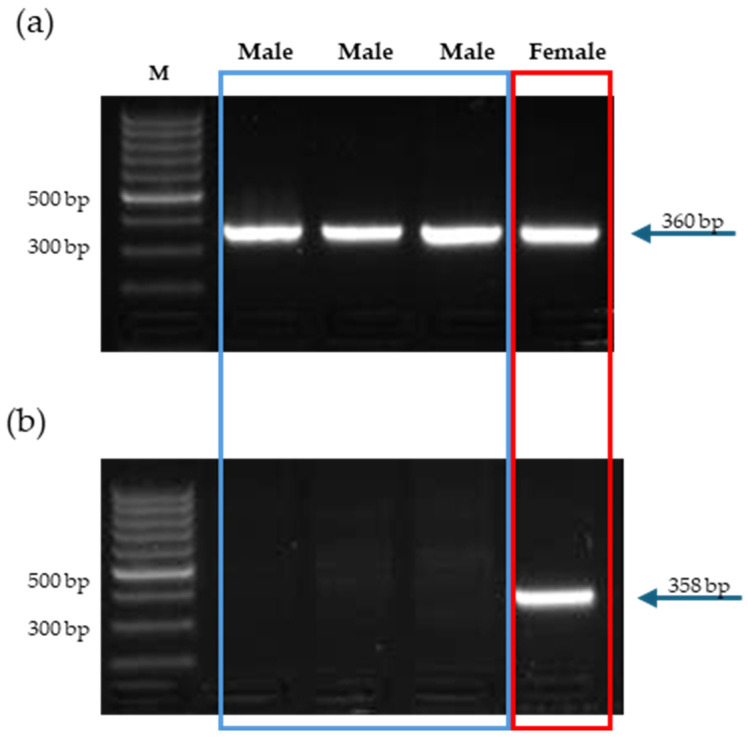 Figure 1
Peer Reviews
No public reviews on file for this paper yet. If you reviewed it on a platform where reviews are public (OpenReview, ICLR, NeurIPS, ICML), you can paste yours below so the community can read it here.
Videos
No videos yet. Explain this paper in a talk, walkthrough, or lecture? Add one.
Taxonomy
TopicsPlant and animal studies · Animal Behavior and Reproduction · Insect and Arachnid Ecology and Behavior