Exploring the Impact of Affinity and Unpleasantness on Conditioned Pain Modulation among Healthy Individuals
María del Rocío Ibancos-Losada, Ángeles Díaz-Fernández, Irene Cortés-Pérez, Esteban Obrero-Gaitán, Virginia López-Moreno, María Catalina Osuna-Pérez

TL;DR
This study explores how people's feelings of affinity and unpleasantness toward pain stimuli affect their pain modulation in healthy individuals.
Contribution
The study identifies affinity as a significant predictor of the CPM effect across two pain protocols in healthy individuals.
Findings
Higher affinity and lower unpleasantness for stimuli result in stronger conditioned pain modulation (CPM) effects.
Extreme categories of affinity and unpleasantness show significant CPM differences, while indifferent groups show no clear trend.
Affinity is the only variable that consistently explains CPM effects in both tested protocols.
Abstract
The variability of the Conditioned Pain Modulation (CPM) effect can be attributed to conditioning stimulus (CS) characteristics, such as intensity, duration, unpleasantness, or affinity. This study investigates the impact of affinity and unpleasantness variables on the CPM effect using two protocols (cold water and ischemia) in the same healthy individuals (n = 54). Additional variables were also examined for their potential influence on the CPM effect. The main results are as follows: (1) a higher level of affinity and a lower level of unpleasantness for the stimuli used resulted in a stronger CPM effect; (2) significant differences were observed in the extreme categories (high and low) of both variables, whereas the ‘indifferent’ group did not show a clear trend; (3) within-subject analysis demonstrated that affinity for the CS had a clear impact on the CPM effect; (4) no correlations…
Genes, proteins, chemicals, diseases, species, mutations and cell lines named across the full text — each resolved to its canonical identifier and authoritative record.
Click any figure to enlarge with its caption.
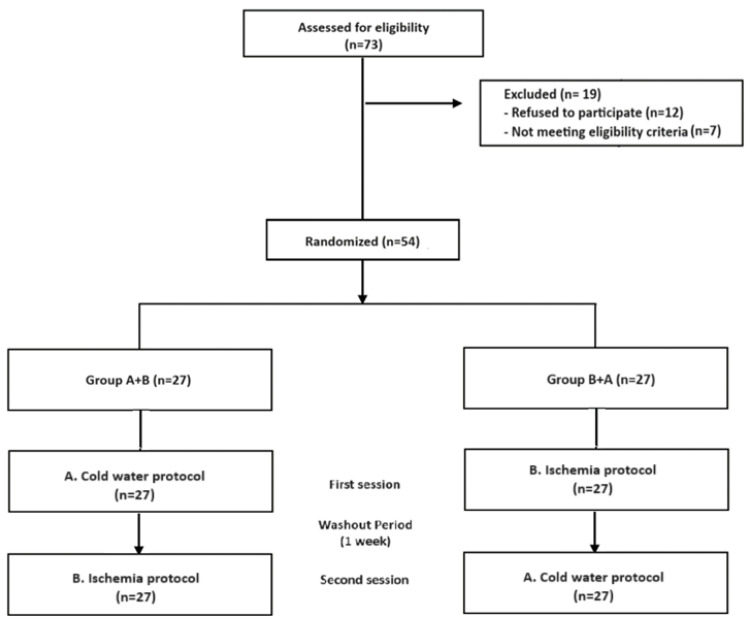 Figure 1
Peer Reviews
No public reviews on file for this paper yet. If you reviewed it on a platform where reviews are public (OpenReview, ICLR, NeurIPS, ICML), you can paste yours below so the community can read it here.
Videos
No videos yet. Explain this paper in a talk, walkthrough, or lecture? Add one.
Taxonomy
TopicsPain Mechanisms and Treatments · Pain Management and Placebo Effect · Musculoskeletal pain and rehabilitation