Management of recurrence after peroral endoscopic myotomy and submucosal tunneling endoscopic septum division
Ke-Yang Fan, Meng-Jiang He, Li Wang, Jia-Qi Xu, Quan-Lin Li, Ping-Hong Zhou

Abstract
Genes, proteins, chemicals, diseases, species, mutations and cell lines named across the full text — each resolved to its canonical identifier and authoritative record.
Click any figure to enlarge with its caption.
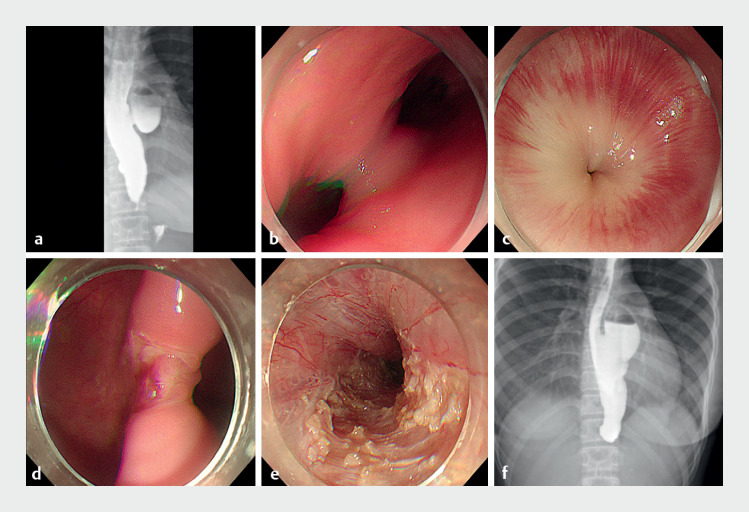 Fig. 1
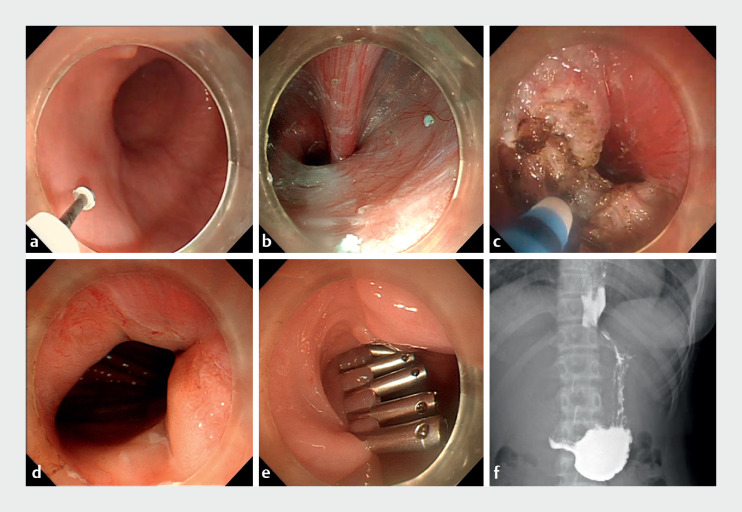 Fig. 2
- —The Natural Science Foundation of China
Peer Reviews
No public reviews on file for this paper yet. If you reviewed it on a platform where reviews are public (OpenReview, ICLR, NeurIPS, ICML), you can paste yours below so the community can read it here.
Videos
No videos yet. Explain this paper in a talk, walkthrough, or lecture? Add one.
Taxonomy
TopicsGastroesophageal reflux and treatments · Dysphagia Assessment and Management · Esophageal and GI Pathology
Achalasia sometimes coexists with esophageal diverticulum 1 , and the combination of peroral endoscopic myotomy (POEM) and submucosal tunneling endoscopic septum division (STESD) is efficient and safe for relieving the symptom 2 3 . However, the management of symptom recurrence after this combination of procedures is more challenging due to fibrosis of the submucosa. We present a case of short-term recurrence in a teenager after POEM and STESD, in which achalasia and epiphrenic diverticulum were treated through a repeat POEM procedure.
A 13-year-old girl was admitted to a local hospital with achalasia and mid-esophageal diverticulum, and underwent POEM and STESD ( Fig. 1 a–e ). The symptoms recurred 3 months after the surgery and responded poorly to balloon dilation. The patient visited our hospital 6 months after the first surgery. Barium esophagography indicated barium retention, and a newly developed epiphrenic diverticulum ( Fig. 1 f ). As this short-term recurrence was caused by incomplete myotomy rather than scar formation or disease progression, the multidisciplinary team scheduled a repeat POEM procedure to alleviate the high pressure, while also treating the epiphrenic diverticulum without septum division ( Video 1 ).
Initial diagnostic and therapeutic history. a Preoperative esophagography. b Endoscopic view of the mid-esophageal diverticulum. c Endoscopic view of the tight cardia. d, e Surgical images of submucosal tunneling endoscopic septum division and peroral endoscopic myotomy. f Postoperative esophagography.
Repeat peroral endoscopic myotomy (POEM) for recurrence of symptoms after POEM and submucosal tunneling endoscopic septum division.Video 1
After rotating the endoscope clockwise by 180 degrees, we created the mucosal entry on the opposite side to the previous entry to avoid the fibrotic submucosa, and extended the submucosal tunnel to 3 cm below the cardia ( Fig. 2 a, b ). Then, we dissected the circular muscle, and performed total myotomy 2 cm above and below the cardia ( Fig. 2 c ). The cardia was noticeably enlarged after the myotomy ( Fig. 2 d ). The entry was closed after hemostasis ( Fig. 2 e ).
Repeat peroral endoscopic myotomy and follow-up. a Mucosal entry creation. b Submucosal tunnel creation. c Total myotomy at the cardia. d Open cardia. e Closure of the entry. f Postoperative esophagography.
At the 3-month follow-up, the patient reported a weight gain of 3 kg, and there was limited barium retention in the esophagus ( Fig. 2 f ).
Although epiphrenic diverticula are typically caused by long-term high pressure, they can also occur as a short-term complication after POEM. For epiphrenic diverticula without obvious septum caused by pressure, additional STESD is not necessary 4 .
Endoscopy_UCTN_Code_TTT_1AO_2AP
The reference list from the paper itself. Each links out to its DOI / PubMed record.
- 1Soares R Herbella FA Prachand VN Epiphrenic diverticulum of the esophagus. From pathophysiology to treatment J Gastrointest Surg 2010142009201520437107 10.1007/s 11605-010-1216-9 · doi ↗ · pubmed ↗
- 2Li QL Chen WF Zhang XC Submucosal tunneling endoscopic septum division: a novel technique for treating Zenker’s diverticulum Gastroenterology 20161511071107410.1053/j.gastro.2016.08.06427664512 · doi ↗ · pubmed ↗
- 3Zhang DF Chen WF Wang Y Submucosal tunneling endoscopic septum division for esophageal diverticulum with a median follow-up of 39 months: a multicenter cohort study Gastrointest Endosc 20229661261935679964 10.1016/j.gie.2022.05.021 · doi ↗ · pubmed ↗
- 4Demeter M Duricek M Vorcak MS-POEM in treatment of achalasia and esophageal epiphrenic diverticula – single center experience Scand J Gastroenterol 20205550951410.1080/00365521.2020.174588132251609 · doi ↗ · pubmed ↗