Correction: Betel quid use is associated with anemia among both men and women in Matlab, Bangladesh
Kristin K. Sznajder, Mary K. Shenk, Nurul Alam, Rubhana Raqib, Anjan Kumar, Farjana Haque, Tami Blumenfield, Siobhán M. Mattison, Katherine Wander

Abstract
Genes, proteins, chemicals, diseases, species, mutations and cell lines named across the full text — each resolved to its canonical identifier and authoritative record.
Click any figure to enlarge with its caption.
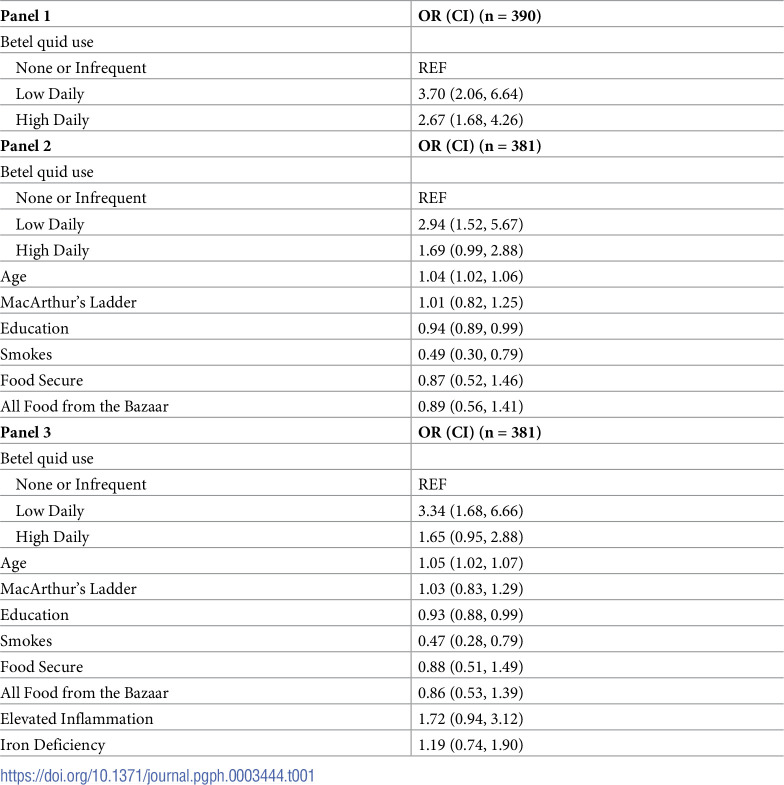 Figure 1
Peer Reviews
No public reviews on file for this paper yet. If you reviewed it on a platform where reviews are public (OpenReview, ICLR, NeurIPS, ICML), you can paste yours below so the community can read it here.
Videos
No videos yet. Explain this paper in a talk, walkthrough, or lecture? Add one.
Taxonomy
TopicsOral Health Pathology and Treatment · Genital Health and Disease
There is an error in Table 3. The classification of eight men who used betel quid infrequently should be no betel quid used group not daily low group. Please see the correct Table 3 here.
In the fourth paragraph of Results, there is an error in the first two sentences. The correct sentence is: Because only eight men reported infrequent use of betel quid, we combined this category with no betel quid use in regression models. When betel quid use was categorized by level of use (none/infrequent daily low (less than 5 times per day), daily high (at least 5 times per day)), shown in Table 3, Panel 2, daily low and daily high betel quid use were associated with anemia compared with no/infrequent betel quid use (aOR: 2.94; 95% CI: 1.52, 5.67 and aOR: 1.69; 95% CI: 0.99, 2.88 respectively).
The reference list from the paper itself. Each links out to its DOI / PubMed record.