The complete mitochondrial genome of a Biwa goby, Gymnogobius isaza (Tanaka, 1916)
Nao Nagao, Saki Hiraoka, Tsuyoshi Mori, Norio Shimizu, Atsushi Kurabayashi, Chiaki Kambayashi

TL;DR
This paper reports the full mitochondrial genome of the Biwa goby, a fish species, and shows how it relates to other similar species.
Contribution
The study provides the first complete mitochondrial genome sequence for Gymnogobius isaza and confirms its close relationship with G. petschiliensis.
Findings
The mitogenome of G. isaza contains 13 protein-coding genes, 22 tRNA genes, two rRNA genes, and two control regions.
Phylogenetic analysis shows a close relationship between G. isaza and G. petschiliensis.
The mitogenome data can aid in environmental DNA surveys and conservation efforts for the species.
Abstract
We determined the complete mitochondrial DNA sequence of a Biwa goby, Gymnogobius isaza (Tanaka, 1916) using next-generation sequencing methods. The composition of its mitogenome is the same as that observed in most other vertebrates, comprising of 13 protein-coding genes, 22 tRNA genes, two rRNA genes, and two control regions. Our molecular phylogenetic analysis confirmed the close phylogenetic relationship between G. isaza and G. petschiliensis. This mitogenome information will be useful for distribution surveys using environmental DNA and the development of conservation strategies for this species.
Genes, proteins, chemicals, diseases, species, mutations and cell lines named across the full text — each resolved to its canonical identifier and authoritative record.
Click any figure to enlarge with its caption.
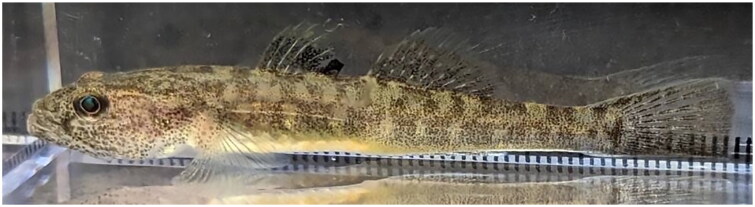 Figure 1
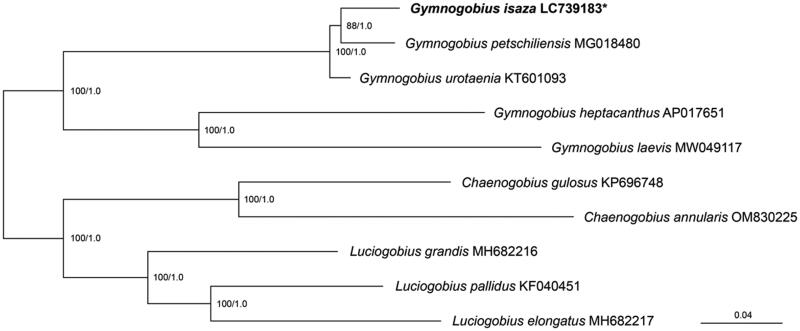 Figure 2
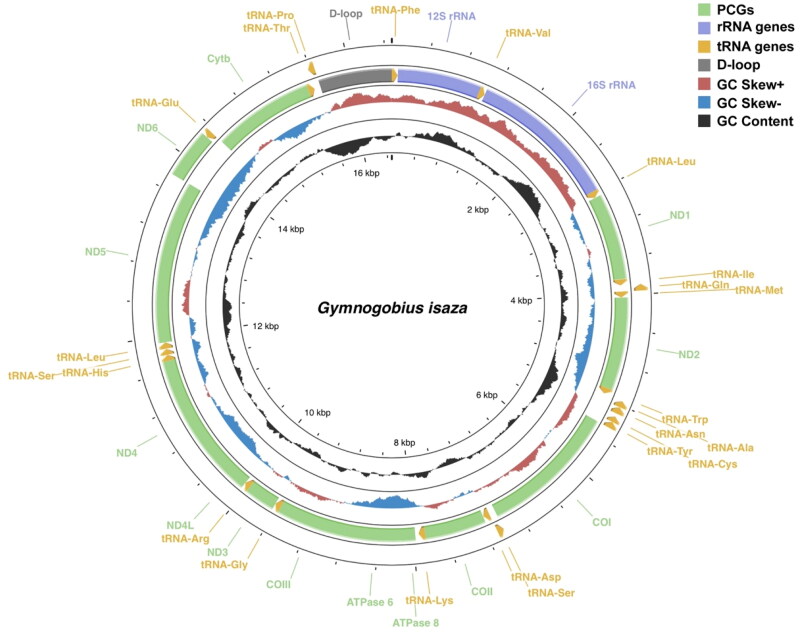 Figure 3
- —Nagahama Institute of Bio-Science and Technology
Peer Reviews
No public reviews on file for this paper yet. If you reviewed it on a platform where reviews are public (OpenReview, ICLR, NeurIPS, ICML), you can paste yours below so the community can read it here.
Videos
No videos yet. Explain this paper in a talk, walkthrough, or lecture? Add one.
Taxonomy
TopicsGenomics and Phylogenetic Studies · Identification and Quantification in Food · Genetic diversity and population structure
Introduction
Gymnogobius isaza (Tanaka, 1916) of the family Oxudercidae (Kuang et al. 2018) is an endemic fish species exclusive to Lake Biwa, the largest ancient lake in Japan. Due to its rapid decline, this species has been listed as Endangered (EN) by IUCN and as Critically Endangered (CR) by Japanese Ministry of the Environment (Kanao and Hasegawa 2019; Ministry of the Environment and Government of Japan 2020). Therefore, there is urgent need to comprehend and monitor the natural habitat of this species. Environmental DNA (eDNA) has proven to be an effective tool for such distribution assessment (Bylemans et al. 2019), but the genetic information for G. isaza is limited to partial sequences of several mitochondrial and nuclear markers (Tabata and Watanabe 2013; Ito et al. 2021), and there are no available primer sets specifically designated for this species. In this study, we sequenced the whole mitochondrial DNA of G. isaza with the aim of designing specific primers for future eDNA surveys.
Materials
The male specimen of G. isaza (59.4 mm in standard length) (Figure 1) was collected alive from Kaizuosaki, located north of Lake Biwa in Japan (35°26'N, 136°05'E), using nets, and deposited at the Hiroshima University Museum (contact: Norio Shimizu, [email protected]) under the voucher number HUM-I-2359.
Species reference image of Gymnogobius isaza photographed by Tsuyoshi Mori.
Methods
The mtDNA was extracted from fresh liver tissue sample isolated from the anesthetized fish specimen using the Mitochondrial DNA Isolation Kit (BioVision, CA) and sequenced on the DNBSEQ-G400 platform using a 200-bp paired-end procedure. From the resultant data, low-quality nucleotide sites (< Q30) were deleted using fastp software (Chen et al. 2018).
The whole mtDNA sequence was assembled from the remaining data using NOVOPlasty v4.3 (Dierckxsens et al. 2017) with the mtDNA of G. urotaenia (Genbank No. KT601093) as the reference. Gene annotation was conducted using MITOS WebServer (Bernt et al. 2013), and inaccurate gene boundaries were corrected by visual observation.
Phylogenetic analyses were performed based on 13 protein-coding genes (PCGs) (11,429 bp) of 10 oxudercid species. The best-fit partitioning scheme and substitution models (see Figure 2 legend) were estimated by IQ-tree v1.6.12 (Nguyen et al. 2015). Maximum likelihood (ML) tree was reconstructed using IQ-tree, then a nonparametric bootstrapping (BS) was conducted with 1000 pseudoreplicates. Bayesian inference (BI) and posterior probabilities (PP) were obtained using MrBayes v3.2.7 (Ronquist et al. 2012) with four independent MCMC runs for two million generations. Parameter estimates and convergence of the chains were checked using Tracer v1.7.1 (Rambaut et al. 2018).
*Phylogenetic tree of the oxudercid species based on mitochondrial protein-coding gene sequences. indicates Gymnogobius isaza of which mtDNA was sequenced in this study. The partitioning scheme and optimal substitution models for the selected partitions were estimated by IQ-tree (partition 1 = ATP6 + ND1 + ND3 + ND4L with substitution model GTR + F + I + G4, partition 2 = ATP8 + COII + COIII with GTR + F + I + G4, partition 3 = COI + cytb with GTR + F + I + G4, partition 4 = ND2 with GTR + F + I + G4, partition 5 = ND4 with GTR + F + I + G4, partition 6 = ND5 with GTR + F + I + G4, partition 7 = ND6 with GTR + F + I + G4). The numbers at the nodes indicate maximum likelihood bootstrap values (left) and Bayesian posterior probabilities (right). Mitochondrial genome sequences are derived from the following records: Chaenogobius annularis OM830225 (Shang et al. 2022); C. gulosus KP696748 (Oh et al. 2015); Gymnogobius heptacanthus AP017651 (Song et al. 2016); G. isaza LC739183 (this study); G. laevis MW049117 (Peng et al. 2022); G. petschiliensis MG018480 (Gong et al. 2017); G. urotaenia KT601093 (unpublished); Luciogobius elongatus MH682216, L. grandis MH682216 (Jun et al. 2018); L. pallidus KF040451 (Yu et al. 2013). Chaenogobius and Luciogobius species were used as the outgroups.
Results
The mtDNA of G. isaza is 16,477 bp in length, with an average depth of 743X (Figure S1). The mitogenome contains 13 PCGs, 22 tRNA genes, and two rRNA genes, as well as two non-coding regions, namely light-strand replication origin (O_L_) and control region (CR) (Figure 3). The gene arrangement of this species coincides with that presented in most gobioids that corresponds to the one of a typical vertebrate, in which most genes are encoded on the heavy-strand, except for the ND6 one and eight of the tRNAs (Figure 3). The nucleotide composition is 28.1, 29.3, 16.4, and 26.1% for A, T, G, and C, respectively, and the COI gene displays a non-canonical GTG start codon. In addition, five PCGs (COII–III, ND3–4, and Cytb) exhibit an incomplete stop codon for T, which can form a complete TAA stop codon through post-transcriptional polyadenylation. All tRNA genes can fold into typical cloverleaf secondary structures. The 37 bp O_L_ is located between the tRNA-Asn and tRNA-Cys genes.
Circular sketch map of the complete mitogenome of gymnogobius isaza. It shows the location of protein-coding genes (PCGs), rRNA genes, and tRNA genes, as well as variations in GC nucleotide composition. Genes encoded on heavy- and light-strands are shown inside and outside the circle, respectively. Light-strand replication origin is located between the tRNA-asn and tRNA-cys genes. This map was drawn using proksee server (https://proksee.ca/).
Both ML and BI analyses yielded the same tree topology as shown in Figure 2. The trees indicate that G. isaza clustered together with G. petschiliensis and G. urotaenia (BS = 100, PP = 1.0) and formed a sister group with G. petschiliensis (BS = 88, PP = 1.0).
Discussion and conclusion
The complete mitochondrial genome of G. isaza is 16,477 bp in length, which falls within the range of mtDNA of Gymnogobius species used in this study (16,422–16,529 bp), but longer than those of the closely related G. urotaenia and G. petschiliensis (Figure 2). The mtDNA of G. isaza contains the typical components found in vertebrates, and the composition and order of the genes are concordant with those of the congeneric species (Song et al. 2016; Gong et al. 2017; Peng et al. 2022). This represents invaluable genetic resources for future eDNA studies, enabling the distinction of G. isaza from its closely related species inhabiting the same water system (i.e. G. urotaenia) and monitoring the distribution range of the species.
Our phylogenetic analysis showed that G. isaza is most closely related to G. petschiliensis, with G. urotaenia as sister to this monophyletic group (i.e. G. urotaenia + [G. isaza + G. petschiliensis]). However, other phylogenetic hypotheses have been proposed in previous studies. For example, based on mitochondrial Cytb sequences, G. isaza has been suggested to be sister group of the clade comprising G. petschiliensis + G. urotaenia (Tabata and Watanabe 2013). On the other hand, in a more comprehensive multilocus study of approximately 18,000 bp combining both mitochondrial and nuclear data, G. isaza formed a monophyletic group with G. urotaenia that is sister to G. petschiliensis (McCraney et al. 2020). Furthermore, in the phylogenetic analyses based on 3,209 bp sequences combining mitochondrial Cytb and three nuclear markers not used in previous studies, both of the above tree topologies were yielded depending on the differences in the ML and BI analytical methods (Ito et al. 2021). The inconsistency in the phylogenetic relationships among these Gymnogobius species may be due to interspecific hybridization or incomplete lineage sorting as suggested for other Japanese gobiid species (Yamasaki et al. 2015). Therefore, further investigations incorporating large-scale genomic data would be required to elucidate the complicated evolutionary history of G. isaza.
Supplementary Material
Supplemental Material
The reference list from the paper itself. Each links out to its DOI / PubMed record.
- 1Bernt M, Donath A, Jühling F, Externbrink F, Florentz C, Fritzsch G, Pütz J, Middendorf M, Stadler PF. 2013. MITOS: improved de novo metazoan mitochondrial genome annotation. Mol Phylogenet Evol. 69(2):313–319. doi:10.1016/j.ympev.2012.08.023.22982435 · doi ↗ · pubmed ↗
- 2Bylemans J, Gleeson DM, Duncan RP, Hardy CM, Furlan EM. 2019. A performance evaluation of targeted e DNA and e DNA metabarcoding analyses for freshwater fishes. Environ DNA. 1(4):402–414. doi:10.1002/edn 3.41. · doi ↗
- 3Chen S, Zhou Y, Chen Y, Gu J. 2018. fastp: an ultra-fast all-in-one FASTQ preprocessor. Bioinformatics. 34(17):i 884–i 890. doi:10.1093/bioinformatics/bty 560.30423086 PMC 6129281 · doi ↗ · pubmed ↗
- 4Dierckxsens N, Mardulyn P, Smits G. 2017. NOVO Plasty: de novo assembly of organelle genomes from whole genome data. Nucleic Acids Res. 45(4):e 18. doi:10.1093/nar/gkw 955.28204566 PMC 5389512 · doi ↗ · pubmed ↗
- 5Gong L, Chen W, Liu LQ, Lü ZM. 2017. The complete mitochondrial genome of Gymnogobius petschiliensis (Gobiiformes; Gobiidae; Gobionellinae) and its phylogenetic implications. Mitochondrial DNA B Resour. 2(2):816–818. doi:10.1080/23802359.2017.1398609.33473994 PMC 7799598 · doi ↗ · pubmed ↗
- 6Ito R, Harada S, Tabata R, Watanabe K. 2021. Molecular evolution and convergence of the rhodopsin gene in Gymnogobius, a goby group having diverged into coastal to freshwater habitats. J Evol Biol. 35(2):333–346. doi:10.1111/jeb.13955.34689368 · doi ↗ · pubmed ↗
- 7Jun J, Choi SH, Kim HY. 2018. Characterization of the complete mitochondrial genomes and phylogenetic analysis of the two Luciogobius species (Perciformes, Gobionellinae) from Korea. Mitochondrial DNA B Resour. 3(2):1154–1155. doi:10.1080/23802359.2018.1522980.33474449 PMC 7799663 · doi ↗ · pubmed ↗
- 8Kanao S, Hasegawa K. 2019. Gymnogobius isaza. The IUCN red list of threatened species 2019. e.T 110461312 A 110461327. doi:10.2305/IUCN.UK.2019-2.RLTS.T 110461312 A 110461327.en. · doi ↗