The safety and efficacy of volumetric modulated Arc therapy combined with computer tomography-guided adaptive brachytherapy for locally advanced cervical cancer: a single institution experience
Tianyu Yang, Tiandi Zhao, Zhe Ji, Runhong Lei, Ang Qu, Weijuan jiang, Xiuwen Deng, Ping Jiang

TL;DR
This study shows that combining VMAT with CT-guided brachytherapy is a safe and effective treatment for advanced cervical cancer, with good survival and low toxicity.
Contribution
The study provides evidence for the efficacy and safety of VMAT combined with CTGAB in treating locally advanced cervical cancer.
Findings
2-year and 3-year overall survival rates were 89.6% and 83%, respectively.
Grade ≥3 gastrointestinal and urinary toxicities occurred in 4.9% and 0.98% of patients.
The average D90% of the high-risk clinical target volume was 92.26 Gy.
Abstract
Volumetric modulated arc therapy (VMAT) is a novel form of IMRT, which can deliver more accurate dose distribution and shorten treatment time. Compared to MRI-guided adaptive brachytherapy, which is recommended as gold standard imaging for cervical cancer contours, CT-guided adaptive brachytherapy (CTGAB) is more available, more widespread, and more affordable in many centers. This study aims to retrospectively analyze the efficacy and the safety of VMAT combined with CTGAB for patients with locally advanced cervical cancer. This study retrospectively analyzed 102 patients with locally advanced cervical cancer who underwent VMAT and CTGAB. Clinical outcomes including local control (LC), overall survival (OS) and progression-free survival (PFS), tumor response to treatment evaluated by the Response Evaluation Criteria in Solid Tumors (RECIST) (version 1.1), and toxicities including…
Genes, proteins, chemicals, diseases, species, mutations and cell lines named across the full text — each resolved to its canonical identifier and authoritative record.
Click any figure to enlarge with its caption.
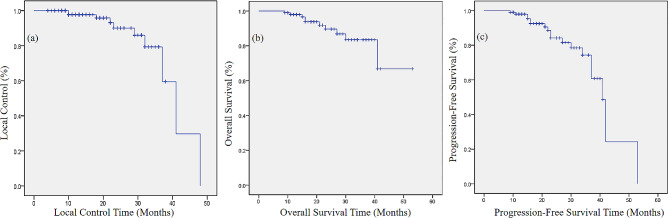 Figure 1
Peer Reviews
No public reviews on file for this paper yet. If you reviewed it on a platform where reviews are public (OpenReview, ICLR, NeurIPS, ICML), you can paste yours below so the community can read it here.
Videos
No videos yet. Explain this paper in a talk, walkthrough, or lecture? Add one.
Taxonomy
TopicsComparative constitutional jurisprudence studies · Criminal Justice and Penology · Human Rights and Immigration