Stumped by a Case of Appendicitis After Appendectomy
Ami Takei Yuen, Anna Suessman

TL;DR
This paper discusses a rare case of stump appendicitis in a child, managed non-surgically before a later elective surgery.
Contribution
The paper presents a successful nonoperative management approach for pediatric stump appendicitis.
Findings
A 10-year-old male was successfully treated with antibiotics for stump appendicitis.
The patient remained asymptomatic for 9 weeks before undergoing elective surgery.
Nonoperative management may be a viable option in select pediatric cases.
Abstract
Background: Stump appendicitis—a rare, delayed complication of appendectomy—is most commonly managed with surgical exploration and stump appendectomy. Conservative management in the pediatric population is poorly characterized in the literature. Case Report: We report a case of a 10-year-old male who was diagnosed with stump appendicitis and initially treated nonoperatively. He received intravenous antibiotics and supportive therapy while in the hospital, was discharged on a course of oral antibiotics, and remained asymptomatic for the following 9 weeks until he underwent an elective interval stump appendectomy. We also review the literature on this uncommon condition and treatment plan. Conclusion: Considering stump appendicitis in the differential of children with history of appendectomy is imperative. Nonoperative management of stump appendicitis may be successful and beneficial in…
Genes, proteins, chemicals, diseases, species, mutations and cell lines named across the full text — each resolved to its canonical identifier and authoritative record.
Click any figure to enlarge with its caption.
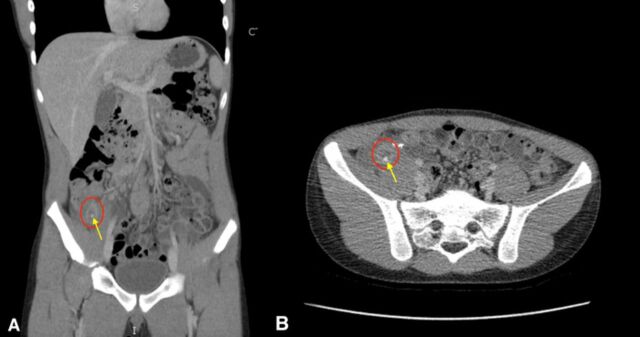 Figure 1
Peer Reviews
No public reviews on file for this paper yet. If you reviewed it on a platform where reviews are public (OpenReview, ICLR, NeurIPS, ICML), you can paste yours below so the community can read it here.
Videos
No videos yet. Explain this paper in a talk, walkthrough, or lecture? Add one.
Taxonomy
TopicsAppendicitis Diagnosis and Management · Intestinal Malrotation and Obstruction Disorders · Intraperitoneal and Appendiceal Malignancies