Characterization of the complete chloroplast genome of the rare medicinal plant: Mandragora caulescens (Solanaceae)
Heqin Ma, Erdong Zhang, Yajing An, Yuqing Wei, Lei Zhang

TL;DR
This study fully sequenced the chloroplast genome of Mandragora caulescens, a rare medicinal plant, and analyzed its structure and evolutionary relationships within the Solanaceae family.
Contribution
The paper provides the first complete chloroplast genome of Mandragora caulescens and reveals its phylogenetic position within the Solanaceae.
Findings
The chloroplast genome has a typical quadripartite structure with 141 complete genes and 38.0% GC content.
Phylogenetic analysis grouped M. caulescens closely with Nicandra physalodes.
The genome provides a foundation for future genetic and genomic studies in the Solanaceae family.
Abstract
In this study, we assembled high-quality chloroplast genomes of Mandragora caulescens through a reference-guided approach using high-throughput Illumina sequencing reads. The resulting chloroplast genome assembly displayed a typical quadripartite structural organization, comprising a large single-copy (LSC) region of 85,233 bp, two inverted repeat (IR) regions of 25,685 bp each, and a small single-copy (SSC) region of 18,207 bp. The chloroplast genome harbored 141 complete genes, and its overall GC content was 38.0%. In maximum-likelihood (ML) and Bayesian inference (BI) trees, the 19 Solanaceae species formed a monophyletic group, dividing into two main clades. M. caulescens and Nicandra physalodes formed a monophyletic group, suggesting a close relationship between the two species. The M. caulescens cp genome presented in this study lays a good foundation for further genetic and…
Genes, proteins, chemicals, diseases, species, mutations and cell lines named across the full text — each resolved to its canonical identifier and authoritative record.
Click any figure to enlarge with its caption.
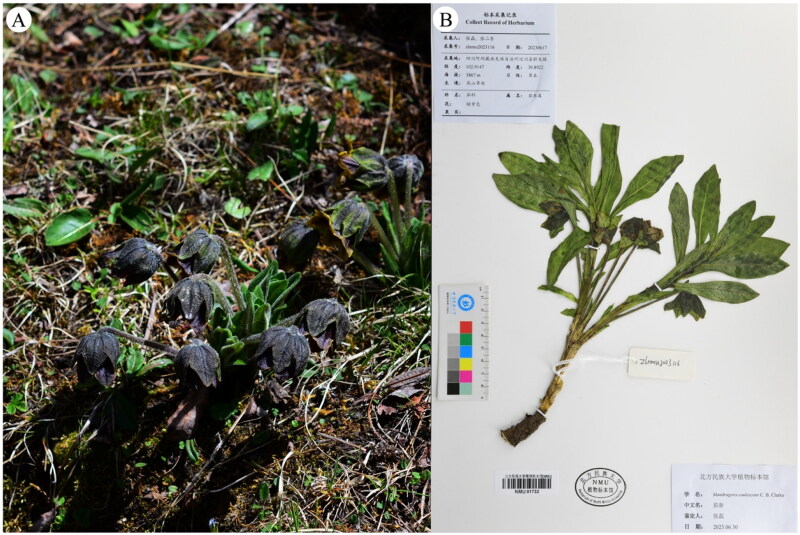 Figure 1
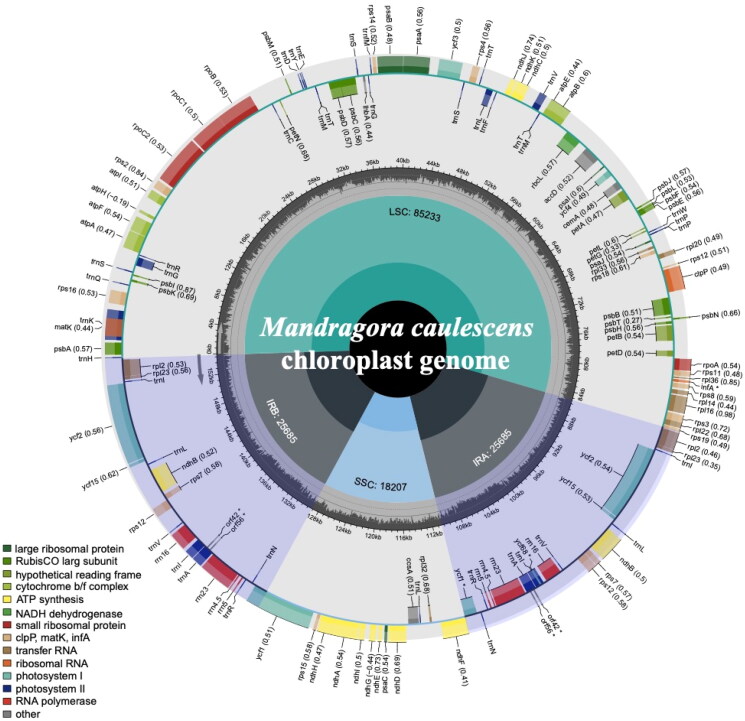 Figure 2
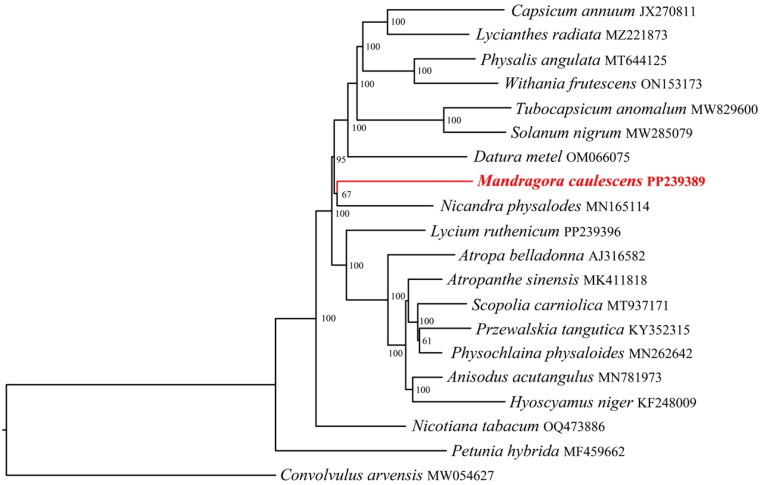 Figure 3
Peer Reviews
No public reviews on file for this paper yet. If you reviewed it on a platform where reviews are public (OpenReview, ICLR, NeurIPS, ICML), you can paste yours below so the community can read it here.
Videos
No videos yet. Explain this paper in a talk, walkthrough, or lecture? Add one.
Taxonomy
TopicsGenomics and Phylogenetic Studies · Plant and Fungal Species Descriptions · Genetic diversity and population structure