Multiconfigurational Character of Repulsive A2Σg+ State Leaves Strong Signature in the Photodissociation Spectrum of Zn2+
Dominik Jank, Milan Ončák, Shan Jin, Christian van der Linde, Martin K. Beyer

TL;DR
The photodissociation spectrum of Zn2+ shows unexpected features due to the multiconfigurational nature of its excited state.
Contribution
The study reveals how multiconfigurational character in a repulsive state leads to a distinct spectroscopic signature.
Findings
The A2Σg+ state of Zn2+ has a multiconfigurational character with two dominant configurations.
The transition dipole moment reaches zero near the equilibrium distance, causing a dip in the spectrum.
The dip in the photodissociation spectrum is a direct signature of the state's multiconfigurational nature.
Abstract
For the excitation to a repulsive state of a diatomic molecule, one expects a single broad peak in the photodissociation spectrum. For Zn2+, however, two peaks for the spin- and symmetry-allowed A2Σg+ ← X2Σu+ transition are observed. A detailed quantum-chemical analysis reveals pronounced multiconfigurational character of the A2Σg+ state. The σg(4s)2σg(4p) configuration with bond order 1.5 dominates at short distances, while the repulsive σg(4s)σu*(4s)2 configuration with bond order −0.5 wins over with increasing bond length. The two excited-state configurations contribute with opposite signs to the transition dipole moment, which reaches zero near the equilibrium distance. This local minimum of the oscillator strength is responsible for the pronounced dip in the photodissociation spectrum, which is thus the spectroscopic signature of the multiconfigurational character of the A2Σg+…
Genes, proteins, chemicals, diseases, species, mutations and cell lines named across the full text — each resolved to its canonical identifier and authoritative record.
Click any figure to enlarge with its caption.
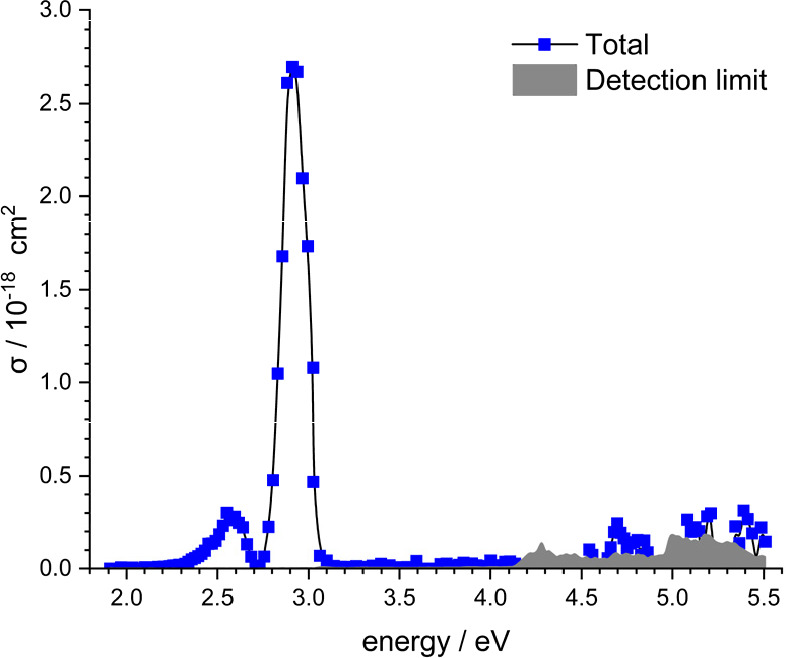 Figure 1
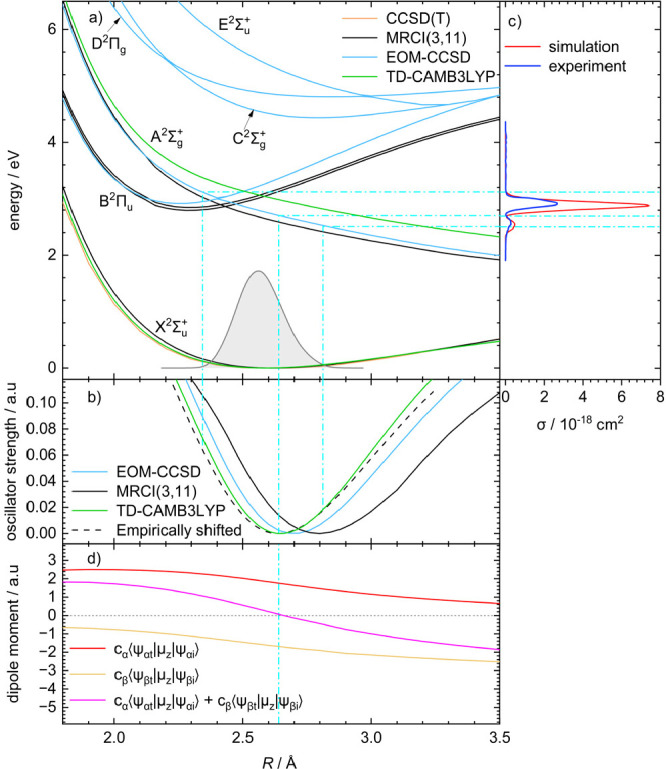 Figure 2
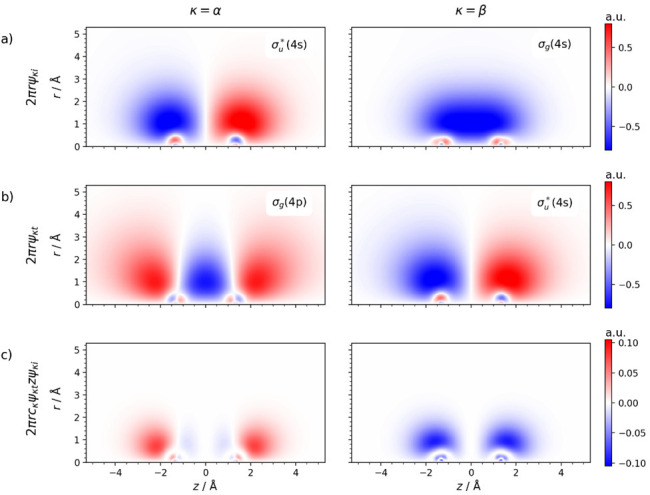 Figure 3
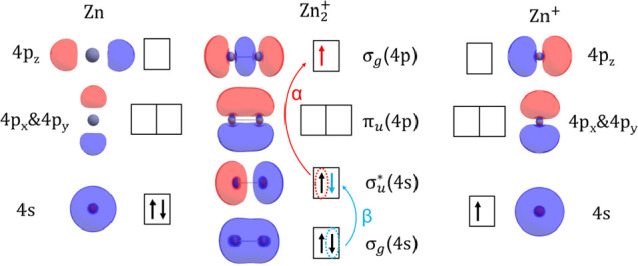 Figure 4
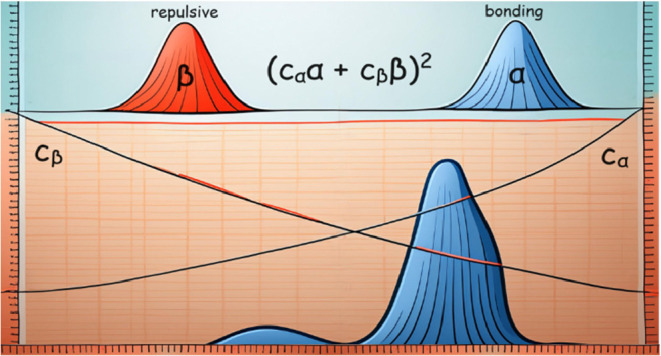 Figure 5
 Figure 6
Peer Reviews
No public reviews on file for this paper yet. If you reviewed it on a platform where reviews are public (OpenReview, ICLR, NeurIPS, ICML), you can paste yours below so the community can read it here.
Videos
No videos yet. Explain this paper in a talk, walkthrough, or lecture? Add one.
Taxonomy
TopicsAdvanced Chemical Physics Studies · Spectroscopy and Quantum Chemical Studies · Photochemistry and Electron Transfer Studies