Decreased and Improved Movement Abilities in a Case of Myotonic Dystrophy Type 1: Examining Longitudinal Characteristics Based on Repeated Evaluations
Kiyoshige Ishibashi, Daisuke Ishii, Satoshi Yamamoto, Yusuke Ono, Kenichi Yoshikawa, Tomoyuki Matsuda, Yasutsugu Asakawa, Yutaka Kohno

TL;DR
This case study examines how muscle strength and movement abilities change over time in a DM1 patient through 44 repeated evaluations over two years.
Contribution
The study provides detailed longitudinal insights into DM1 progression using frequent, repeated assessments in a single patient.
Findings
Right knee extensor muscle strength decreased significantly after a fall, indicating disuse syndrome.
Walking speed decreased, but timed up-and-go test scores improved, showing compensatory movement strategies.
Walking endurance was maintained despite muscle weakness, highlighting functional compensation.
Abstract
Several large longitudinal studies on myotonic dystrophy type 1 (DM1) patients have revealed that proximal muscles show more gradual muscle weakness than distal muscles and that the progression of muscle weakness might differ between the sexes. However, these longitudinal studies were based on two follow-up time points. The present report aimed to verify the longitudinal characteristics of muscle strength and various movement abilities in a case of DM1 by examining the results of 44 repeated evaluations for approximately two years. A 40-year-old male patient with DM1 could walk independently without any aid. We recorded the longitudinal changes in his muscle strength and movement ability during outpatient rehabilitation. During follow-up, he had a fall and was diagnosed with a right ankle sprain. To evaluate the effects of the fall, we examined his recorded data. He had a significant…
Genes, proteins, chemicals, diseases, species, mutations and cell lines named across the full text — each resolved to its canonical identifier and authoritative record.
Click any figure to enlarge with its caption.
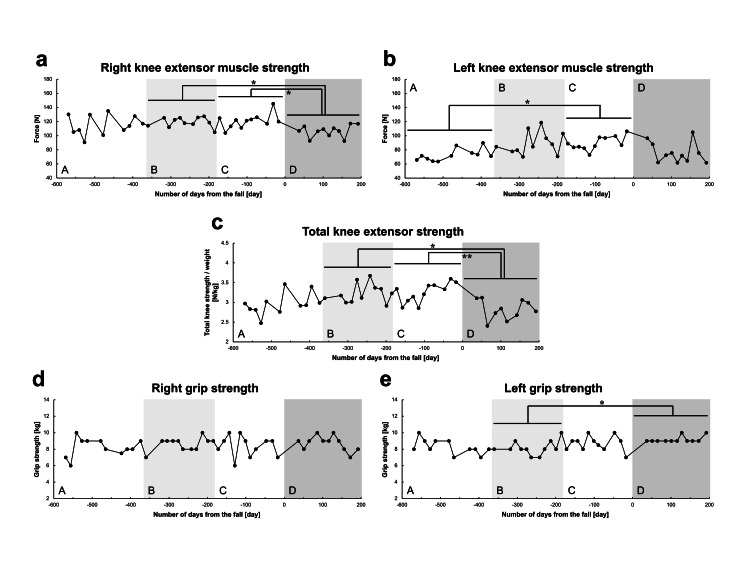 Figure 1
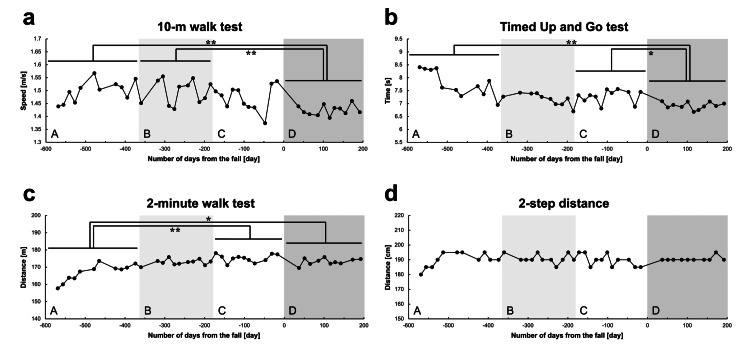 Figure 2
Peer Reviews
No public reviews on file for this paper yet. If you reviewed it on a platform where reviews are public (OpenReview, ICLR, NeurIPS, ICML), you can paste yours below so the community can read it here.
Videos
No videos yet. Explain this paper in a talk, walkthrough, or lecture? Add one.
Taxonomy
TopicsGenetic Neurodegenerative Diseases · Muscle Physiology and Disorders · Parkinson's Disease Mechanisms and Treatments