The complete mitochondrial genome of Membranipora villosa Hincks, 1880 (Bryozoa: Gymnolaemata: Cheilostomatida): phylogenetic relationship of two kelp-encrusting bryozoans within the suborder Membraniporina
Geon Woo Noh, Sang-Hwa Lee, Hyun Sook Chae, Ho Jin Yang, Hyun Il Yoo, Ji Eun Seo

TL;DR
This paper reports the complete mitochondrial genome of Membranipora villosa and uses it to clarify the phylogenetic relationship between two similar kelp-encrusting bryozoans.
Contribution
The study provides a new mitogenome sequence and confirms the species distinction between M. villosa and M. membranacea using molecular data.
Findings
The mitogenome of M. villosa is 15,407 bp long with typical gene content for membraniporids.
M. villosa and M. membranacea differ by 20% in mitogenome sequence and 16.1% in protein-coding genes.
Phylogenetic analysis shows M. villosa is closely related to M. membranacea within the suborder Membraniporina.
Abstract
The two commonest kelp-encrusting bryozoans, Membranipora villosa and M. membranacea, are difficult to distinguish morphologically. Molecular studies of M. villosa should thus be helpful for the identification of both species because the mitogenome of M. membranacea was already sequenced. The complete mitogenome of M. villosa collected from Sinjido was determined in this study through Illumina NovaSeq sequencing. Maximum-likelihood (ML) analysis was based on concatenated 13 protein-coding genes dataset from nine bryozoan species. The mitogenome length was 15,407 bp, and its gene arrangement was similar to those of the mitogenome of other membraniporids, having 13 PCGs, two ribosomal RNAs, and 22 tRNAs. It had an overall A + T content of 63.7% (29.7% A, 16.7% C, 19.6% G, and 34.0% T). M. villosa and M. membranacea showed sequence differences of 20% for the total length of mitogenome and…
Genes, proteins, chemicals, diseases, species, mutations and cell lines named across the full text — each resolved to its canonical identifier and authoritative record.
Click any figure to enlarge with its caption.
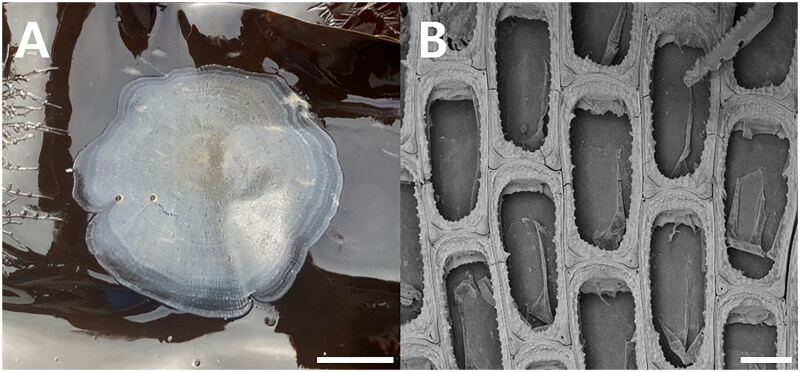 Figure 1
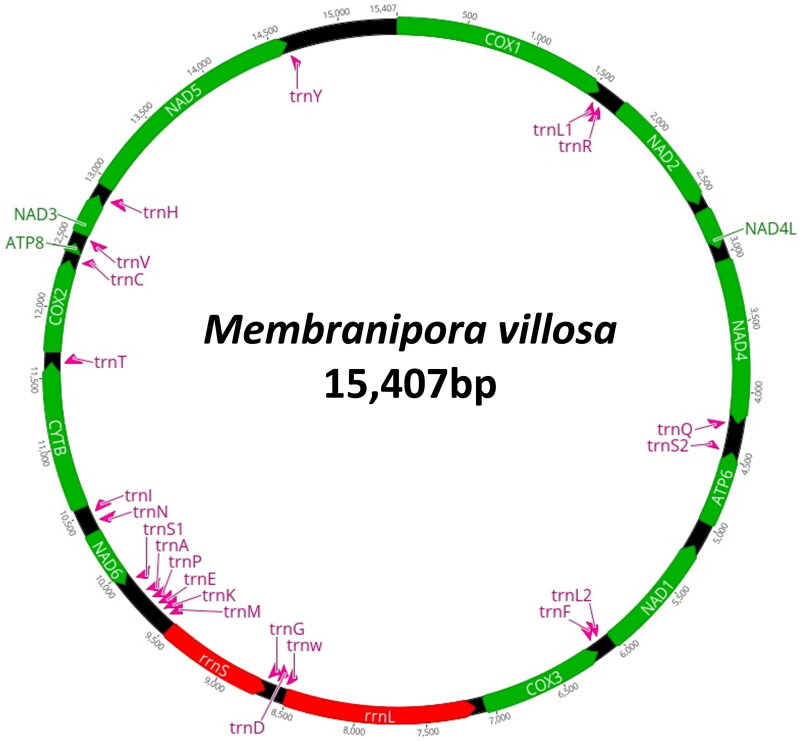 Figure 2
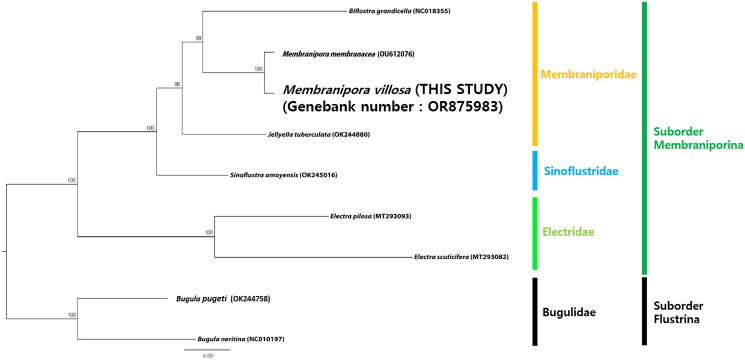 Figure 3
Peer Reviews
No public reviews on file for this paper yet. If you reviewed it on a platform where reviews are public (OpenReview, ICLR, NeurIPS, ICML), you can paste yours below so the community can read it here.
Videos
No videos yet. Explain this paper in a talk, walkthrough, or lecture? Add one.
Taxonomy
TopicsSpanish Culture and Identity · Spanish History and Politics · Memory, violence, and history