The effect of inadvertent systemic hypothermia after mechanical thrombectomy in patients with large-vessel occlusion stroke
Kristina auf dem Brinke, Fabian Kück, Ala Jamous, Marielle Ernst, Nils Kunze-Szikszay, Marios-Nikos Psychogios, Ilko L. Maier

TL;DR
This study found that about 20% of stroke patients experience hypothermia after a procedure called mechanical thrombectomy, and this hypothermia is linked to worse recovery outcomes.
Contribution
The study identifies postinterventional hypothermia as an independent predictor of poor functional outcomes in stroke patients after mechanical thrombectomy.
Findings
Hypothermia after mechanical thrombectomy was associated with unfavorable 90-day functional outcomes (OR 2.06).
Hypothermic patients had higher NIHSS scores at discharge and greater NIHSS changes compared to normothermic patients.
Approximately 19.4% of patients experienced hypothermia following the procedure.
Abstract
Postinterventional hypothermia is a frequent complication in patients with large-vessel occlusion strokes (LVOS) after mechanical thrombectomy (MT). This inadvertent hypothermia might potentially have neuroprotective but also adverse effects on patients’ outcomes. The aim of the study was to determine the rate of hypothermia in patients with LVOS receiving MT and its influence on functional outcome. We performed a monocentric, retrospective study using a prospectively derived databank, including all LVOS patients receiving MT between 2015 and 2021. Predictive values of postinterventional body temperature and body temperature categories (hyperthermia (≥38°C), normothermia (35°C–37.9°C), and hypothermia (<35°C)) on functional outcome were analyzed using multivariable Bayesian logistic regression models. Favorable outcome was defined as modified Rankin Scale (mRS) ≤3. Of the 480 included…
Genes, proteins, chemicals, diseases, species, mutations and cell lines named across the full text — each resolved to its canonical identifier and authoritative record.
Click any figure to enlarge with its caption.
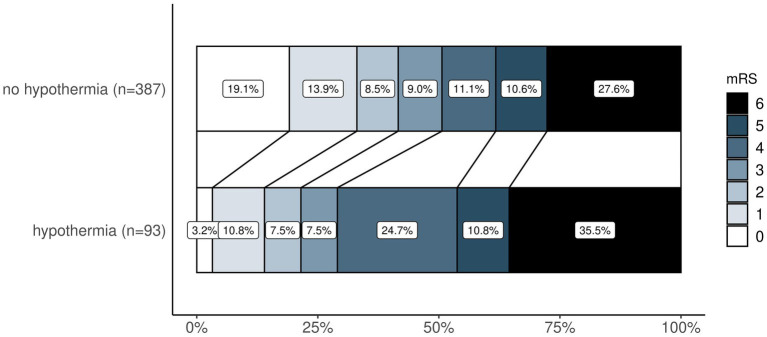 Figure 1
Peer Reviews
No public reviews on file for this paper yet. If you reviewed it on a platform where reviews are public (OpenReview, ICLR, NeurIPS, ICML), you can paste yours below so the community can read it here.
Videos
No videos yet. Explain this paper in a talk, walkthrough, or lecture? Add one.
Taxonomy
TopicsSpaceflight effects on biology · Space Exploration and Technology · Space Science and Extraterrestrial Life